
 Christian Ryan
When considering the most unique creatures in the animal kingdom, few stand out like the kangaroo. With kangaroos and their relatives comprising over 50 species, these fascinating animals come in many shapes and sizes. The red kangaroo, the largest species, bounds across dry, open plains, while the tree-dwelling Bennett’s tree kangaroo lives in rainforest canopies. Rabbit-sized quokkas inhabit temperate forests and swamps, while yellow-footed rock wallabies like to live on jagged, rocky cliffs.
The views expressed in this article reflect those of the authors mentioned, and not necessarily those of New Creation.1
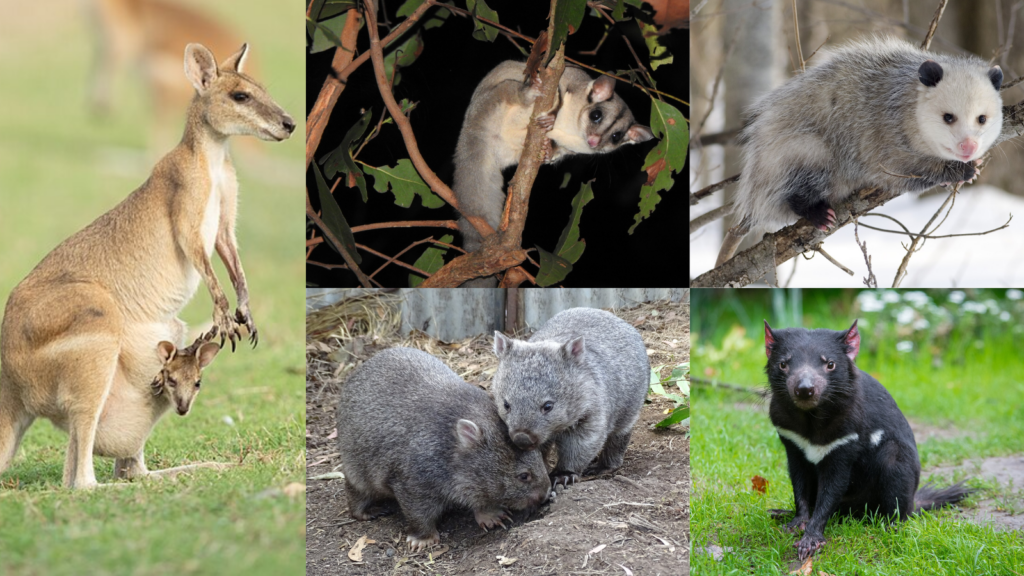
But despite their diverse habitats, you will not find a single kangaroo native to anywhere outside the continent of Australia. In fact, this island continent is home to two-thirds of all known marsupial species. Marsupials, like the kangaroo, are mammals that give birth to underdeveloped young. Many of them carry those young in their pouches.
From a young-age creationist perspective, the almost-exclusive presence of marsupials in Australia raises intriguing questions. After all, we know from Scripture that a worldwide Flood decimated all land-dependent animals except at least two of each kind aboard Noah’s Ark. The Bible records that the Ark landed in the Mountains of Ararat, in the Middle East. But we do not find fossils of marsupials like kangaroos, koalas, or wombats anywhere except Australia. So if the Flood account is true, how did Australia wind up with kangaroos and two-thirds of all the other species of marsupials?
Hopping, Climbing, Running, and Burrowing With Marsupials
Marsupials are a very diverse group of mammals. They give birth to babies at a much earlier stage of development from other mammals. These babies, called joeys, are born with very well-developed front limbs needed to crawl from the birth canal into its mother’s pouch for the first stage of its life. There, it is provided with its mother’s milk and a safe, warm place to grow until it is ready to walk (or hop!) on its own.
Marsupials of Australia
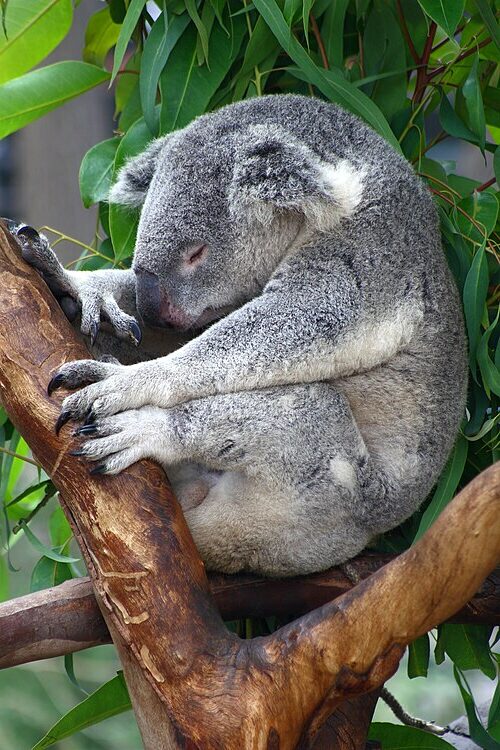
Marsupials come in an astonishing variety of shapes and sizes. Some, like koalas, are adept tree-climbers, using their strong limbs and claws to navigate and feed on eucalyptus leaves. Others, such as the sugar glider, soar between trees using skin flaps between their arms and legs. On the ground, marsupials like the wombat dig extensive burrows, while the elusive marsupial mole “swims” through sand in pursuit of burrowing insects. Some marsupials are predators, like the fierce Tasmanian devil and the thylacine (or Tasmanian tiger/wolf). The latter were tragically hunted to extinction by the 1930’s.
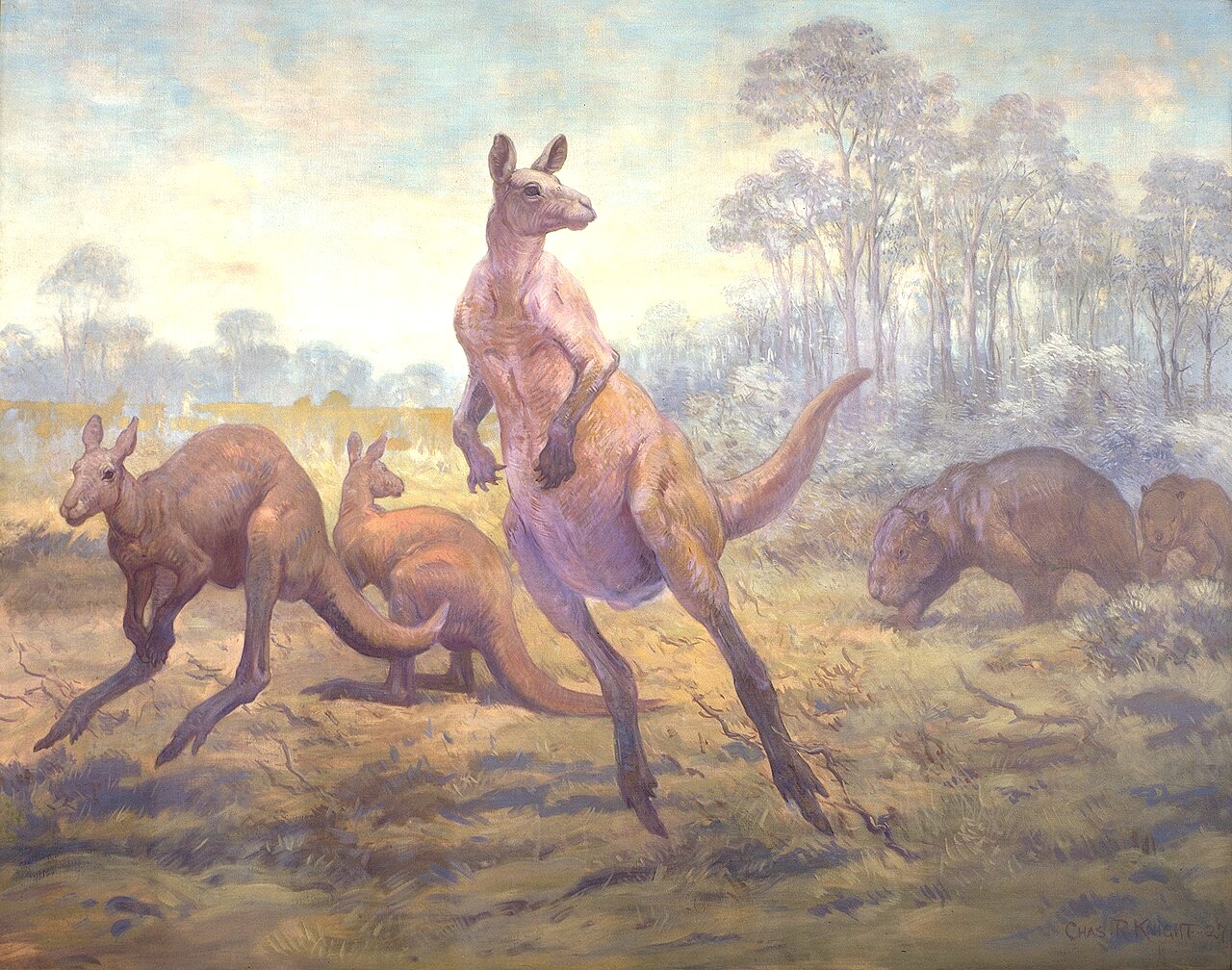
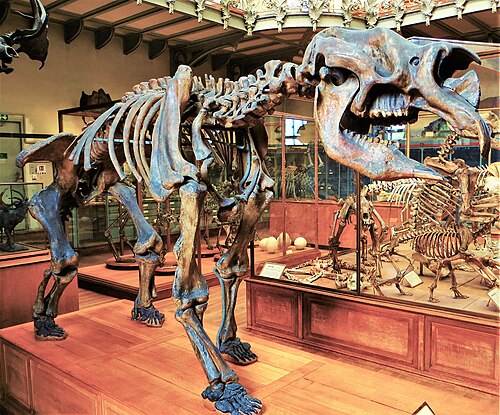
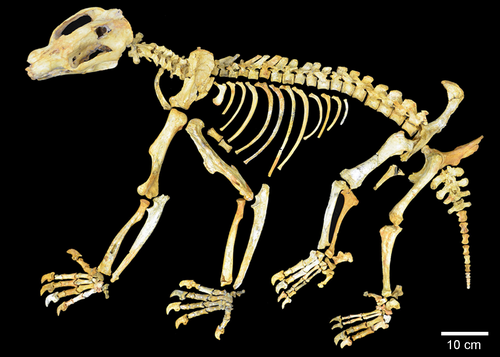
Turning to Australia’s fossil record, we see an even grander variety of marsupials. There were giant kangaroos, called Procoptodon, that stood up to ten feet tall. Herds of Diprotodon, a rhinoceros-sized relative of the wombat, marched across the ancient landscape in search of food. Stalking these animals were predators, like the marsupial lion, Thylacoleo.
Of additional interest is the lack of non-marsupial mammals from this continent. A few exist, such as the egg-laying monotremes (duck-billed platypus and echidna), bats (which can fly), and a few species of rodents. Otherwise, marsupial mammals reign supreme.
Marsupials of the Americas
One-third of marsupials live in the Americas. All of these are opossums, not to be confused with the possums (starting with a “p” instead of an “o”) native to Australia. There exist well over a hundred species of opossums, with most of them native to Central and South America. A single species exists on the North American continent: the Virginia opossum, commonly found across the eastern United States and along the Pacific coast.
How Many For Your Traveling Party?
Not every species of marsupial needed to migrate from the Ark’s landing site to Australia. God informed Noah that at least two of each kind of land-dependent animal would come to him so that he could bring them aboard the Ark. It was not until after the Flood that these animal kinds diversified into the dizzying array of marsupial species we see today. Only two representatives of each marsupial kind needed to make the trip. So how many different kinds of marsupials were there?
Marsupials After Their Kinds
Baraminology (the study of created kinds) helps creationists develop possible answers to this question. In 2012, Dr. Jean Lightner noted that marsupial classification remains controversial, even among mainstream evolutionary biologists.3 Because of this, identifying created kinds among marsupials is particularly challenging. She further suggested that some marsupial kinds may roughly correspond to smaller groupings of species (perhaps the family classification level). Others, she posits, may encompass much larger groupings of species (perhaps even above the order classification level).
A 2018 study by Dr. Todd Wood and Thompson on the baraminology of mammals found evidence that at least certain families of marsupials, such as the kangaroos (Macropodidae), koalas (Phascolarctidae), and ringtail possums (Pseudocheirinae), are distinct enough from other marsupials to belong to their own created kinds.4 There are some 19 different families of marsupials in Australia.5 If every family of marsupials is a created kind, this means that all 19 of them would independently migrate from the Ark to Australia and end up nowhere else in the world. To many creation biologists, this seems unlikely.
At the same time, some creation researchers have suggested that marsupial kinds may be considerably larger than the family classification level. Paleontologist Dr. Kurt Wise has suggested that, after the Flood, the genetic mechanisms causing created kinds of animals to change and diversify may have formed distinct-looking groups within a created kind.6 Biologist Chad Arment further proposes that, most likely, none of the modern species or families of Australian marsupials were on the Ark.7 Rather, these families and species branched off from the created kinds spared from the Flood. If this is the case, as Wise has estimated, there may have been as few as one to five kinds of Australian marsupials, and six to eleven kinds of American marsupials.
From Australia, to the Ark, and Back?
With so many marsupials found only in Australia today, many people wonder how they could have traveled from Australia to the Ark before the Flood. Then, they must have made their way back after the Flood was over. And all this while leaving little to no evidence of such a migration, right?
The problem with this line of thinking is that it relies on two major assumptions creation biologists do not actually accept. To better understand why, we must turn to the fossil record of marsupials to see what implications it has for the Flood and its aftermath.
Assumption #1: Australia Has Always Been in the Same Place
This stems from the idea that the Earth’s surface looks exactly the same today as it did when Noah’s Flood happened. This is almost certainly not correct. Most young-age geologists think that the seven continents we have today formed during the break-up of the supercontinent Pangaea. This probably happened during the Flood. As such, Australia did not exist as the island-continent we have today.
Furthermore, the Flood itself completely reshaped the geography of the Earth’s surface. What would have been dry land before the Flood experienced extensive erosion. Then, great quantities of thick, fossil-bearing sedimentary rock layers were piled on top. This means that even the surface of what would become Australia was not the same as before the Flood.
Assumption #2: Marsupial Fossils are from the Flood

Another common misconception is that creationists believe all fossils are from plants and animals that died during the worldwide Flood. It is true that Noah’s Flood left behind thick, extensive packages of often marine-dominated sedimentary rock layers on the continents of the world. But the classic families of marsupials Australia is known for are absent from these rock layers.
Instead, we tend to find them in more recent fossil sites near the Earth’s surface. These include locations such as the Riversleigh World Heritage Area, which yields fossils preserved in ancient freshwater limestone deposits. Another example is Naracoorte Caves National Park, where fossils can be found throughout the cave system. These limestone deposits and caves are either on top of or carved into rock layers formed during the Flood. Since these features cannot predate the Flood, they must have been formed well after it. As such, any fossils associated with these features must be from animals that lived after the Flood as well.
In summary, the familiar Australian marsupial groups appear to be absent from the Flood’s fossil record. As such, we do not know where their ancestors lived before the Flood. This means there is little basis for assuming marsupials were confined to Australia prior to the Flood and later returned there. For all we know, it is entirely possible that marsupials may have been living in the same region as Noah when he was building the Ark.
The Asian Route is a No-Go
We have established that Australia broke away from the other continents during the Flood, and that most if not all marsupial fossils are from after the Flood. So how did marsupials actually get to this island-continent? Traditionally, young-age creationists have argued for a land bridge that connected Australia to mainland Asia.8
After the Flood, the Ice Age lowered sea levels by hundreds of feet. This exposed what were previously vast expanses of seafloor, turning them into walkable dry land. Land bridges formed connecting Australia to New Guinea, and Indonesia to Southeast Asia. This created a new region of dry land called Sundaland.
According to the Asian Route hypothesis, marsupials competed with other animals as they moved to various areas. Since marsupials can travel with their young in their pouches when they are immature, some quickly made it to Australia. Then, the Ice Age ended and ocean levels rose. This cut them off from the rest of the world. However, there are notable challenges that arise from the Asian Route hypothesis.
Close, But No Connection
It is true that Australia and New Guinea were connected during the Ice Age. The same can be said for Southeast Asia and Indonesia. The problem is that these two landmasses were still separated by a region of deep ocean channels called Wallacea. Some of these channels are tens of thousands of feet deep! Needless to say, these were not exposed as dry land even in the middle of the Ice Age.
The Wallace Line

The Wallace Line is perhaps an even more serious challenge for the Asian Route hypothesis. Presumably, a land bridge connecting Australia with Southeast Asia would serve as an open corridor for many types of land animals, not just marsupials. As a result, we might expect to find broadly similar types of animals on either side of the divide. However, this is not what we observe.
The islands north of Wallacea are home to animals more like those found in mainland Asia, like tigers, elephants, and monkeys. Meanwhile, the landmasses south of Wallacea are more like those in Australia, including marsupials. It is almost as if an invisible boundary separated Asian-type animals from Australian-type animals. This striking pattern was first documented by British naturalist Alfred Russel Wallace in 1859. The boundary itself later became known as the Wallace Line in his honor.
Marsupials Are Not Just Problematic for Creationists
For the reasons described above, some young-age researchers have pulled away from the Asian Route hypothesis as an explanation for the distribution of marsupials. But what might not be too obvious as first glance is that marsupial distribution is not an easy problem for old-age scientists to solve either.
In fact, many aspects of marsupial origins, classification, and dispersion remain topics of active debate among mainstream biologists today. There is disagreement concerning which continent marsupials first evolved, and whether this happened in the Southern or Northern Hemisphere.9 There is even ongoing discussion about how many times marsupials colonized Australia from other continents.10
The Missing Record
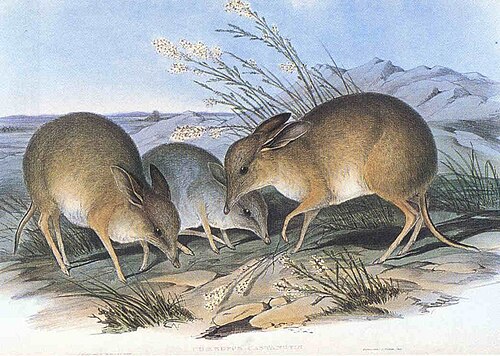
A large part of the difficulty comes from the fossil record itself. Or more appropriately, its incomplete nature. According to the old-age timescale, there is approximately a 30-million-year gap in Australia’s fossil record.11 This means that the fossils that would supposedly document the evolution of the modern major groups of marsupials from a common ancestor are missing. The oldest well-documented fossil sites in Australia are located in places such as the Riversleigh World Heritage Area. Amazingly, the marsupials here are already quite distinct from each other and belong to marsupial families we recognize today. Among them are ancient kangaroos, koalas, wombats, thylacines, and others.
This problem is not unique to Australia. The early fossil record of marsupials in South America is still relatively poorly known, especially in the south of the continent.12 Researchers find it feasible that future South American marsupial fossils wait to be found. The marsupial fossil record in Antarctica is even more unknown because most of the continent is covered in miles-thick sheets of ice. However, some isolated teeth and bones thought to belong to marsupials have been found on Seymour Island, located along the Antarctic Peninsula.13
The scant fossil record of early marsupials makes it virtually impossible for young-age or old-age scientists to reconstruct a foolproof natural history of marsupials based on the evidence we currently have. This means that any account of marsupial natural history, creationist or otherwise, is tentative at best, and subject to change with new fossil discoveries.
Where Will Marsupials Take Us From Here?
The natural history of marsupials presents us with great uncertainty and the possibility of new discoveries at every turn. With the Asian Route hypothesis under scrutiny, creation researchers have come up with other ideas. In their book, Understanding the Pattern of Life (2003), Dr. Todd Wood and Megan Murray briefly discussed the independent dispersion of marsupial kinds by getting washed out to sea rafting on natural debris.14
This explanation relies on ocean currents known to have circulated between major continents both today and in the past. This includes those separating the Old World from the other continents. In recent times, researchers have observed that animals have spread to new places across seaways by these same means.15
The natural rafts used in these instances typically consist of floating log mats, plant debris, and other vegetation. It is thought that the global Flood may have left multitudes of vegetative debris floating in the ocean that took centuries to disappear. Any animals wandering onto these mats (perhaps searching for food) when they temporarily beached could have washed out to sea and ended up in an entirely different part of the world.
Heavy Traffic on the High Seas
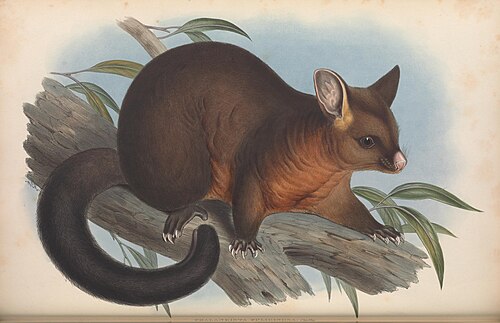
It appears marsupials had beneficial advantages during their long-distance travels across the sea. Many species have a lower metabolism than other mammals, allowing them to survive for considerable time without nourishment. Rafting seems to have been a common method for animals crossing the Atlantic Ocean into South America. Other South American animals thought to have descended from ancestors in the Old World include monkeys; tortoises (Chelonoidis); weak-flying birds called hoatzins; burrowing, legless reptiles (Amphisbaenidae); and possibly even the flightless terror birds (Phorusrhacoids).16,17,18,19,20 Unlike the proposed migration path along Southeast Asia and into Australia, the Atlantic Ocean appears to have been crossed repeatedly by dispersing animals.
Meanwhile, Chad Arment, another creation biologist, has proposed a perhaps unexpected connection between South America and Australia for a brief period of time after the Flood. What might this connection have been? Arment suggests the now-frozen continent of Antarctica.21

Strange as it may seem, the presence of post-Flood marsupial fossils in the southern continent suggests that they lived there for at least a brief time after the Flood. Arment summarizes several lines of evidence that point to Antarctica, rather than Southeast Asia, as the bridge by which marsupials crossed into Australia.
- Fossils of warm-climate plants and animals show that Antarctica did not freeze over until sometime after the Flood. This was probably thanks to oceans left warm by tectonic and volcanic activity during the Flood.
- Old-age scientists believe that Antarctica remained connected to Australia and the southernmost tip of South America until relatively recently in geologic time. Research in the young-age paradigm is still incomplete in this area. However, it is possible that these three continents retained some land connection for a brief time after the Flood.
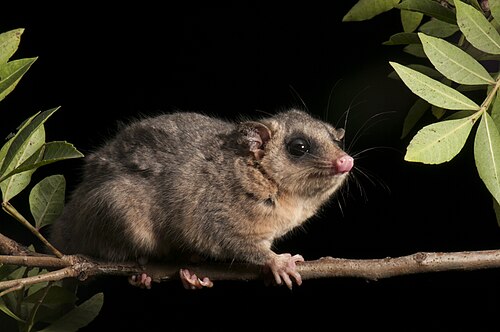
- Researchers have found fossils of “Australian marsupials” in South America and Antarctica.22,23 One group, called Microbiotheria, still has a living species alive today in South America, called the monito del monte (“little monkey of the bush” in Spanish).
- Fossils of other types of animals are found across these southern continents, suggesting a connection between the three. For example, researchers have discovered platypus fossils in South America, and fossil ratites (relatives of the South American rhea and Australian emus and cassowaries) in Antarctica.24,25
Asian Route vs. Antarctic Route
The Antarctic Route hypothesis may offer several advantages over the Asian route. Wallacea poses significant difficulty to the Asian Route hypothesis. Southeast Asia and Australia are geographically very close. But these continents are separated by a series of deep ocean channels that were never above sea level. Additionally, the Wallace Line demonstrates that, despite this, animals did not regularly cross from one landmass to the other.
We can contrast that with the Antarctic Route hypothesis. Unlike the Asian Route, we see significant evidence that animals actively radiated across South America, Antarctica, and Australia for at least a brief period of time. And we have active evidence that the Atlantic Ocean was a common thoroughway for animals as well.
Is this the final answer to how marsupials got to Australia? We dare not say for sure. Future discoveries could drastically alter our understanding of marsupial distribution in the past. Nevertheless, that does seem to be where the evidence is pointing for the time being.
Conclusion
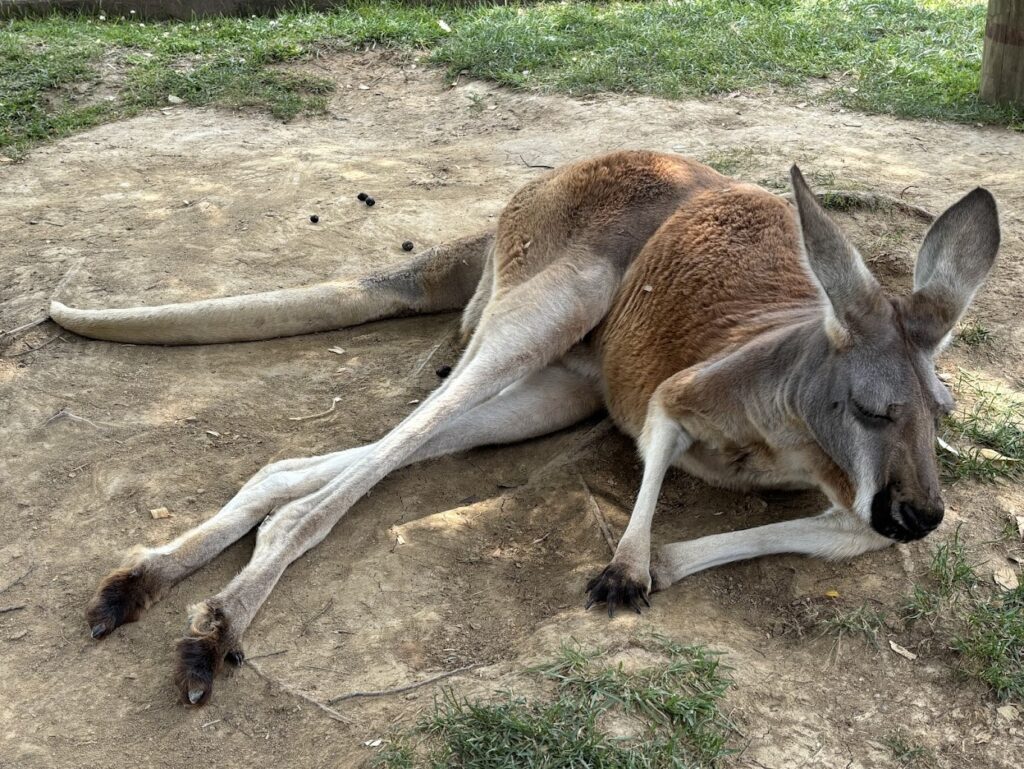
“How did kangaroos get to Australia?” What began as a seemingly simple question expanded into a fascinating exploration of the natural history of marsupials as a whole. Along the way, we discovered that creation and secular scientists have often proposed explanations based on incomplete evidence. And as new discoveries come to light, old ideas are frequently revised and re-evaluated.
Contrary to popular belief, the quest to unravel the mystery of marsupials demonstrates that creation scientists are not only interested in debunking unbiblical claims about our world’s creatures. They also seek to develop a well-rounded understanding of the diversity of life that accounts for the evidence we observe. To do this, they develop testable scientific models, like the ones discussed here, to explain the spread and diversification of marsupials after the Flood.
While we do not yet have all the answers, young-age scientists remain committed to exploring mysteries such as these and glorifying the Creator of it all.
Footnotes
- This article is an updated version of an article previously titled “Journey to the Land Down Under” published on November 2, 2022. ↩︎
- Kangaroo with joey — Photograph by JJ Harrison, via Wikimedia Commons, CC BY-SA 4.0 | Sugar glider — Photograph by Greg Tasney, via Wikimedia Commons, CC BY-SA 3.0 | Virginia opossum — Photograph by Cody Pope, via Wikimedia Commons, CC BY 2.5 | Wombats — Photograph by -jkb, via Wikimedia Commons, CC BY-SA 4.0 | Tasmanian devil — Photograph by Mathias Appel, via Wikimedia Commons, CC BY-SA 3.0. ↩︎
- Lightner, Jean K. 2012. “Mammalian Ark Kinds.” Answers Research Journal 5 (October 31): 151–204. ↩︎
- Thompson, C., and Todd Wood. 2018. “A Survey of Cenozoic Mammal Baramins.” The Proceedings of the International Conference on Creationism 8 (1): 217-A83. ↩︎
- Baker, Andrew M., Mark DB Eldridge, Diana O. Fisher, Greta Frankham, Kristofer Helgen, Stephen M. Jackson, Sally Potter, Kenny J. Travouillon, and Linette S. Umbrello. “Taxonomy and diversity of living Australasian marsupials.” In American and Australasian Marsupials: an evolutionary, biogeographical, and ecological approach, pp. 1-85. Cham: Springer International Publishing, 2023. ↩︎
- Wise, Kurt P. 2009. “Mammal Kinds: How Many Were on the Ark?” In Genesis Kinds: Creationism and the Origin of Species. Edited by Todd Charles Wood and Paul A. Garner, 129–161. Center for Origins Research Issues in Creation, No. 5. Eugene, Oregon: Wipf and Stock. ↩︎
- Arment, Chad. 2025. “To the Ark, and Back Again? Using the Marsupial Fossil Record to Investigate the Post-Flood Boundary: A Reply.” Answers Research Journal 18: 5–11. ↩︎
- Johnson, Bill. 2012. “Biogeography: A Creationist Perspective.” Creation Research Society Quarterly 48, no. 3 (Winter): 212–223. ↩︎
- Flannery, Tim F., Thomas H. Rich, Patricia Vickers-Rich, E. Grace Veatch, and Kristofer M. Helgen. 2022. “The Gondwanan Origin of Tribosphenida (Mammalia).” Alcheringa: An Australasian Journal of Palaeontology 46, no. 4: 605–620. ↩︎
- Nilsson, Maria A., Gennady Churakov, Mirjam Sommer, Ngoc Van Tran, Anja Zemann, Jürgen Brosius, and Jürgen Schmitz. 2010. “Tracking Marsupial Evolution Using Archaic Genomic Retroposon Insertions.” PLoS Biology 8, no. 7: e1000436. ↩︎
- Crichton, Alexander I., Robin M. D. Beck, and Michael Archer. 2023. “A Probable Koala from the Oligocene of Central Australia Provides Insights into Early Diprotodontian Evolution.” Scientific Reports 13: 15769. ↩︎
- Goin, Francisco J., Marcelo A. Reguero, M. O. Woodburne, T. M. Bown, and S. N. Case. 2007. “First Antarctic Records of Marsupials from the Eocene of Seymour Island.” Journal of Mammalian Evolution 14, no. 1: 1–18. ↩︎
- Beck, Robin M. D. 2019. “The Geography and Timing of Marsupial Evolution.” Journal of Biogeography 46, no. 10: 2322–2335. ↩︎
- Wood, Todd Charles, and Megan J. Murray. 2003. Understanding the Pattern of Life: Origins and Organization of the Species. Nashville, Tennessee: Broadman & Holman. ↩︎
- Censky, E. J.; Hodge, K.; Dudley, J. (1998-10-08). “Over-water dispersal of lizards due to hurricanes.” Nature. 395 (6702): 556. ↩︎
- Bond, Mariano, Marcelo F. Tejedor, Kenneth E. Campbell Jr., Laura Chornogubsky, Nelson Novo, and Francisco Goin. 2015. “Eocene Primates of South America and the African Origins of New World Monkeys.” Nature 520, no. 7548 (23 April): 538–541. ↩︎
- Le, Minh, Christopher J. Raxworthy, William P. McCord, and Lisa Mertz. 2006. “A Molecular Phylogeny of Tortoises (Testudines: Testudinidae) Based on Mitochondrial and Nuclear Genes.” Molecular Phylogenetics and Evolution 40. no. 2 (August): 517–531. ↩︎
- Mayr, Gerald, and Vanesa L. de Pietri. 2014. “Earliest and First Northern Hemispheric Hoatzin Fossils Substantiate Old World Origin of a ‘Neotropic Endemic’.” Naturwissenschaften 101, no. 2 (February): 143–148. ↩︎
- Vidal, Nicolas, Anna Azvolinsky, Corinne Cruaud, and S. Blair Hedges. 2007. “Origin of Tropical American Burrowing Reptiles by Transatlantic Rafting.” Biology Letters 4, no. 1 (4 December): 115–118. ↩︎
- Angst, Delphine, Eric Buffetaut, Christophe Lécuyer, and Romain Amiot. 2013. “‘Terror Birds’ (Phorusrhacidae) from the Eocene of Europe Imply Trans-Tethys Dispersal.” PLoS ONE 8, no. 11 (November 27): e80357. ↩︎
- Arment, Chad. 2020. “To the Ark, and Back Again? Using the Marsupial Fossil Record to Investigate the Post-Flood Boundary.” Answers Research Journal 13: 1–22. ↩︎
- Lorente, Malena, Laura Chornogubsky, and Francisco J. Goin. 2016. “On the Existence of Non-Microbiotherian Australidelphian Marsupials (Diprotodontia) in the Eocene of Patagonia.” Palaeontology 59, no. 4 (July): 533–547. ↩︎
- Beck, Robin M. D. 2012. “An ‘Ameridelphian’ Marsupial From the Early Eocene of Australia Supports a Complex Model of Southern Hemisphere Marsupial Biogeography.” Naturwissenschaften 99, no. 2012 (5 August): 715–729. ↩︎
- Pascual, Rosendo, Michael Archer, Edgardo Ortiz Jaureguizar, José L. Prado, Henk Godthelp, and Suzanne J. Hand. 1992. “First Discovery of Monotremes in South America.” Nature 356, no. 6371 (April 23): 704–706. ↩︎
- Bourdon, Estelle, Armand de Ricqles, and Jorge Cubo. 2009. “A New Transantarctic Relationship: Morphological Evidence For a Rheidae-Dromaiidae-Casuariidae clade (Aves, Palaeognathae, Ratitae).” Zoological Journal of the Linnean Society 156, no. 3 (July): 641–663. ↩︎


 Noel Grimes
 Paul Garner
 Todd Wood

 Abigail L.

 Hannah Klein
 Ken Coulson
Glad to see this article. I have thought and studied about marsupials relation to biogeography for a long time. The answer is easy.
Marsupials are the same creatures as elsewhere and after the flood they simply in certain areas changed bodyplans to allow faster reproduction.
Its impossible for the marsupials to have gone THAT WAY but not other ways and other creatures NOT GO THAT WAY but everywhere else. IMPOSSIBLE> thats why opponents or thoughtful people ask how could creatures have migrated from the ark in such wonderful order of types.
A big thing in marsupials is they have exactly the same bodyplans as placentals. the marsupial; wolf, mole, lion, etc. tHis is. impossible from a creationist view. it simply is a minor tweeting after they migrated to Australia and South america.
It simply is they are the same creatures and later the water rose somewhat not allowing more creatures to come in.
If interested i wrote a Essay called “Post Flood Marsupial Migration Explained” by Robert Byers. just google.
I MAY BE in the left field here, BUT have y’all ever thought, looked at the theory that all land mass was connected like the “Gondola theory” BEFORE the flood, and AFTER the flood, the continental plates moved to where they are today??
Hello Andre,
Most creation scientists would put the division of the pre-Flood supercontinent during the Flood. However, there are a few who associate it with the division of the earth recorded as having occurred in the days of Peleg (Genesis 10:25). You can check out this article to read about one young-earth geologist who holds this view. If he is correct, then it is possible that this could help explain the distribution of marsupials and other animals after the Flood.
That is the most obvious, simplest explanation I have heard, and it makes a lot of sense to me. I don’t believe the dating of the breakup is “settled science”, so why not?
The amazing thing that always gets me is that people can believe that Moses made it through crocodile infested waters in a tiny basket, but they cannot believe God for things. He is God, after all. We should never have to get involved with having to explain things to people, but rather we should live by faith. Also, if you had done your Bible studies a little better, you would have read that 7 of every clean animal was put onto the ark and 2 of every unclean. I cannot in a moment decide whether Marsupials are clean, but I don’t eat possum. Doesn’t mean others can’t because they do. I have eaten squirrel and alligator and pork. I am a Protestant, except when it comes to most foods. I never protest food. : )
I think the key is diet. Changing Eucalyptus distribution over time probably was the chief influence. Outside of Australia marsupials had to adept but not very successfully, only a couple varieties. So why are Eucalyptus so prevalent down-under. The other factors mentioned in the article were certainly in play.
Good point! I had not thought of that, but food availability is a huge factor in all migrations.
1st out of the starting gate, we need to realize with God all things are possible with in the boundaries of Truth… Is evolution possible from a millions or billions of years perspective within God’s narrative, the answer is no… In 6 days God has said he created all things and on the 7th he rested… We still have that 7 day time clock today and it works very well… Common sense would argue, it’s an absolute far fetched notion that all of the intricate life we see formed randomly, by chance, and then in a following statement argue, it’s impossible, not a chance for animals to have migrated to other continents… It’s almost laughable to suggest, life came from nothing and evolved to everything, and then struggle with the concept how did animals migrate, and say it’s impossible to get to another current continent… Possibly it’s as simple as humans took them there via boats, rafts, after all, Noah and his family were already boat builders, were they not… Animals quite likely weren’t as wild in the early post flood era and made it much easier to manage and carry them off to distant lands…And of coarse the lands weren’t as distant at first… I fully believe people migrated to other continents much earlier after the Noah flood era, especially after the tower of Babel which was a significant time of global dispersion… Native Indians in America often criticize European settlers coming and taking over their lands, when they themselves were settlers from the eastern continent earlier on but they too were settlers from an earlier migration… That is a lot more plausible then to imagine everything came from nothing, only an empty mind can except that and then randomly create a narrative to fit the idea… Human minds are extremely open to deception, as we’ve witnessed not just in the last few years, where it’s normal for some to rationalize hundreds of genders, when biologically there has only been 2 genders for the past thousands of year, in the animal population as well in the human population… Simply desiring to believe something in the construct of reasoning doesn’t make something a reality or true…Just because humans can’t explain something doesn’t mean it’s not possible or true… This I do know, evolution in the sense as explained by the modern evolutionists is beyond belief, massive leap of faith I don’t buy… The fact that all things created, have a creator, is logical and factual… It’s naive to say, well it just happened by chance… Truth is grounded in existence, understanding meaning and value…
Very interesting. It is possible their were land bridges and they disapeared because of the ring of fire. the extensive volcanic activity in these areas destroys and forms land mass all through time. also possible people took animals with them when they migrated.
not so sure this explains how most of the marsupials ended up in australia or why migrants decided to take them, but perhaps this was what God wanted so it happened.
I come up with a big question when reading this article. You make mention that marsupials didn’t migrate to Ararat then back… but if that’s not true, then how did any and all the animals get to the Ark? Animals were all over the place, were they not, before the flood, so of course they had to travel (migrate) to get to the Ark and then travel (migrate) to whereever they wanted to go? Since the world land masses were different after the flood, they had the opportunity to go wherever God wanted and difected them?!?
Here’s my take on the majority of marsupials ending up in Australia. My reasoning assumes two things: 1) the Bible is a history of the earth that should be taken literally except where it cannot be so interpreted due to the text (Jesus’ statement, “I am the vine,” obviously cannot be taken literally), and 2) many animals have an instinct to migrate, and when displaced, they can have a “homing instinct” that urges them to go back to their original locations on the earth. (We all know of stories of pets travelling many miles to return to their original location after being dislocated by the humans with whom they were living.)
So, here goes:
1. God created the heavens and the earth.
2. On the third day, God gathered the waters on the earth into one place:
Gen. 1:9 – Then God said, “Let the waters below the heavens be gathered into one place, and let the dry land appear”; and it was so.
This would imply (by physical law) that there was also only one place on the earth where there was dry land.
Also on day three, God made all of the plants grow that would be necessary for food for the animals that were about to be created. It would be no problem for God to create the necessary plants in the locations necessary to feed the animals He would create in those locations.
Thus, there is no need for the assumption of “land bridges” between portions of land, since the land was all one mass at that time.
3. The flood happens. This also includes the event that God drew all of the animals He wanted to save to the location of the ark—a kind of “reverse migration.”
4. After the flood, the animals are either drawn back to their original locations by God, or they respond to migratory instincts, including “homing instincts,” and return to their original locations on the earth.
5. Many years later, the tower of Babel happens, and multiple languages are then created. In Genesis, this event must be recorded out of order (in chapter 11), since in chapter 10 we see the people divided by “languages,” which was not true of the people before the events of the tower of Babel. Gen. 11:1 says the people had one language.
6. During the lifetime of Peleg (recorded in Genesis 10:25), the earth was “divided.” This root word is not only the source of Peleg’s name, but is also used for many events in the Scriptures where there was a division (or “channeling”, or “dividing by water”):
Prov. 21:1 – The king’s heart is like channels of water in the hand of the Lord;
Ps. 65:9 – The stream of God is full of water;
Job 20:17 – “He does not look at the streams, The rivers flowing with honey and curds.
Job 29:6 – And the rock poured out for me streams of oil!
Ps. 1:3 – He will be like a tree firmly planted by streams of water,
Ps. 46:4 – There is a river whose streams make glad the city of God,
Ps. 119:136 – My eyes shed streams of water,
Prov. 5:16 – Streams of water in the streets?
Isaiah 30:25 – there will be streams running with water
Isaiah 32:2 – Like streams of water in a dry country,
Lam. 3:48 – My eyes run down with streams of water
Between the end of the flood and the lifetime of Peleg, the “Australian” marsupials could easily have migrated back to their original locations. Then, when the “canal” effect, or dividing by water happened (what we might call the “drifting of the continents,” (though it was probably much more of a cataclysm than a “drifting”), the animals would be isolated on different land masses.
This isolation of the land masses, with different animals and humans on each one, will also explain genetically many of the species that have resulted, and variations of homo sapiens (or races, if you will).
So, I don’t see much of a problem with how most of marsupials ended up in Australia. If that was their location on the one land mass, and then some were saved in the ark, and then they migrated back to their original location, only to be separated on the land mass of “Australia” when the “earth was canaled by water,” then does not need to go outside of the history presented in the Bible to understand this phenomenon.
One picky little detail: the word “decimate,” from a practice of the ancient Romans, means to kill every tenth one. The Flood did a lot worse than that. “Devastate” would be a better word.
First, let me say that I am a young-earth creationist. (My materials are available online at http://www.creationorevolution.net/creation-in-science-education/ .)
I have also thought that since marsupial babies travel in their mothers’ pouches, the species could travel faster than the placentals, in which the young have to walk. However, this does not explain monotremes, which are known only from Australia. (Fossils in the Cretaceous as well as living forms.) They do not travel in their mother’s pouch but must walk. Any thoughts on why living monotremes are found only in Australia?
He mentions it in the article but monotreme fossils have been found in South America, specifically in the Patagonia region of Argentina. These discoveries prove that egg-laying mammals were not always exclusive to Australasia.
Thank you Mr. Ryan for another fine article. I always enjoy reading them, discussing your ideas and sharing your knowledge. Keep up the good work!
I believe in the biblical account of the flood but am also a graduate in Biological Science to a Masters level. It was always the isolation of marsupials in Australia that was the most difficult thing for me to reconcile with the biblical account of a global flood. After much thinking about it (without throwing out the flood account) I came to the conclusion that marsupials were faster at migrating and spreading forth across the land than eutherian (placental) mammals after leaving the boat. During the post flood ice-age period sea levels were much lower and South America formed a bridge with Antarctica and Australia. Further post flood tectonic activity ensured this was cut off before Eutherian mammals were able to make it all that way to Australia. Leaving only marsupials and monotremes. It is reassuring to read in this article that others have come to similar conclusions and that there are even fossil records that show marsupials in both South America and Antarctica. Excellent and very interesting article. Thank you for sharing.
Its very obvious to me what happened. The marsupials are just the same creatures as filled the earth after the flood. Just trivial reproductive changes, a few more, that affected most creatures that got to the farthest areas from the ark in australia and S america. land bridges are impossible. the exclusiveness of marsupial here but not thre and placentals not there but here is impossible.
I suggest you watch, many times, the last moving pictures of the marsupial wolf, on the internet. its just a dumb old dig.
i rite an esaay once called “Post flood Marsupial Migration Explained” by robert Byers. just google.. my fellow creationist must drop impossible ideas about marsupials on the ark and instead see these traits are trivial additions.
You say:
It is true that Australia and New Guinea were connected during the Ice Age. The same can be said for Southeast Asia and Indonesia. The problem is that these two landmasses were still separated by a region of deep ocean channels called Wallacea. Some of these channels are tens of thousands of feet deep! Needless to say, these were not exposed as dry land even in the middle of the Ice Age.
The Wallace Line is perhaps an even more serious challenge for the Asian Route hypothesis…
… It is almost as if an invisible boundary separated Asian-type animals from Australian-type animals. This striking pattern was first documented by British naturalist Alfred Russel Wallace in 1859. The boundary itself later became known as the Wallace Line in his honor.
The article mentions the Wallace Line but does not attempt to account for its existence. Although the deep-water trench sea gaps, still present during glacial periods, are narrow the invisible Wallace Line (of several proposed in the same general area) is a biogeographical transition zone where millions of years (not thousands even if evolutionary processes are ‘sped up’) of geographic including tectonic isolation have led to a particularly unique and contrasting couple of broad evolutionary ecosystems. Asia and Australia have probably never been connected by land; the young earth creationists also ignore or reject that in the distant past there were two supercontinents – Laurasia in the north included Asia and Gondwanaland in the south included Australia. All we seemingly get from these young earth creationists (any oversimplification is unintentional) is that there was a supercontinent of the world’s land (possibly Rodinia* which preceded Pangea; the latter broke apart to form Laurasia and Gondwanaland) and that supercontinent broke up and led more or less directly to today’s continents. Genesis 1:9 refers to waters being gathered to ‘one place’ and creationists think this also means there was one single landmass (until the Genesis flood – see Genesis 7:11 which they fancifully interpret to mean massive catastrophic tectonic activity accompanying the waters from below and the rainfall).
* Noah’s Lost World | Answers in Genesis (skimmed)
The article also includes fanciful speculations about kangaroos, koalas and wombats somehow getting (a) from Ararat to Antarctica and (b) from Antarctica to Australasia (via proposed land bridges) around 4,500 years ago. I suggest he looks at a map to see how far away Antarctica is from Australia and most other continents. (It’s thought the southern supercontinent Gondwanaland broke apart roughly 180 million years ago.) But – apart from saying that ‘catastrophic plate tectonics’ to make the separation of Antarctica from both Asia and Australia a short-lived recent phenomenon is itterly unscientific and ridiculous – it would be harder to disprove the ‘Antarctica route’ hypothesis in the same way as the ‘Asia route’ hypothesis has been disproven.
There’s also nothing in the Genesis account of the flood and its aftermath to suggest that the land of the time – possibly a single landmass based on Genesis 1:9 – would, after the floodwaters disappeared, end up being several continents and lots of islands separated (in many cases permanently) by the seas and oceans. Based on Genesis 8:17 God’s plan was for the animals (including flightless and creeping ones) to abound and multiply on the Earth. But despite this the author at New Creation blog states:
Most young-age geologists think that the seven continents we have today formed during the break-up of the supercontinent Pangaea. This probably happened during the Flood.
And in their Conclusion they refer to debunking unbiblical claims about our world’s creatures. But I’m not sure their own claims are fully biblical – they appear to add assumptions to what Genesis actually says (I allow for 2 Peter 3:6 which speaks of a world being ‘destroyed’ though that refers in part to mass animal and human death).
To summarise, and as a non young earth creationist, I’m not convinced.
Hello Ashley,
Thank you for reading my article and providing detailed feedback. I will attempt to deal with your concerns in a detailed, yet succinct manner.
You mentioned that the article neglects to account for Wallacea’s existence within a young-age framework. You are correct. I did briefly consider incorporating that as well, but ultimately decided against it because doing so would have taken the article down a related, but different rabbit (kangaroo?) trail, and I didn’t want the article to be any longer than it already is. Plus, I figured it would be much better to simply write an article specifically about Wallacea in the future. It would be a nice companion piece to the article above.
That said, I don’t think Wallacea is uniquely difficult to explain within a young-age paradigm. The reason Wallacea exists is essentially because the deep ocean channels separating Southeast Asia from Australia/New Guinea provide a barrier to most terrestrial animals, with animals migrating to that boundary line separating the two regions from two different directions. It seems to me that if you lessen the amount of time Wallacea has existed, it would be LESS likely to find shared animal biotas on both sides of the line, not more.
I would also disagree with your assertion that the Antarctic Route is too speculative in a young-age creationist framework. I think there may be some misunderstanding regarding how and when continental separation is envisioned within many young-age creationist models (which, to be fair, I only briefly touched on in the article). Within the secular model, Australia and New Guinea separated from Antarctica during the Eocene (approx. 40 Ma), while South America became separated from Antarctica by the opening of the Drake Passage (estimates have ranged between 17 and 49 Ma). For a young-age creationist, however, there would likely be at least a few hundred years available between the end of the Flood and the complete isolation of Antarctica. This would not be catastrophic plate tectonics in the sense of what occurred during the Flood, but residual plate tectonic movements as the Earth was regaining equilibrium and the speed of the plate movements was decreasing to its present value.
I would also note that I do not reject the existence of intermediate continental configurations such as Laurasia and Gondwana. However, even according to both young-age and old-age scientists, South America, Antarctica, and Australia were already separated from Africa, Madagascar, and India well before marsupials made their way to Australia. As such, a detailed discussion of Gondwana and Laurasia was not particularly relevant to the question being addressed in this article, which focused on possible marsupial migration routes rather than the entire history of continental breakup.
I also think there may be some confusion as to what counts as “biblical” versus “unbiblical” claims. By “biblical/unbiblical claims,” I mean whether specific claims start from a biblical perspective or not. Not whether they refer to a phenomenon specifically mentioned in the Bible. And not all unbiblical claims are necessarily wrong. A claim can be not derived from Scripture and still be consistent with the biblical events and timeline.
As such, catastrophic plate tectonics is a scientific model not directly mentioned in the Bible. However, many creationists regard it as a model that is consistent with what the Bible describes. More broadly, creationists often infer post-Creation and Flood-related geological events from the physical evidence while attempting to remain consistent with the biblical timeline. In that sense, catastrophic plate tectonics is not intended to add to Scripture, but rather to explain geological observations within a biblical framework.
Thanks again for taking the time to read the article and share your thoughts.
Thanks; you mention shared animal biotas. Of land-based animals, very few – such as the crab eating macaque and some rodents – are found on either side of the Wallace Line. Had the present configuration of continents and islands only been in place for c 4,500 years maybe, based on your argument, maybe not even these would be present on both sides.
I still think that your claim ‘Most young-age geologists think that the seven continents we have today formed during the break-up of the supercontinent Pangaea. This probably happened during the Flood’ adds to what scripture suggests. Which makes the claim extra-biblical if not strictly unbiblical (contrary to scripture). It seems like an attempt to explain the world’s present day geography from a ‘biblical’ rather than materialistic perspective (the latter involves Laurasia and Gondwanaland whereas the YEC perspective often seems not to).
‘However, many creationists regard [catastrophic plate tectonics] as a model that is consistent with what the Bible describes’. I’d be interested to know what Bible verses you or other young earth creationists think are consistent with the absurd and unscientific notion that is the ‘catastrophic plate tectonics’ model. (It seems to me a similar example to that of the YEC ‘post-flood ice age’ which is absent from scripture and contrary to the talk of summer and winter in Genesis 8:22 a verse that Ken Ham is so keen on quoting when he denies human-caused climate change and declares global heating is nothing to do with burning fossil fuels.)
Looks like you had no answer to my comments so you blocked me instead.
Hello Ashley,
You were not blocked. I have not yet had an opportunity to finish my response to your earlier comment, but I appreciate the time you took to engage with the article and will reply when I am able.
Thanks,
Christian Ryan
You blocked my substantive comments from a few days ago.
Sorry – I’ve just seen your reply to me below (I didn’t get an email alert).
One of the areas we do not seem to ever discuss in these articles is the kinds , were the kangaroos on the ark as we see them today,or were they as has been found the very forerunners of what are the modern kangaroos, for instance, they have found fossils of giant kangaroos or giant sloths . The short-faced kangaroo Procoptodon goliah grew as tall as three metres and may have weighed more than 250 kilograms.
There was another genus of extinct kangaroos, Protemnodon, which were more like the grey and red roos we know today, but little is known about their lives. When the kinds went onto the ark for years, we have been taught the two-by-two elephants and kangaroos, etc., etc., and the good old comments did the lions and tigers what did they eat, you know the stories. But if two of a kind were the family genus of all the species within their kinds, maybe we should be approaching what the kinds exactly were on the ark. It may eliminate the modern animals we now see, and there is great indication that animals were much bigger than now because of the pre-flood conditions. It may change the way some of these questions are posed as to how these animals got to where the modern versions are. t
Hello Alan,
Thank you for reading my article and for your thoughtful comment. I agree with you that identifying the created kinds represented on the Ark is an important part of this question. In fact, the article includes a section titled, “How Many for Your Traveling Party?” that discusses this exact issue.
I agree that modern kangaroo species, or necessarily even all the modern marsupial families, were present on the Ark in the forms we recognize today. Some creationist researchers tentatively identify separate kinds corresponding to particular marsupial families, whereas other researchers have proposed that the original kinds may have been considerably broader. Under the latter view, perhaps only one to five ancestral kinds gave rise to the major Australian marsupial groups after the Flood. That would mean that the Ark animals were not simply red kangaros, gray kangaroos, koalas, wombats, and so forth lined up two-by-two. Rather, they may have been the ancestral representatives with the capacity to diversify into numerous later forms.
I would be cautious, however, about identifying giant kangaroos such as Procoptodon or Protemnodon as the Ark ancestors. They are extinct members of the kangaroo family, but that does not necessarily make them the genealogical forerunners of modern kangaroos. Moreover, as stated in the article above, the familiar Australian marsupial fossils (including these larger forms) occur in post-Flood deposits. They would therefore represent animals that had already diversified after leaving the Ark rather than pre-Flood animals preserved during the Flood.
So I agree with your broader point that determining the boundaries and characteristics of the original marsupial kinds could substantially change how we reconstruct their post-Flood migration and diversification. At present, however, we do not know precisely what those ancestral animals looked like, which is why I present several possibilities rather than a definitive reconsturction.
On thing that I’ve been contemplating recently is the possibility that animal were released in stages. It seems to me that the text would allow for this. Although it doesn’t seem likely that staging would be staggered far enough apart to allow for things like herbivores multiplying before predictors are released–it doesn’t appear that this would be necessary anyways because of the possible abundance of food after the flood (initially carrion followed by trapped fish & other water based animals that become progressively available to predators).
If the post flood conditions are still rather chaotic as we increasingly believe to be the case, then groups of animals may have been persuaded to go in different directions based on when they were released due to storms, rockslides on the mountain side on which they were released (thus changing the path that animals took), etc. If marsupials and monotremes were released in the same group, such post-flood chaos may have acted as a funnel sending them out in the same general direction, and further chaos may have persuaded other groups to go in yet other directions.