

 Joshua Cedar
“Scientist DESTROYS evolution in 10 minutes!” “Geological evidence PROVES Noah’s Flood!” “‘Transitional’ fossils DEBUNKED by science!” If your social media feed is anything like mine, you’ve probably seen scores of video thumbnails and titles like these.
Packaging online content with provocative messaging is great for encouraging clicks and engagement. But could it also be sending people the wrong message? While seeking to encourage people’s faith in the Bible, could it actually be causing them to place an unhealthy amount of faith in science—or, at least, to have an unrealistic view of science?
In this article, I will argue that an honest look at the nature and limitations of science requires us as young-age creationists to be far more conservative and cautious in how we make apologetic arguments based on science, and to cling more closely to Scripture as our foundation.
The views expressed in this article reflect those of the author mentioned, and not necessarily those of New Creation.
Certainty and the Nature of Science
Whenever a Christian apologist says something like, “This evidence demolishes evolution” or “That evidence proves Noah’s Flood,” they are using terms that convey certainty. The problem is that science, by its very nature, always carries with it a degree of uncertainty.
Terms like “prove” are common in everyday speech. Judges in criminal cases apply “proof beyond reasonable doubt” as the standard by which to evaluate a defendant’s alleged guilt. But in science, terms like “prove” and “proof” are scarcely used.
True, scientists may use the terms “prove” and “proof” in popular-level books, videos, and articles. But when speaking to other scientists, they prefer to use more tentative terms like “imply,” “suggest,” and “indicate” when arguing for a particular interpretation of the data. They may speak of a hypothesis being “supported” by the data, rather than proven.
The reason scientists hedge their claims in such tentative terminology is because they recognize that scientific knowledge has its limits. Science is a human endeavor, and humans are finite and fallible. Our current models are always only our best attempt to describe how the natural world works given the data we have. New conceptual paradigms can reframe how we understand the data, and new technologies can show us new data that changes our picture of the phenomena we are studying.
Even ideas that are widely accepted today can be radically overturned in the future. Just consider one example from the dustbin of scientific history: the geosyncline theory.
RIP: Geosyncline Theory
Prior to the plate tectonics revolution of the 1960’s and 70’s, the geosyncline theory was hailed as “probably one of the greatest–unifying principles in geologic science.”1 It posited that as sediment built up in linear depressions in the earth, it caused earth’s crust to bow downwards. Geologists eventually called these sediment-filled regions geosynclines. The nineteenth-century American geologist James Hall proposed that the downward bowing of the geosynclines caused sedimentary layers at the top of the basin to be compressed. This compression formed the familiar folded layers seen in outcrops of many mountain chains around the world.
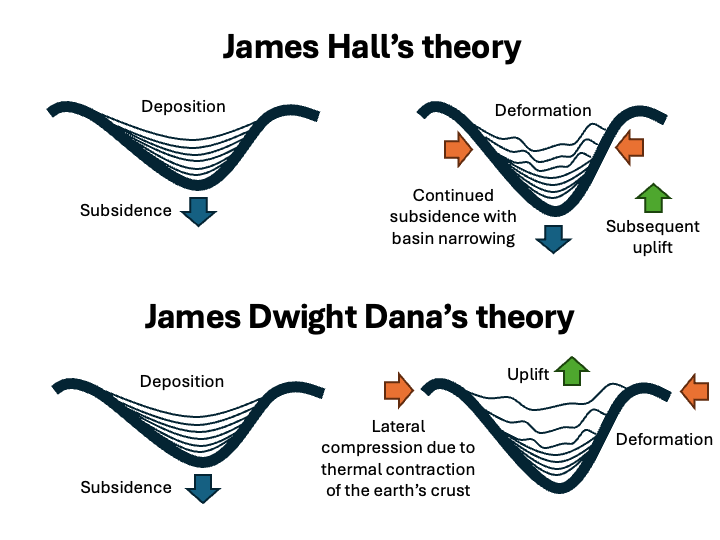
Another American geologist named James–James Dwight Dana–proffered a different theory. He hypothesized that thermal contraction of the earth’s crust caused compression and uplift of the sediments into mountain chains.2
Geosyncline theory seemed to explain the observable geology in some places very well (e.g., the Appalachian Mountains). But it didn’t explain everything. And as geologists tried to apply it to more and more places, it had to become more and more complex in order to explain the data.3
Once plate tectonics developed as a theory, it readily explained the same data as geosyncline theory—and data it couldn’t explain—along with a host of seemingly-unrelated geological phenomena. It could explain the distribution of mountain chains, oceanic trenches, earthquakes, volcanoes, fossils, the pattern of magnetic mineral orientation on the seafloor, and much more. Because of its explanatory power, geologists now embrace plate tectonics as an accurate model of how the earth works.
The Tentativeness of Scientific Models
But let’s imagine, for the sake of argument, that geologists developed a new “unifying theory of geology” that explained all the same data, but even better. It could even explain phenomena that conventional plate tectonics struggles to explain. Is such a scenario possible?4 A fair-minded geologist would have to say yes.
As good as plate tectonics is at explaining geological phenomena, it is not infallible. It is only a reflection of our current best understanding of how the earth works. It is always possible that more data could challenge that understanding. And this isn’t just true in the earth sciences. It is true in all fields of science.
Please don’t misunderstand: I’m not saying that science is divorced from truth, or that we cannot obtain truth about the physical world using science. However, I am saying we need to be realistic and honest about the natural limitations of science.
The Need for Caution in Scientific Apologetics
If all science carries with it an inherent degree of uncertainty, then honesty requires us to display caution in our use of scientific arguments for the Christian faith. Rather than saying that a particular scientific discovery “destroys” evolution or “proves” Creation and the Flood, we ought to couch our apologetic arguments in language that befits the tentative nature of science. To see what I mean, let’s consider an example from the field of baraminology (study of created kinds).
Case Study: Extinct Reptile Created Kinds
In 2023, paleontologist Dr. Matthew McLain and his students from The Master’s University presented a paper at the 9th International Conference on Creationism on the baraminology of a group of reptiles called archosauromorphs (ARK-oh-SORE-oh-morphs).5
Archosauromorphs include familiar animals like crocodiles, dinosaurs, and pterosaurs along with a menagerie of less-familiar, extinct reptiles. These include the long-necked, fish-eating tanystropheids (TAN-ee-stroph-EE-ids), the beak-toothed, herbivorous rhynchosaurs (RINK-oh-saurs), the hook-nosed, predaceous proterosuchids (PRO-ter-oh-SOOK-ids), the crocodile-like phytosaurs (FY-toh-SAURS), and many others.
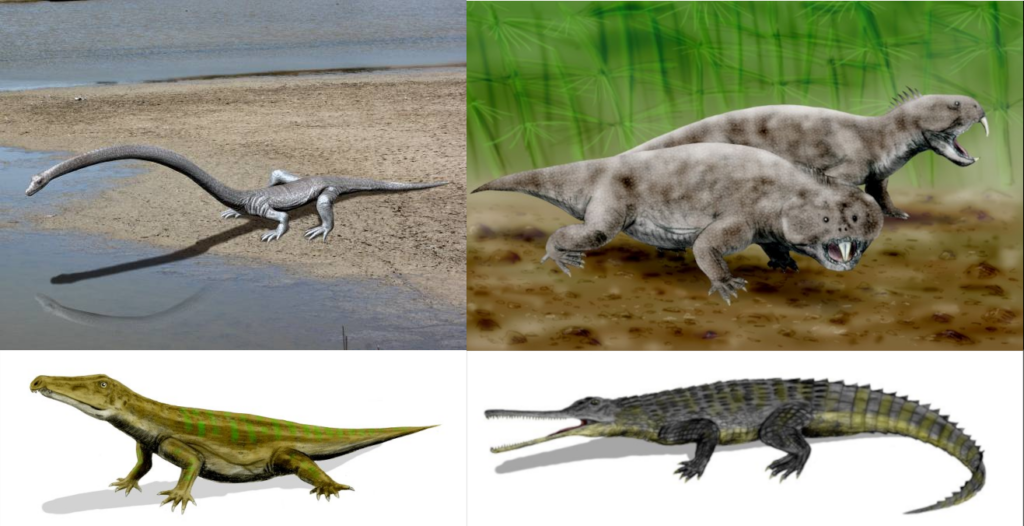
What is striking about each of these archosauromorph groups is that they first appear in the fossil record suddenly as distinct and recognizable groups, rather than gradually emerging from common ancestors. Given these facts, McLain and his students predicted that these groups (most of which are at the family level in terms of classification) would appear as discrete holobaramins (approximated “kinds”) when subjected to statistical baraminology. Their results largely confirmed this prediction.
Now that we have seen what Dr. McLain and his students found, let’s consider two ways a creation apologist might present these findings.
Approach #1: Evolution DEMOLISHED, Creation CONFIRMED
Our creationist apologist could take the results of this paper and use them to say that it destroys the idea that these reptiles evolved from a common ancestor. Evolutionary theory predicts the existence of ancestors connecting each of the major archosauromorph groups, but the fossil evidence for these connections is weak. So far, so good. However, they conclude by stating that this absence of evidence proves that archosauromorph evolution didn’t happen and proves instead that these different groups were created separately by God.
The problem with this approach is that it tries to make the evidence say too much. Does the evidence support evolutionary predictions? No. Does that then prove that evolution didn’t happen? If we are being intellectually honest, no it doesn’t. There is always the possibility that new fossil evidence could be discovered that links some or all of the groups together. Does the absence of links prove divine Creation? Again, if we are being intellectually honest, we’d have to say no. The lack of evidence for one explanation does not necessarily prove the alternative.
Approach #2: Research Supports Creationist Predictions
Now let’s say our creationist apologist argues instead that while this evidence does not disprove evolution or prove creation, it does confirm a major prediction of young-age creationist biology: the existence of abundant discontinuity among living things. Because we believe that God created life in discrete units (= “kinds”) with the ability to diversify and adapt to different environments, we would expect to find “clusters” of organisms that display continuity (overall similarity) with one another and discontinuity (overall dissimilarity) with organisms in other clusters.
A familiar image young-age creationists use to illustrate the “kind” concept is the “Orchard of Life,” where individual trees represent different created kinds.6 From each tree springs many separate branches and leaves, each representing different genera and species. This image contrasts with the evolutionary “Tree of Life,” which depicts all species as branches emerging from a single common ancestor. In the evolutionary view, all discontinuity we observe in biology is ultimately an illusion, because in reality, all living things are related to one another. From a young-age creationist perspective, however, discontinuity is a real fact of life. The results of many baraminology studies, like the one done by Dr. McLain and his students, confirm the predictions of the young-age creation model rather than the evolutionary one.
A Measured Case > An Overstated Case
At first, it might seem like our creation apologist in the second scenario is presenting a weaker case than in the first. But a closer look reveals the opposite. In the first case, all it took was a little probing to reveal that our apologist was overstating their case. A skeptic could justifiably dismiss what our apologist is saying because our apologist hasn’t been measured or accurate in how they have handled the scientific evidence.
But notice how in the second scenario, though our creation apologist has presented a more modest argument, the argument is fully defensible given the results of the study. Although our apologist has said less, it still requires an answer from the skeptic. A skeptic would most likely reply that, “These results do show discontinuity among these reptile groups, but I am confident that further fossil discoveries will reveal a greater continuity between them.” Our creation apologist could reply, “Only time and future discoveries will be able to confirm or falsify those predictions. But in the meantime, why are you so confident in your evolutionary views?” Now there is a bridge for deeper conversations!
Scientific Uncertainty as an Apologetic Tool
In conversations about origins, people often have a hard time taking creationist claims seriously because they go against the majority view among scientists. But might there ever be a time when it is reasonable to question or reject the scientific majority?
To answer this, let’s go back to the example we looked at early from the history of geology. If you were a geologist living before the plate tectonics revolution, the idea of plate tectonics would have been a minority viewpoint among geologists. To many, it would have seemed preposterous! After all, what kind of force could literally move continents? But when new technology allowed human beings to scan the seafloor and confirm the idea of seafloor spreading, it became possible to imagine how continents could move as parts of tectonic plates. As a result, the theory compelled many scientists.
Now consider this: if no one had been willing to go against the majority and venture new, untested ideas, then progress in our understanding of how the earth works would have been stunted. The history of science is full of such pioneers whose discoveries challenged the prevailing ideas of the time.
Here is the question for non-creationists to consider, “Is it possible that all the data currently used to support the theory of evolution—DNA similarities, homologous structures, fossil sequences, radioisotope dating, and so on—could actually be better explained by a different model?” If they are being intellectually honest, they would acknowledge that, yes, it is possible.
Now we could ask, “If a young-age creationist understanding of earth history is true, being rooted in the self-revelation of the unchanging God who does not lie, could it not guide us toward building such a model?” Again, if they are being intellectually honest, they would have to say yes.
With these two acknowledgements, you now have a platform upon which you can show how a commitment to Scripture has led young-age creationist scholars to make exciting new discoveries!7 More importantly, you have brought them back to the foundational issue of starting points. As young-age creationist ministries have long argued, the authority you accept as ultimate, whether it is God’s revelation or human reason untethered from the Creator’s light, will determine how you interpret the data. With this reality exposed, you can gently press them on where they stand and why.
Why This Ultimately Matters
I not only believe a more measured, careful approach to young-age creationist apologetics is advantageous, but I also believe it best honors Christ by accurately presenting the truth. We do not honor Christ when we overstate our case. In reality, it actually demonstrates a lack of trust in His Word. The only reason we would feel the need to overstate our case is if we do not believe His Word is powerful enough to stand on its own. Dear brother or sister, let’s be honest—do we believe that Scripture needs the support of scientific evidence to have authority in our lives or in the life of the unbeliever we are talking to? Or do we believe that its power is sufficient to make the spiritually dead person come to life?
At the end of the day, our confidence should not be in the authority of science to compel someone to believe in creation or a young Earth. Ultimately, we must receive the doctrine of creation by humble faith (Hebrews 11:3). Even if there were no young-age creationist scientists out there making discoveries, would that shake our faith in the basic tenets of young-age creationism? Or would we cling to them because they are derived from a careful reading of Scripture? I certainly hope we would do the latter.
Conclusion
As young-age creationists, let’s strive to change our approach to defending our views. Instead of making statements that overstate our case (e.g., “This evidence DESTROYS evolution!”), let’s be humble, honest, and willing to state the facts clearly. But let’s also be firm in our confidence that God has spoken, and it is His Word—not science, as helpful and powerful as it may be—to which we cling as the ultimate source of unchanging, unerring truth.
Footnotes
- Knopf, A. (1948). The geosynclincal theory. Bulletin of the Geological Society of America, 59, 649-670. https://doi.org/10.1130/0016-7606(1948)59[649:TGT]2.0.CO;2. ↩︎
- Dott, R. H. (1997). James Dwight Dana’s old tectonics—global contraction under divine direction. American Journal of Science, 297, 283-311. ↩︎
- Kay, S. M. (2014). 125th anniversary of The Geological Society of America: Looking at the past and into the future of science at GSA. GSA Today, 24(3). doi:10.1130/GSAT-13PresAdrs.1. ↩︎
- In a sense, young-age creationist geologists who subscribe to catastrophic plate tectonics as a modified version of plate tectonics theory are making this very claim. ↩︎
- McLain, M. A., Clausen, C., Perez, T., Bebee, K., & Ahten, A. (2023). A preliminary analysis of archosauromorph baraminology. The Proceedings of the International Conference on Creationism, 9, 487-539. ↩︎
- Wise, K. P. (1990). Baraminology: A Young-Earth Creation Biosystematic Method. The Proceedings of the International Conference on Creation, 2, 345-360. ↩︎
- Brand, L., & Chadwick, A. (2016). Research and Predictions. In Faith, Reason, & Earth History (3rd ed., pp. 360-368 in ebook version). Andrews University Press. ↩︎


 Christian Ryan
 Sara Anne

 Matt McLain

 Todd Wood
 Abigail Van Huss
 Peter
Peter

I agree with most of this article. But I actually do believe the claims of holy scripture because of the weight of evidence, not just scientific evidence, but other evidence as well.