
 Peter
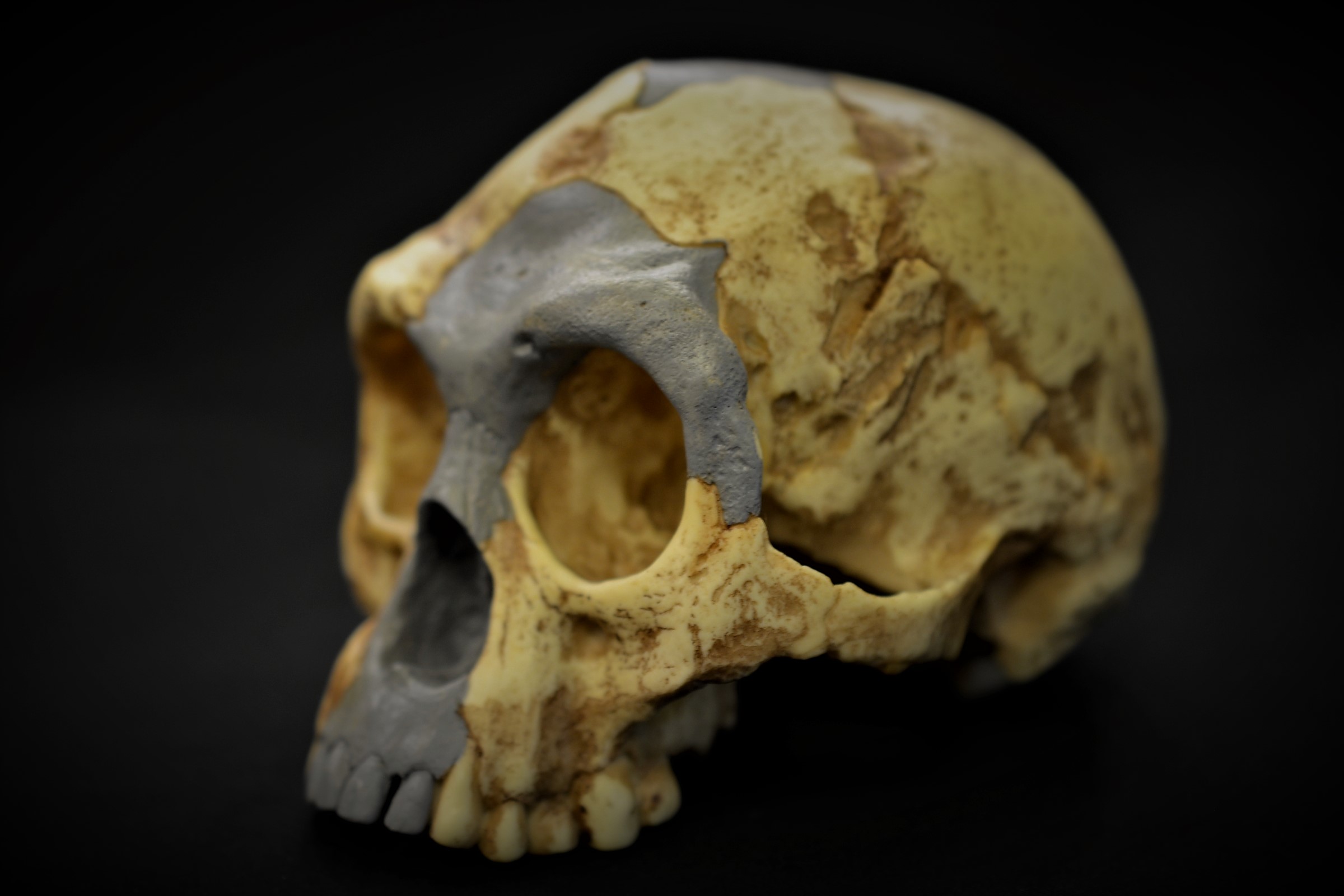
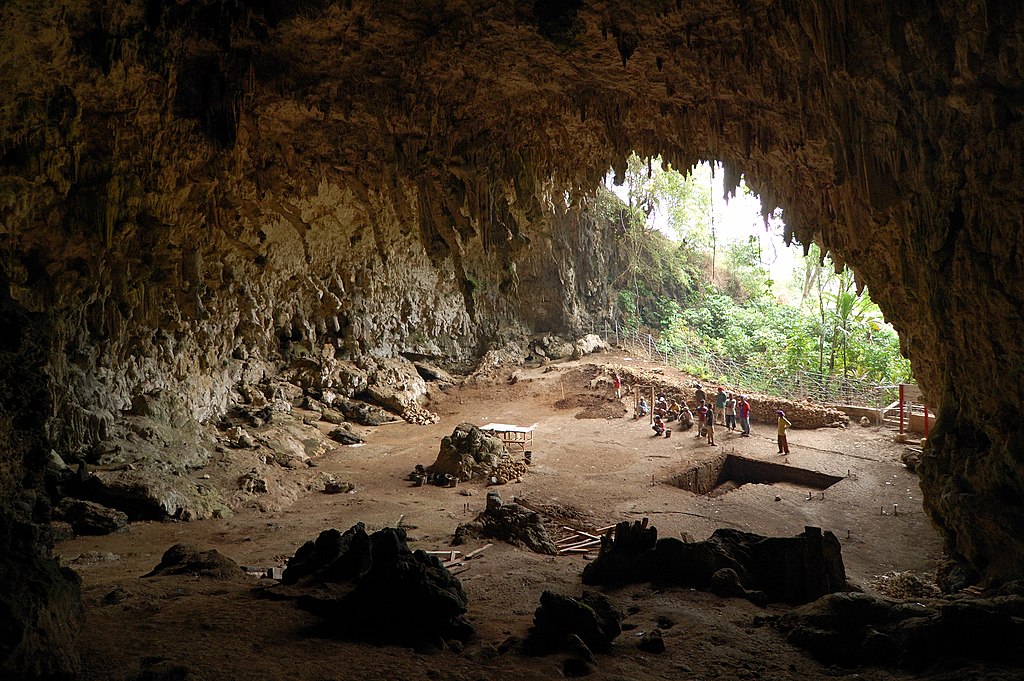
PeterOn September 2, 2003, excavators uncovered the top of a tiny skull. They were digging in a remote cave on the Indonesian island of Flores. At this point, they were about 20 feet beneath the cave floor. It was dangerous to dig so deep in wet sediments. A wooden scaffolding system was needed to prevent sediment from slumping into the pit.1 But the team’s perseverance had finally paid off.
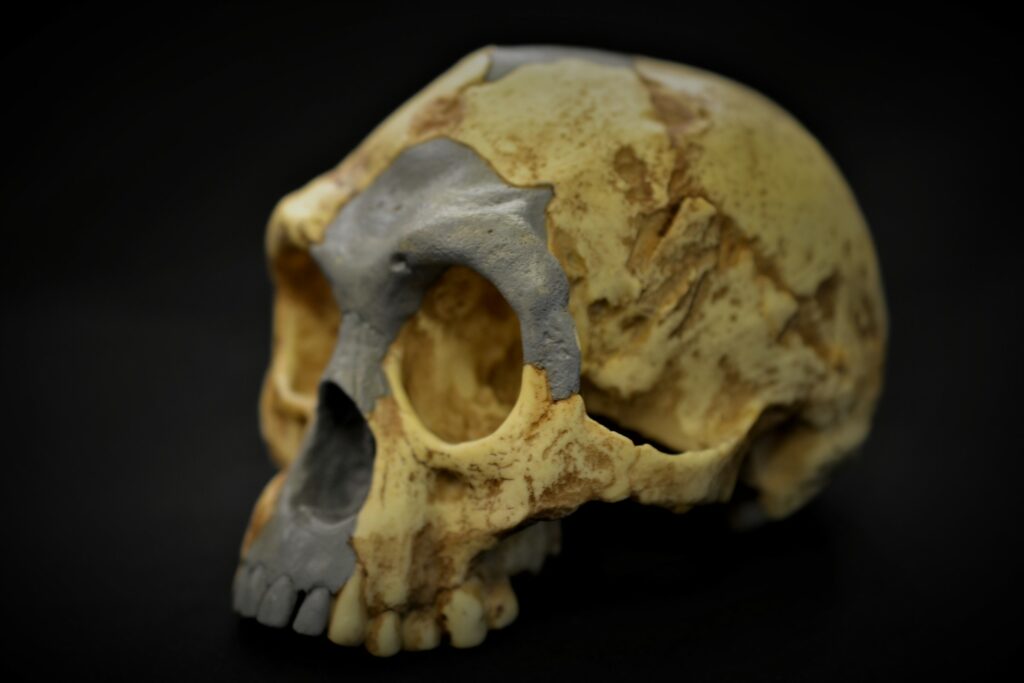
Initially, excavators believed that the skull belonged to a young child because of its small size. As the team continued to dig, they found more of the child’s skeleton. Some of the bones still sat next to each other, connected as they had been in life. The fossils were unbelievably fragile, having lain in their damp grave for thousands of years. One of the excavators described them as having “the consistency of wet blotting paper.” They could only remove the bones after drying and stabilizing them with chemical hardeners.2 Scientists slowly removed the clay covering the child’s skull to get a better look at its teeth. To their surprise, the team found that the individual’s teeth were worn from years of use. Its wisdom teeth had already erupted! The skull belonged to a tiny adult, not a child.
A New Species?
This skeleton was officially described in 2004.3 It belonged to a small female, standing just a little over three feet tall! Her brain was just one-third of the size of an average modern human brain. The remains were assigned to a new species, Homo floresiensis. Researchers sometimes affectionately refer to the little lady as “Flo.” And Flo was not alone. Lian Bua Cave yielded the remains of at least fifteen more small-bodied individuals.
Competing researchers quickly argued that Flo had a developmental condition.4,5,6 Some claimed that she was a pygmy with microcephaly, a pathology that results in an unusually small brain. Many of these papers had statistical errors, inaccurate estimations, and illogical arguments.7 Scientists have identified convincing evidence that Flo’s small stature and brain size were not the result of disease or developmental abnormalities. For example, a statistical analysis of her brain shape strongly indicated that it was not affected by microcephaly.8 Some scientists suggest that Flo and her kin adapted to the scarcity of food on the island of Flores by shrinking in size. But this hypothesis struggles to explain certain aspects of Flo’s anatomy, like her limb proportions. Other researchers argue that Homo floresiensis is closely related to early members of the genus Homo, some of whom were already short-statured.
Human or Ape?
Young-earth creationists believe that Flo and her kin were human. Despite its tiny size, Flo’s skull shares many features in common with other human fossils. Flo’s limb bones clearly show that she walked upright on her hind legs. However, she had unusual limb proportions. Flo’s arms were surprisingly long.9 Flo’s kind probably migrated to Indonesia soon after Noah’s Flood. Her bones date to the Pleistocene Epoch.10 Most creationists correlate this time period with the few centuries between the global flood and the birth of Abraham.
Flo’s ancestors probably reached the island of Flores by boat.11 Flores is separated from the western portion of the Indonesian Archipelago by a swift ocean channel. The channel prevented the spread of many Asian animals. It is quite unlikely that Homo floresiensis reached the island by accident. Some sort of watercraft was probably needed to cross this oceanic barrier. Despite having small brains, Flo and her kin appear to have been intelligent human beings.
Footnotes
- M. J. Morwood and P. van Oosterzee, A New Human: The Startling Discovery and Strange Story of the “Hobbits” of Flores, Indonesia (Washington, D.C.: Smithsonian Books, 2007). ↩︎
- Morwood and van Oosterzee, A New Human (Footnote 1). ↩︎
- P. Brown et al., “A New Small-Bodied Hominin from the Late Pleistocene of Flores, Indonesia,” Nature, 431, no. 7012 (2004), 1055–1061. ↩︎
- M. Henneberg and A. Thorne, “Flores Human May Be Pathological Homo sapiens,” Before Farming, 2004, no. 1 (2004), 1–3. ↩︎
- T. Jacob et al., “Pygmoid Australomelanesian Homo sapiens Skeletal Remains from Liang Bua, Flores: Population Affinities and Pathological Abnormalities,” Proceedings of the National Academy of Sciences, 103, no. 36 (2006), 13421–13426. ↩︎
- I. Hershkovitz, L. Kornreich, and Z. Laron, “Comparative Skeletal Features Between Homo floresiensis and Patients with Primary Growth Hormone Insensitivity (Laron Syndrome),” American Journal of Physical Anthropology, 134, no. 2 (2007), 198–208. ↩︎
- C. Groves, “The Homo floresiensis Controversy,” HAYATI Journal of Biosciences, 14, no. 4 (2007), 123–126. ↩︎
- D. Falk et al., “Brain Shape in Human Microcephalics and Homo floresiensis,” Proceedings of the National Academy of Sciences, 104, no. 7 (2007), 2513–2518. ↩︎
- Brown et al., “A New Small-Bodied Hominin,” 1060. ↩︎
- T. Sutikna et al., “Revised Stratigraphy and Chronology for Homo floresiensis at Liang Bua in Indonesia,” Nature, 532, no. 7597 (2016): 366–369, accessed March 2025. ↩︎
- M. Morwood et al., “Fission-Track Ages of Stone Tools and Fossils on the East Indonesian Island of Flores,” Nature, 392, no. 6671 (1998): 173–176, accessed March 2025. ↩︎

 Christian Ryan
 Noel Grimes
 Ken Coulson

 Kurt Wise


 Brittany Martin

This is a fantastic introduction to floresiensis. It is short, concise, and understandable. Fantastic for someone who isn’t super familiar with human origins. I wish I had this when I was new to creation science. Great job, Peter!
Thanks John, I hope to do a similar article for many of the hominin species.
Hey Peter, I love your articles! I was wondering if you could make an article about the classification of different fossils, like ordering them in the category Human or Ape species in a clear manner according to your current knowledge.
I believe people are struggling with clearly defining the line in the fossil record, especially because many creationists even disagree with each other. So I would hope to have your interpretation on this.
An example would be the skulls KNM-ER 1470 and KNM ER 1813. I see many creationists putting both into the Australopithecus category, but I personally think KNM ER 1813 could also fall into the human category. I think this is the case because other skulls, like those of the Dmanisi site show both features of the KNM ER 1813 skull and the Nariokotome Boy skull, while other skulls of that same site look identical to Homo Erectus, which we know to be human. And the common consensus is that all Dmanisi skulls are from the same species (Homo Erectus – Human).
This is why I would love to see an article from you where you could talk about this.
Hi Pascal, thanks for your comment. I love your idea of making an article parsing out which fossils are human and which are not. Guess I have to get to work!
All Pleistocene human fossils are in fact fossils of pre-flood humans. Our genome contains more variation because we are descendants of Noah, who was righteous. All other pre-flood people suffered from incest by monstruous behavior of guys like Lamech. These old and strong bad guys had reproduced with there own daughters, granddaughters, and so on.
Their behavior resulted in all kind of degenerated sorts of human. It is in fact one of the reasons that God had to reset creation and to restart with Noah’s descendants.
Thanks for sharing your thoughts. The idea that Pleistocene fossils are pre flood is problematic. Even creationists who hold to an upper Cenozoic flood boundary consider human fossils to be post-flood. Geologically, there is no license to place the flood boundary after the Pleistocene.