
 Hannah Klein
On July 11, 2020, NASA released the very first images from the James Webb Space Telescope (JWST). For six years now, the JWST has been expanding our view of the universe. Each year it has brought new discoveries and breathtaking images. The psalmist David wrote that “the heavens declare the glory of God” (Psalm 19:1). With that in mind, what has the JWST shown us about God’s creation?
The views expressed in this article reflect those of the author mentioned, and not necessarily those of New Creation.
Distant, Mature Galaxies
In astronomy, time acts almost like another spatial dimension. This is because space is so immense that light itself – the fastest moving entity in the universe – can take ages to reach from one point in space to another.
In our everyday experience, we think of light travel time as instantaneous. When you flip on a light switch, you don’t have to wait for the light to travel from the bulb and fill the room. But in space, light leaving our Sun right now will take 8 minutes to reach Earth. The nearest star to our Solar System, Alpha Centauri, is 4 light-years from Earth. This means that when you look at Alpha Centauri, the light striking your eye left that star four years ago. The star Arcturus – the fourth brightest star in the night sky – is 37 light-years from Earth. So when you see Arcturus on a clear spring evening, you’re seeing the star as it appeared 37 years ago.
This results in a phenomenon called “look-back time.” As our telescopes gaze farther and farther into the universe, we are, in effect, looking further back in time. This has an exciting implication for cosmology: as we look deeper into space, we are looking back at the history of the universe.
The James Webb Space Telescope was designed with this in mind. With its infrared cameras, able to pierce through dust and gas clouds that obscure our view, the JWST’s mission is to discover the “cosmic dawn,” the early eras of our universe.
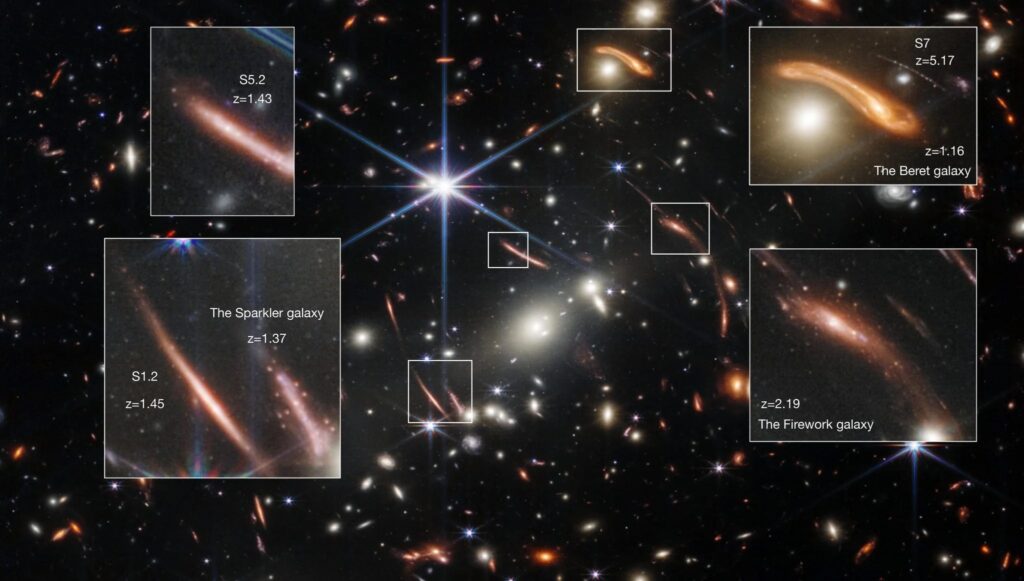
Conventional astronomers were expecting that this cosmic dawn would include young galaxies, still in the early stages of development, at extreme distances. These galaxies would be first generation, forming a few billion years after the Big Bang. The JWST found distant galaxies, alright – at distances of up to thirty-four billion light-years from Earth – but these galaxies appear mature and well-developed.
This finding has implications for creation cosmology as well as the Big Bang. Look-back time isn’t just an evolutionary concept. Rather, it’s a result of how incomprehensibly enormous the universe is.1 For creationists, the JWST observations seem to indicate that galaxies were fully formed and mature by the end of Creation Week. Thus, these mature galaxies at the extreme edges of the observed universe hold implications for various creation cosmological models.
Star-Forming Regions
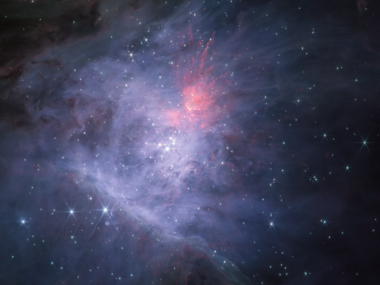
As mentioned before, the James Webb Space Telescope’s specialty is in infrared radiation. Any object can be opaque in certain wavelengths of light, but transparent in others. An interesting example is window glass, which is, of course, transparent to visible light (hence its use in windows). In infrared, however, window glass is opaque and very reflective. The infrared instruments on the JWST allow us to see through regions of nebulae that would be obscure to an optical telescope. This has given researchers better insight into star formation in regions such as the Orion Nebula.
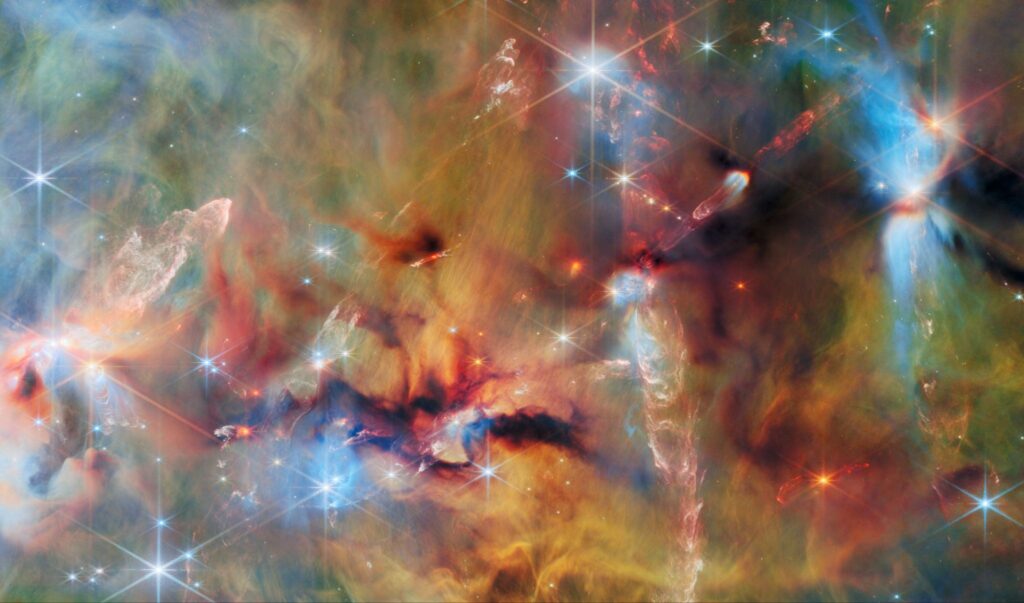
In a previous blog post, I wrote about star formation models and how they fit within a creationist perspective. This image, from a zoomed-in portion of the Orion Nebula, illustrates various stages of star formation. The red streaks seen in the image are jets from protostars – clouds of gas compressing under gravity. The bright blue objects are newly formed stars. The dark knots of gas are regions of compression where new protostars are being formed. These details are normally obscured by the dust and gas in the Orion Nebula, but are easily discerned with the JWST’s infrared instruments. The JWST is allowing us to better study the lifecycle of stars. In the process, we can better understand the physical laws that God established to govern the universe.
Exoplanet Research
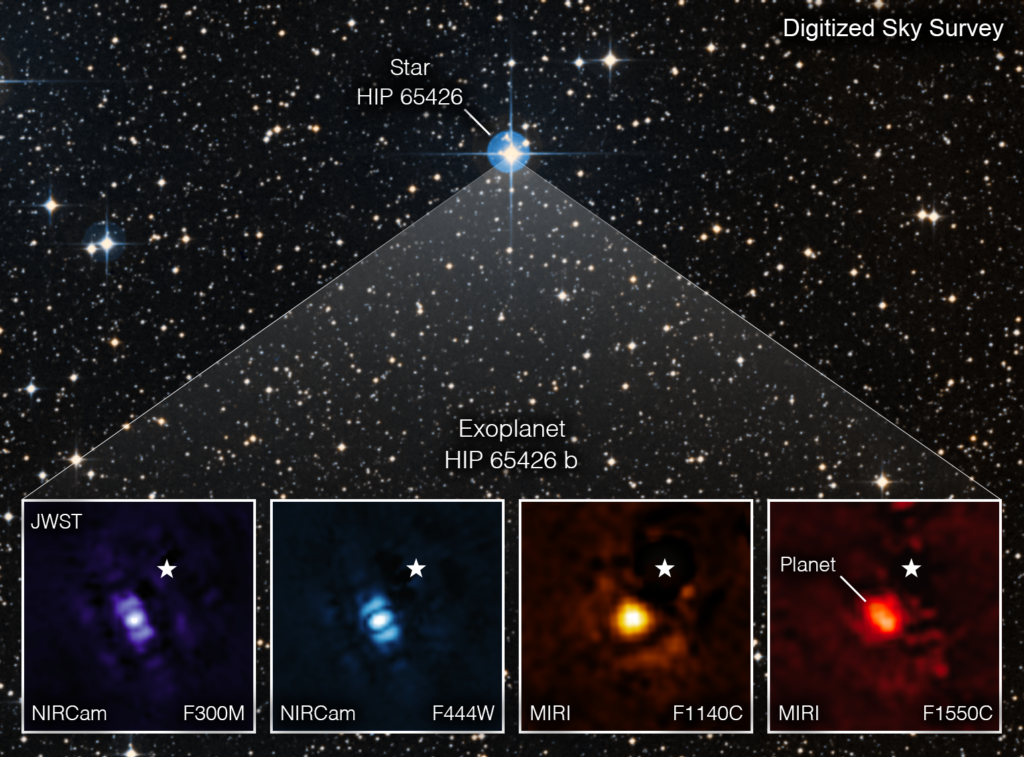
The James Webb Space Telescope has also turned its advanced infrared cameras to exoplanets. Exoplanets are planets orbiting stars other than our Sun. Many stars in our galaxy, as well as throughout the universe, have planets orbiting around them, forming planetary systems much like our own Solar System. The JWST has been studying the atmospheres of these planets using spectrometry.
Spectrometry is the study of the light spectrum; in this case, the spectrum of the light reflected from these exoplanetary atmospheres. We can study spectra by using a prism to break apart the constituents of a light beam. As we’ve discussed in a previous blog post, spectra from astronomical objects can contain either dark (absorption) or bright (emission) lines. These lines indicate the element composition (as well as the temperature) of the object in question. Through this study, the JWST has been able to give a much clearer picture of the presence and composition of exoplanet atmospheres.
In the process, we’ve found exoplanet atmospheres that are dramatically different from anything in our Solar System. One interesting example is WASP-121 b, an exoplanet orbiting a star in the southern constellation Puppis. This planet is a “hot Jupiter” – a gas giant that is so close to its host star that it’s locked in synchronous rotation. That means WASP-121 b only shows one side to its host star. The JWST discovered that the composition of WASP-121 b’s atmosphere varies dramatically between its day and night hemispheres, consistent with the atmospheric temperature differences between the two sides of the planet.
Incredible Beauty
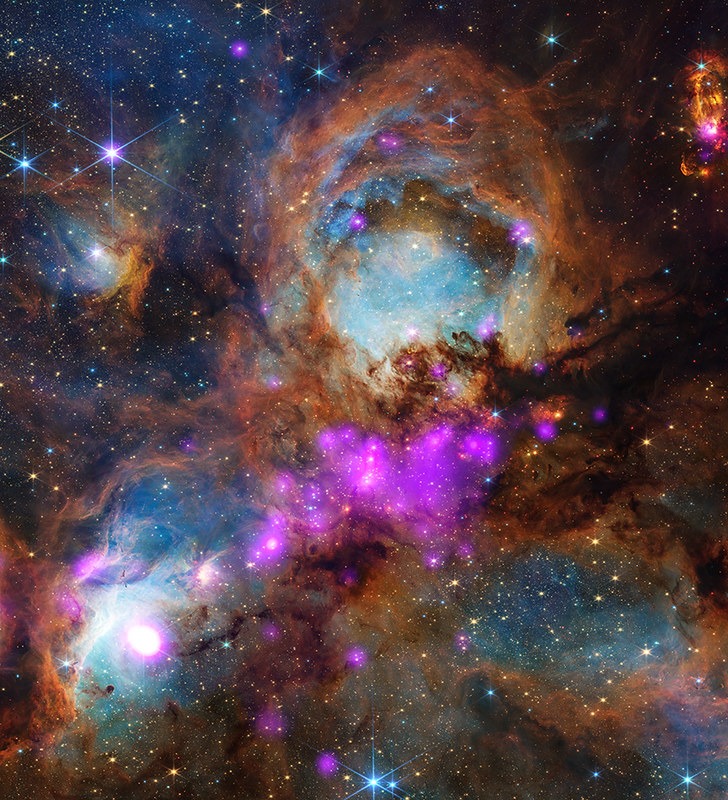
On top of all the exciting scientific breakthroughs, the James Webb Space has given us views of incredible, awe-inspiring beauty in the universe. God’s magnificent handiwork is evident by whatever means we choose to appreciate it. For the scientist, there is always something new, something mind-bending, something to upend our understanding and inspire new questions as it answers our current ones. For the artist, there is color and richness and structure and incredible vistas. No matter what your view of beauty is, you will find that beauty in the astronomical creation. And the James Webb Space Telescope has deepened our view of that beauty.
“The heavens are telling of the glory of God;
And the expanse is declaring the work of His hands.
Day to day pours forth speech,
And night to night reveals knowledge.”
(Psalm 19:1-2)
Footnotes
- There are some creationist cosmologies that assert that we are seeing the universe in real time, making the concept of “look-back time” unnecessary. You can read more about this in this blog post. ↩︎

 Todd Wood
 Ken Coulson


 Abigail L.
 Christian Ryan
