
 Hannah Klein
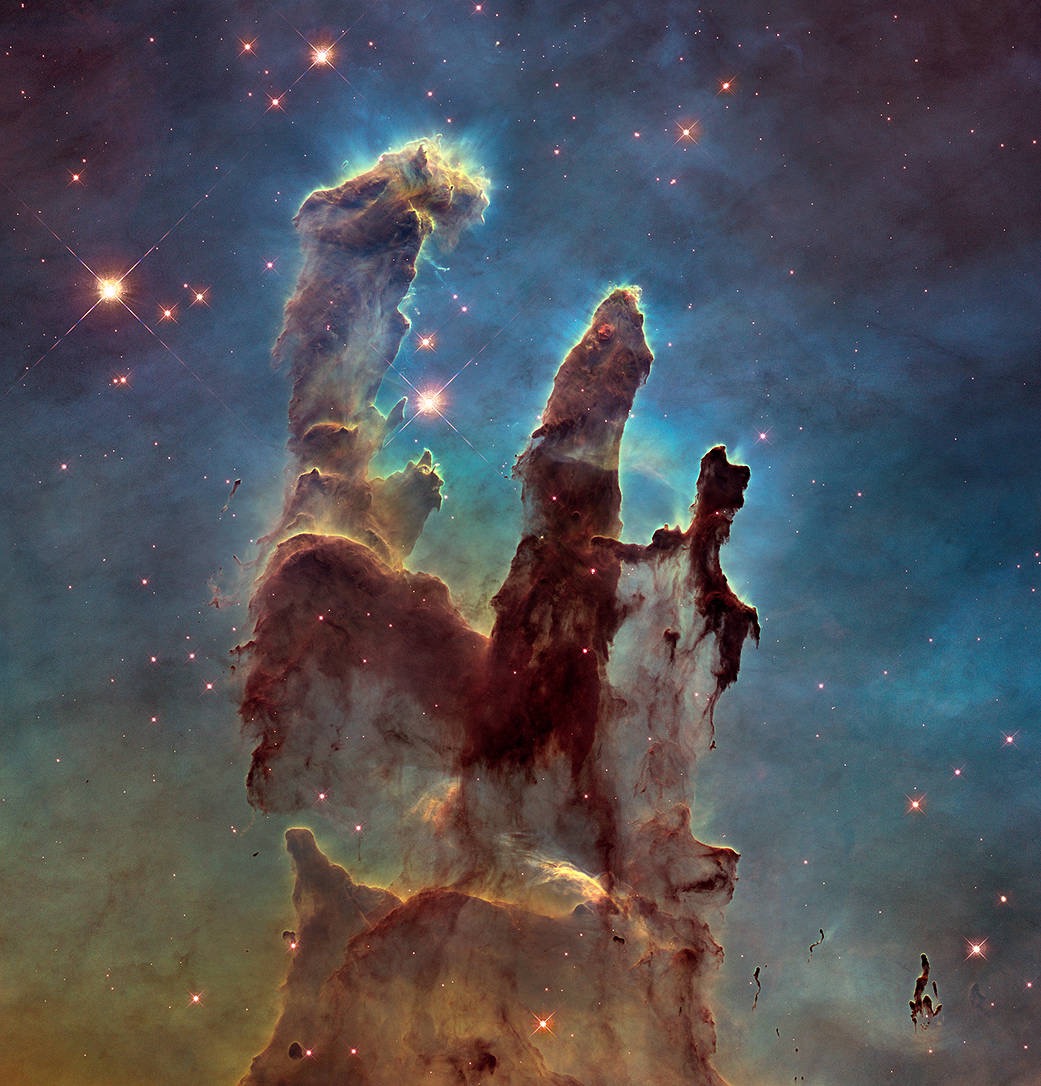
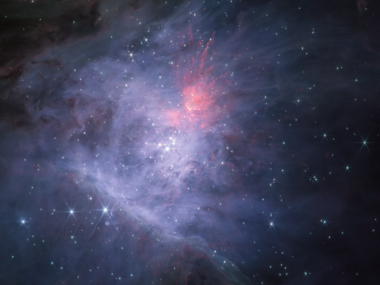
One of the most iconic images from the Hubble Space Telescope captures a frame from the Eagle Nebula, showing the Pillars of Creation towering four to five light-years high. Here, in the heart of an old star cluster, the Pillars host a stellar nursery, where new stars are forming. Or so the story is told.
But can stars form today? For that matter, did star formation ever happen to start with? While star formation is taken for granted in conventional astronomy, young-age creationists have differing opinions on this question. You’ll hear some creationist speakers say that stars aren’t capable of forming and that this confirms the Bible,1 while others entertain the possibility that star formation can fit within a creationist perspective.2
The views expressed in this article reflect those of the author, and not necessarily those of New Creation.
There are two angles we need to consider in this question. The first is, what does the Bible have to say about the possibility of stars forming today? Does star formation contradict a young-age interpretation of Genesis? The second angle is the scientific evidence. Is star formation scientifically possible? In creationism, we (rightly) start with what the Bible allows or doesn’t allow as far as theories of the universe’s origin. We then allow that to constrain what scientific models we accept. When it comes to stellar astronomy, creationists have historically argued that star formation does not fit within a Biblical framework. Thus, they are motivated to show that star formation is also not plausible scientifically.3 To begin this conversation, let’s consider what the Bible says, or does not say, about star formation and Creation Week.
Biblical Considerations
There isn’t time for star formation to occur
When we think about star formation, perhaps the first objection that comes to mind is: Don’t stars take billions of years to form? How can that possibly be occurring, if the Bible says the universe is less than ten thousand years old?
The first thing I want to say about this consideration is that it’s certainly on the right track. As Christians who try to interpret Scripture straightforwardly, we are convinced by Scripture that the universe has been in existence for around ten thousand years. So we are rightly wary of scientific models and theories that assume an ancient universe.
However, as young-age creationists, we believe that present processes and rates haven’t always been in effect. According to Scripture, there are at least two major eras in Earth history – Creation Week and Noah’s flood – where processes occurred that differ from our everyday experience. It’s possible that the evidence we see today of star formation processes is the result of processes that occurred on Day 4 of Creation Week.
In other words, we shouldn’t necessarily evaluate Creation Week using modern natural rates of process. In fact, Scripture gives us every reason to expect that.
Rates and Processes during Creation Week
We know that during Creation Week, physical processes were occurring that we don’t see today. For example, plants sprouted and grew to maturity from the ground within the course of the third day. The waters “brought forth” sea creatures on the fifth day. Dry land “appeared,” evidently as the result of massive geologic upheaval, within the 24-hour confines of the third day.4 And it’s quite possible that some complicated physics was operating to allow starlight from distant space to reach Earth by the end of the fourth day. It’s not outside the bounds of Scripture to suggest that star formation processes were also invoked by God, at accelerated rates, during Creation Week.
Keep in mind that this idea of accelerated processes is already being used in young-age creationist research. A good example is found in geology. The most comprehensive Flood model at this time is the Catastrophic Plate Tectonics model (CPT). CPT was created by creationist scientists. They were trying to understand the evidence for uniformitarian plate tectonics (UPT, for our purposes) within a creationist framework. Thus, the CPT model invokes many of the same processes as UPT, but at accelerated rates. As young-age creationists, we believe there have been times in the past when we would expect to see processes occurring that we don’t see today. Creation Week, and Day 4 specifically, is of course one of those times.
God finished His work on the seventh day
The previous consideration addresses stars being originally created with a process similar to conventional models of star formation. When it comes to star formation in the present day, there’s another consideration raised by young-earth creationists. If God finished His work on the seventh day, how could stars be forming now?
This comes from Genesis 2:2, which reads, “And on the seventh day God completed His work which He had done, and He rested on the seventh day from all His work which He had done.” The idea is that, since God finished his creative work by the seventh day, stars cannot be created after Creation Week.5
An important thing to keep in mind here is the idea of ex nihilo creation versus the continuous recycling and reforming of existing material in the universe. Let’s take another cue from geology. Think about mountains on the surface of the Earth. According to plate tectonic theory, mountains rise, are eroded down over time, and are replaced by new mountains. In a young-age creationist view, the mountains we see today have all been shaped during the Flood or by post-Flood processes. All the mountains that stood at the end of Creation Week are long since gone. For that matter, even dry land has been created after the Creation Week (for example, Surtsey Island in Iceland, which formed in the 1960s).6
The point being, when God created the Earth, He built into it a cyclical process by which mountains are formed, recycled, and reformed. It would not be outside Biblical constraints to suggest that He instituted a similar process for the stars as well.
Scientific Considerations
Isn’t star formation a naturalistic idea?
Sometimes young-age creationists find it uncomfortable to entertain scientific theories that have been originally proposed by naturalistic scientists. After all, if scientists who don’t believe in God propose a theory, then isn’t it just a way to rule God out of science? But we have to use discernment here. As I’ve just demonstrated, the idea of stars forming is not incompatible with Scripture. So we can’t just rule out the idea because naturalistic scientists originally proposed it. We have to consider the idea on its own scientific merits.
If that feels uncomfortable, consider CPT again. Remember, the original theory of plate tectonics was developed primarily by naturalistic geologists within the framework of deep time. But the philosophical mindset of the scientists who originally proposed the theory doesn’t change the data upon which they built the theory. In the same vein, we can evaluate the conventional models of star formation and evolution objectively. We do this by looking at the data behind those theories on their own merit.
When we do that, we find that the story of a star’s formation (and its subsequent evolution, or change over time) is built on a foundation of astrophysics, not just ideology.
Stars can’t form naturalistically
Creationists often use quotes from astronomers expressing the limits of their models in explaining the formation of the first stars.7 In addition, we often discuss how the current best theories for star formation necessitate already-existing stars. If star formation theories depend on stars already existing, doesn’t that rule them out from the start?
No, actually. Here’s the thing: explaining the formation of the very first stars is quite different from explaining how stars may form today.
Let’s go back to our example of CPT again. In the conventional model of plate tectonics, theory matches evidence pretty well in our present world. But the origin of plate tectonic motion is a mystery to uniformitarian geologists. As creationists, we don’t disregard the entirety of plate tectonic theory because of that fact. Instead, we recognize that there was a supernatural institution of plate tectonic motion which set in motion the processes we observe and study today. (This was perhaps associated with Creation Week or else with the beginning of the Flood.)
Similarly, we’d expect that the first generation of stars came into existence supernaturally, by means of mechanisms that science will never be able to fully elucidate. However, this doesn’t preclude the possibility of stars forming after Creation Week, through processes involving previously existing stars.
How Do You Make A Star?
With that said, what are the physical processes by which stars could potentially form? The defining characteristic of a star is thermonuclear fusion. Stars are primarily composed of hydrogen and helium gases, which, conveniently, also make up much of the interstellar medium (the space between the stars). Thus, a gas cloud in space has a very similar composition to a star, just with vast differences in pressure and temperature.
To make a star, then, one needs to compress a gas cloud such that it attains the necessary pressure and temperature for thermonuclear fusion to begin. The tricky part about this is that gas pressure usually overrides gravitational collapse. As a gas cloud compresses, it heats up, and thus its pressure increases; this fights against further gravitational collapse.
However, there is more nuance to this situation. Mathematically, it can be demonstrated that there is a certain threshold in terms of mass that, if exceeded sufficiently, will lead to the gravitational collapse of a gas cloud. This threshold, called the Jeans criterion, depends on the temperature and density of the gas cloud. Certain regions of the interstellar medium have higher density than others, which is why you’ll hear astronomers label certain areas as “stellar nurseries.”
The Beginning Of A Star
Now this is where the aforementioned previously existing stars come into play. Shockwaves from supernovae can result in an increase of density sufficient to cause instability in an already dense gas cloud. This can begin the process of gravitational collapse.
Another way to begin collapse of a gas cloud involves radiational cooling through dust particles. Dust particles (basically, larger molecules – silicates, ices, sometimes metals) radiate heat and cool faster than the surrounding gas molecules. The cooler dust particles then absorb heat from the surrounding gas, cooling the overall temperature of the gas cloud, which allows it to reach the Jeans criterion. These dust particles themselves arise from supernova explosions, which is why this model also depends on previously existing stars.
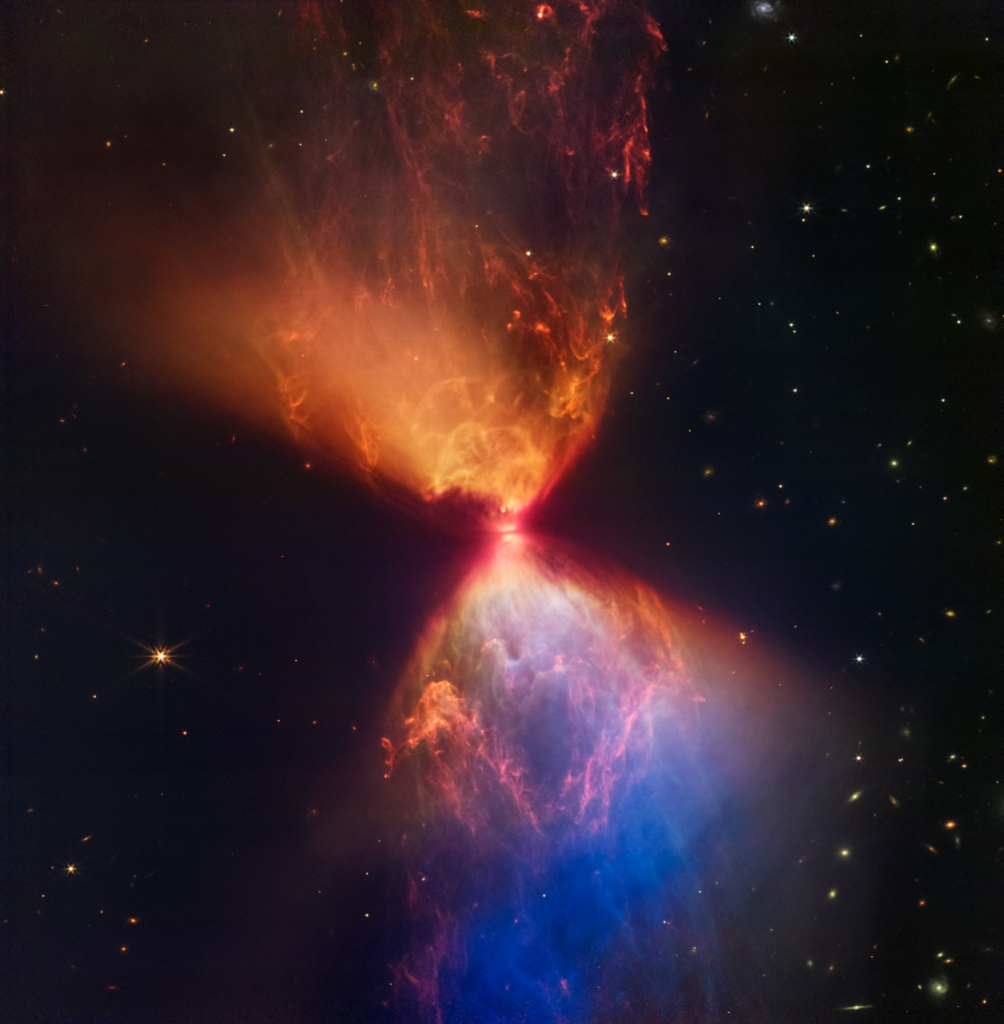
Once the gas cloud begins to collapse under its own gravity, it becomes denser and hotter. We call this collapsing gas cloud a protostar. Due to the conservation of angular momentum, the protostar also begins to spin more and more rapidly as it collapses. The transition from protostar to star occurs when the source of energy transitions from gravitational collapse to nuclear fusion. At this point, we say a star has been “born.”
The physics of all of this is far more complicated than this treatment will allow. For a much deeper dive into the mechanics of star formation theory, I refer you to Dr. Danny Faulkner’s review of star formation in the Answer Research Journal.8
What Time Frame Are We Talking About?
What’s the time frame for this entire process? The entire process, from the beginning of the protostar to the final, mature star, takes a few million years. On the surface, this doesn’t fit nicely within the young age creationist perspective. A few things, however, can be said to add clarity here.
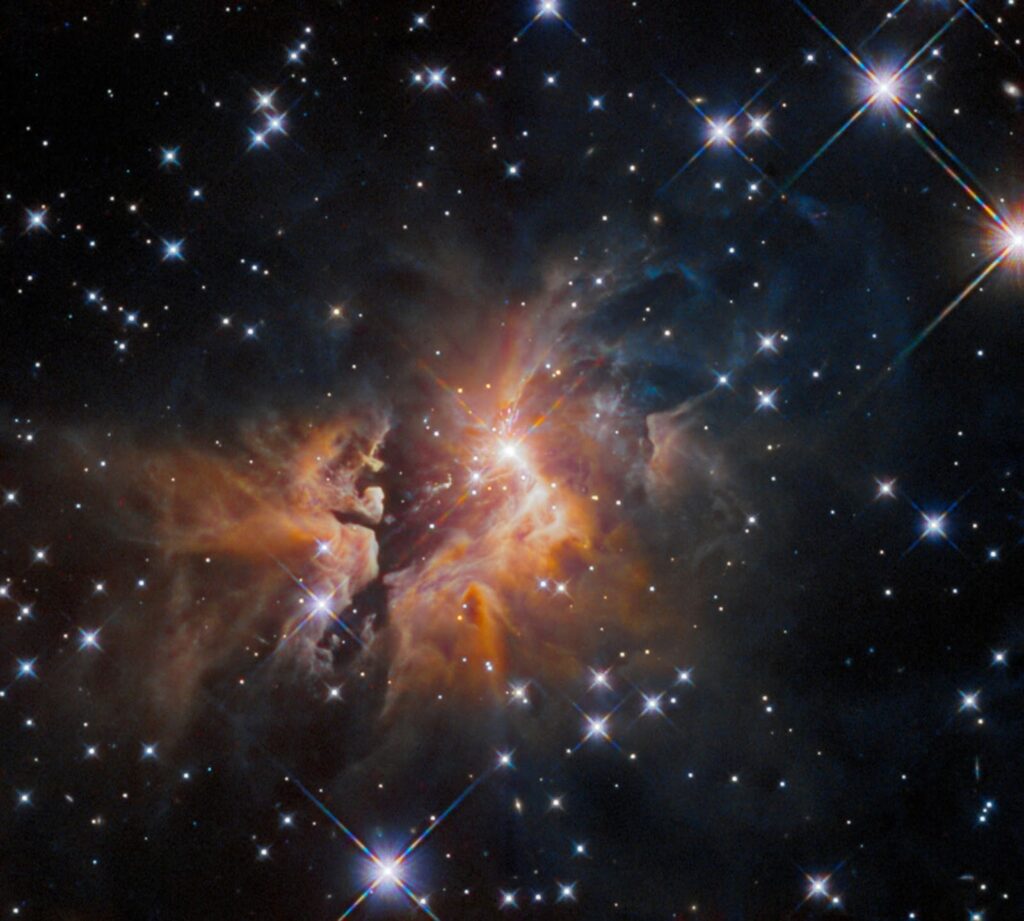
First, remember that we’ve never seen (and no astronomer claims that we’ve seen) a gas cloud condense into a protostar and then mature into a fully fledged star. What we do see are snapshots of this process, at different stages, in various stellar objects scattered around the universe. Sometimes astronomers say they’ve found a stellar nursery, where new stars are being born. What they mean is that they’ve discovered a place where the temperature and density of the interstellar medium is conducive to forming stars, or perhaps they’ve found objects that they’ve identified as protostars. The point being, yes, star formation processes take a long time, longer than we could ever hope to observe.
Second, recall what we said about rates and processes being different during Creation Week. It’s possible that God used processes similar to those we observe today, but at accelerated rates, to form the stars during Day 4. After all, when we look at the universe, we don’t see all objects having the same apparent age, as though they were all created at the same time. Rather, we see objects that look like they’ve been through varying amounts of astrophysical history.
Creation Week And Beyond
Perhaps God used supernatural means to create the first generation of stars, and then allowed them to mature and facilitate the formation of new generations of stars, at extremely accelerated rates, all during Day 4 of Creation Week. Then, when He ended His creative work, the universe was left much like we see it today – mature, with stars and other celestial objects at various ages, allowing us to see what the physical processes behind stars look like.
So, Are Stars Forming Today?
Hopefully this overview has demonstrated that the physics of star formation models are reasonably well-attested. More importantly, Scripture does not rule out the concept of star formation in theory. Therefore, it can plausibly fit into models of creationist astronomy. It’s quite possible that continued study of the history of stars, their formation, and their development will open windows into understanding what happened on Day 4. And this will help creationist astronomers build a comprehensive model of creation astronomy.
References
- Thomas, Brian. 2015. “Do Stars Still Form Today?” Acts & Facts 44, no. 5 (June): 15. ↩︎
- Faulkner, Danny R. 2014. “Are Stars Still Forming Today?” Answers 9, no. 2 (April/June): 48–49. ↩︎
- Mulfinger, George. 1970. “Critique of Stellar Evolution.” Creation Research Society Quarterly 7, no. 1 (June): 7–24. ↩︎
- Snelling, Andrew. 2009. Earth’s Catastrophic Past. Green Forest, AR: Master Books. 94. ↩︎
- Mulfinger, George. 1970. “Critique of Stellar Evolution.” Creation Research Society Quarterly 7, no. 1 (June): 7–24. ↩︎
- The Surtsey Research Society. 2025. “Surtsey Eruption 1963-1967.”
https://english.surtsey.is/surtseyjareldar-2/ ↩︎ - Bernitt, Rod. 2002. “Stellar Evolution and the problem of the ‘first’ stars.” Journal of Creation 16(1):12–14, April 2002. ↩︎
- Faulkner, Danny R. 2021. A Review of Stellar Formation Theory. Answers Research Journal, 14, 417–426. ↩︎

 Todd Wood
 Ken Coulson

 Abigail L.
 Christian Ryan

If you invoking the supernatural to explain CPT or star formation or anything, you are, by definition, no longer in the realm of science.
Wrong. you are. Science is about accuracy in investigation in nature. Its an option for God thus great power to be at work. Dism,issing God etc before the investigation is opposed to scientific investigation. Science must not be interfered with wherever the truth is.
Excellent summery of the issue and well said. The bible seems to imply stars no longer are formed. There is a verse somewhere that says he named all the stars. indeed no time to test if they are forming. So called ne stars might be damaged stars just fading away. There is a light time issue. I suspect nom stars are formed as they are created by God on ncreation week and no ability to create themselves. So NO. Stars have no appeared since creation week. Hmmm. possible within creationist modsd. Hmmm. maybe. Anyways the ideas of lightspeed already nullify the competence of non biblical astronomers.