
 Dave
DaveFor decades, some evolutionary scientists have used dendrochronology to discredit the biblical account of human origins. The majority of creationist scientists, on the other hand, have been very critical of this discipline. Over the past two years, I have presented my work on biblical chronology using dendrochronology. In this article, I would like to explain this science as clearly as possible, while presenting the current state of knowledge.
The views expressed in this article reflect those of the author, and not necessarily those of New Creation.
A Method for Dating to Within a Year
Dendrochronology is a scientific method developed in the early 20th century by an American astronomer named A.E. Douglass. It allows certain wooden objects to be dated with exceptional accuracy.
Depending on climatic conditions, trees of the same species and from the same region tend to grow in a similar way. When the climate is favorable, trees produce wide growth rings, while in an unfavorable climate, the rings are narrower.
By analyzing these rings of varying sizes, it is possible to link trees that lived at the same time. The dendrochronologist’s work consists first of taking wood samples from a given region, then establishing reference curves. By collecting samples from trees that grew at different times, he can, in a sense, reconstruct the climatic and chronological history of these trees (fig. 1).
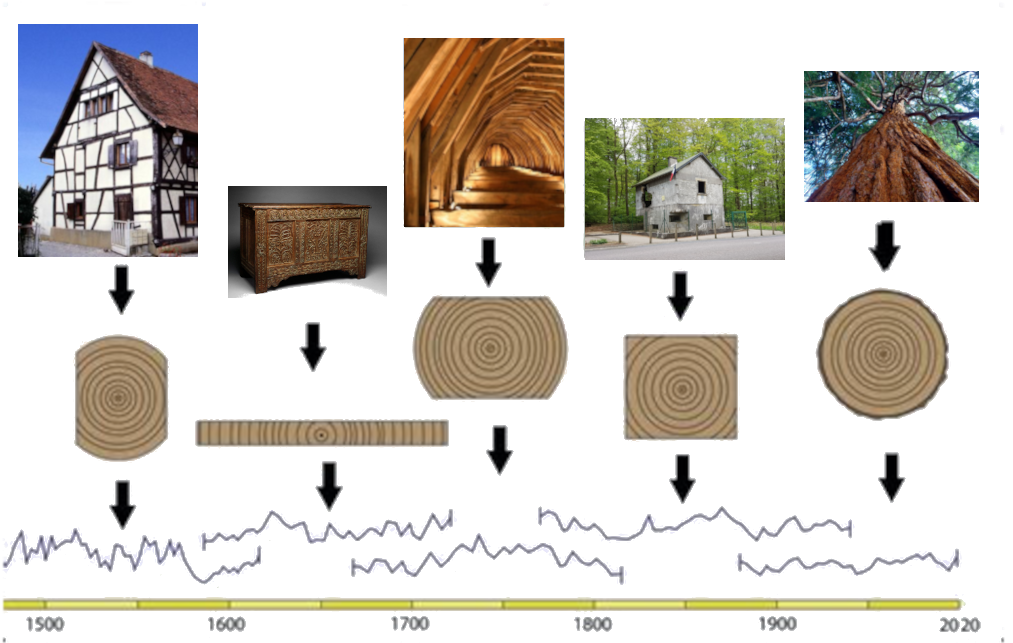
Dendrochronology can be used to date all kinds of wooden objects: roof frames, musical instruments, works of art, boats, and even piles from prehistoric villages.1,2
If the sample still has its bark, it is even possible to determine the exact year the tree was felled.
However, the method also has its limitations, as it cannot accurately date samples from trees whose species have not been studied previously.
To date, 17 major dendrochronology studies covering several millennia have been published worldwide:3
- 11 are based on dry wood from high altitudes,
- 6 on wood preserved in wet environments (peat bogs, gravel pits, lake beds).
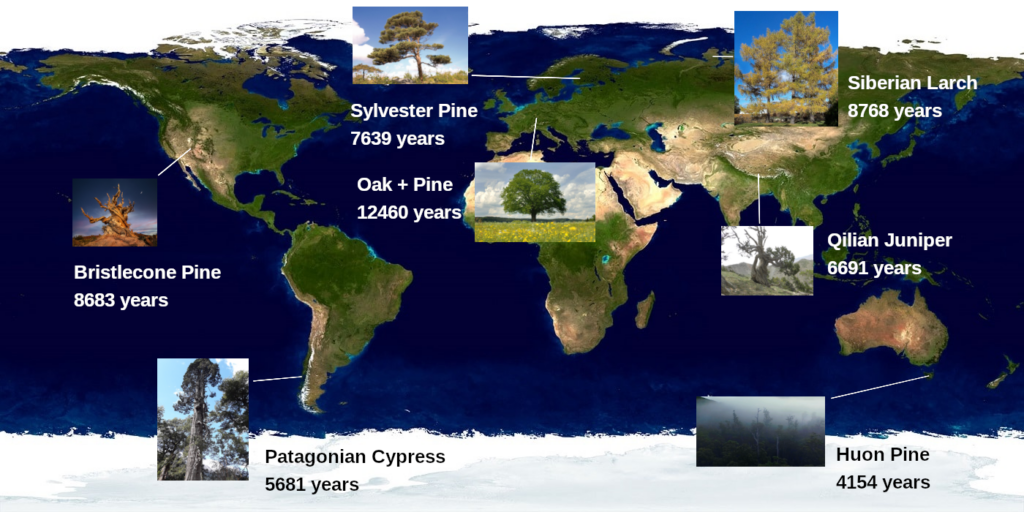
The longest dendrochronology in the world spans 12,460 years. It was established using oak and pine wood from river deposits collected in gravel pits across Germany.4
The longest dendrochronology in the southern hemisphere is the Patagonian cypress chronology in Chile, which dates back more than 5,680 years. The oldest samples have been preserved in volcanic ash.5
Dendrochronology and Carbon-14 Dating
Dendrochronology and radiocarbon (14C) dating are closely related. Carbon-14, a radioactive isotope produced in the upper atmosphere by cosmic rays, is absorbed by plants and then by the animals that consume them. When an organism dies, the amount of 14C it contains gradually decreases. By measuring this decrease, it is possible to estimate the age of a sample.
However, the atmospheric concentration of carbon-14 is not constant: it varies from year to year. To correct for these variations, researchers rely on dendrochronology, as the age of tree growth rings is precisely known. This calibration has significantly improved the accuracy of archaeological dating.
However, the fact that dendrochronology is a very reliable dating method does not guarantee that all carbon-14 dating is automatically accurate.
The Miyake Events
The Miyake events correspond to violent cosmic storms that caused a sharp increase in carbon-14, an increase that can be seen today in tree growth rings. They were first identified in 2012 by Japanese researcher Fusa Miyake.6
Five events have been identified: those of 7176, 5259, and 660 BC, as well as those of 774 and 993 AD. Their simultaneous detection in dendrochronological series from various regions of the world reinforces the reliability of the method and shows that different laboratories have arrived at the same results without error.
Millimeter-Accurate Dating for Human History
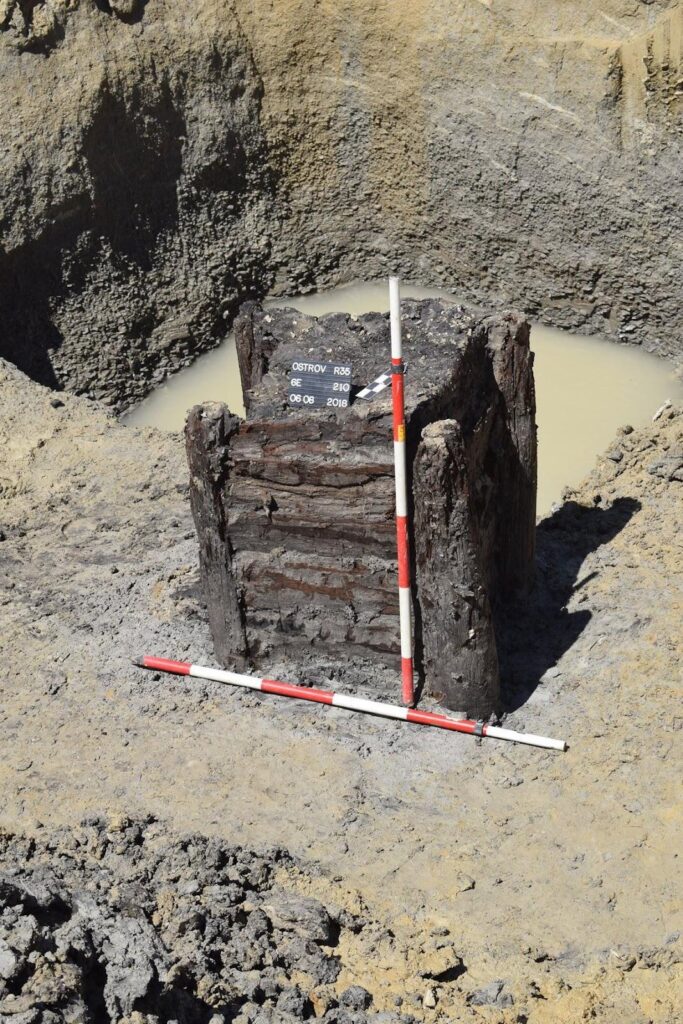
Some of these dendrochronologies have made it possible to date numerous pieces of wood that have been shaped by humans. Archaeologists use this science whenever possible to accurately date ancient civilizations. Prehistoric pile-dwelling settlements around the Alpine crescent provide a good example.7 In 2018, the remains of an oak well discovered in the Czech Republic (fig. 3)—dated to 5256 BC—revealed the carpentry skills of Neolithic societies. It is the oldest known wooden structure so far, dated solely by dendrochronology.8
The Miyake event of 5259 BC made it possible to establish a “floating” chronology and accurately date a Neolithic house built in 5320 BC on the shores of Lake Kastoria in Greece. To date, it is the oldest wooden structure to have been absolutely dated.9
The Debate with Young-Age Creationists
Most young Earth creationists question the reliability of this discipline because it contradicts their interpretation of the biblical account, according to which the Earth is approximately 6,000 years old.
To support their argument, they cite anomalies such as the formation of multiple growth rings in a single year.
However, these phenomena are well known: they are identified and corrected by correlating tree series with each other. Their frequency depends on many factors that are now better understood, such as tree species and age, climatic conditions, geographical location, etc.10
An analogy with genetics helps to clarify this point: it has only been possible to sequence the DNA of ancient human remains for a few decades. This process can be disrupted by the unintentional contamination of the sample with the laboratory technician’s DNA. This is a well-known phenomenon, and laboratories have protocols in place to prevent or correct it. It would therefore be absurd to conclude that genetics is unreliable simply because such contamination exists.
Similarly, rejecting dendrochronology on the basis of double growth rings is not a serious scientific approach.
Conclusion
The data presented here show that dendrochronology is a robust method capable of providing accurate and consistent chronological markers across the globe. For believers committed to the authority of Scripture, these results should not be seen as challenging the faith, but as an invitation to deepen our understanding of the history of creation.
It is possible that certain phenomena related to ancient climate or the flood—whether global or regional—may have profoundly influenced tree growth and preservation. It is also possible that our reading of certain biblical passages or genealogies needs to be refined. In any case, the study of creation and the study of God’s Word are not opposed: both come from the same Author.
The goal, therefore, is not to choose between science and the Bible, but to let each field inspire us to seek the truth with humility. Dendrochronology, properly understood, can be a useful tool for better understanding how God has acted in the history of the world, without ever diminishing the significance of the biblical account.
Footnotes
- (Hafner et Suter, 2000) Die Entwicklung der Bauerngesellschaften im 4. Jahrtausend v.Chr. am Bielersee aufgrund der Rettungsgrabungen von Nidau und Sutz-Lattrigen. ↩︎
- (Viellet, 2009) Apport des études dendrochronologiques à la connaissance des sites lacustres néolithiques de Chalain et Clairvaux (Jura). ↩︎
- (Bebchuk et al, 2023) Sudden disappearance of yew (Taxus baccata) woodlands from eastern England coincides with a possible climate event around 4.2 ka ago. ↩︎
- (Friedrich et al., 2004) The 12,460-year Hohenheim oak and pine tree-ring chronology from Central Europe; A unique annual record for radiocarbon calibration and paleoenvironment reconstructions. ↩︎
- (Lara et al, 2020) A 5680-year tree-ring temperature record for southern South America. ↩︎
- (Miyake et al., 2012) A signature of cosmic-ray increase in AD 774–775 from tree rings in Japan. ↩︎
- (Billamboz, A., 2014) Regional patterns of settlement and woodland developments: dendroarchaeology in the Neolithic pile-dwellings on Lake Constance (Germany). ↩︎
- (Rybníček et al., 2018) World’s oldest dendrochronologically dated archaeological wood construction. ↩︎
- (Maczkowski et al., 2024) Absolute dating of the European Neolithic using the 5259 BC rapid 14C excursion. ↩︎
- (Battipaglia et al., 2023) Intra-annual density fluctuations in tree rings are proxies of air temperature across Europe. ↩︎


 Christian Ryan
 Noel Grimes
 Paul Garner
 Todd Wood

 Abigail Van Huss
 Peter
Peter

Interesting. I am an adamant Young Earth Creationist but I find these facts about Dendrochronology challenging. If “our reading of certain biblical passages or genealogies needs to be refined”, then our Young Earth view is incorrect because we can’t “refine” the timeline to accommodate over 12’000 years and stay true to the Word. Could it be possible that God created trees with millennia worth of rings already installed on the day of their creation? I’m struggling to understand why He’d do that?
It’s a really good comment, right now, I think that the time of the creation is not the time of the fall. Bless you.
I think most would be ok with that. But isn’t the real problem the Flood?
Hello David,
Thank you for your comment. I agree with David Pierron that the trees used in these long chronologies would have grown long after Creation Week, in the post-Flood world. And even with all of the dendrochronology data discussed in the article, we can still be confident that the age of the Earth is far closer to thousands of years than billions of years.
You are also right to notice that the data presented here is not obviously compatible with the most common young-earth timeline at first glance. But that doesn’t mean that the Bible is wrong or that young-age creationism is doomed. It means there are questions that still require research.
David Pierron mentions in the article that our reading of certain biblical passages or genealogies may need to be “refined.” I want to be clear what is meant by that: refining does not mean abandoning the young-earth framework. It means being more careful and precise about how biblical chronological details are interpreted (including the possibility of genealogical gaps or other interpretive factors). Historically, even within young-age creationist scholarship, there has been discussion about whether the Earth could be somewhat older than the popular 6,000-7,000-year figure. Some have proposed ranges closer to 10,000-20,000 years (for example, this topic is discussed by the authors Henry Morris and John Whitcomb in The Genesis Flood). So even if the mainstream dendrochronology conclusions are correct, that does not mean young-age creationism itself is incorrect.
Beyond that, there are several important areas where further creationist research could be fruitful. Robert M. Porter (2020) recently published an article on dendrochronology with the following suggested avenues for research:
1) Verification of the time increments represented by growth rings (i.e., whether rings are always strictly annual under unusual post-Flood conditions)
2) More robust models of global and local carbon-14 fluxes in the early post-Flood period (since changing carbon dynamics could artificially make samples appear older than they actually are)
3) A more complete understanding of carbon-14 contamination and calibration issues, especially in long-lived species.
4) Biogeographic history of tree species, since post-Flood migration and ecology may impact dendrochronology assumptions and calibration curves.
Porter, Robert M. “Dendrochronology: A Brief Introduction to the Problems and Opportunities of Tree-Ring Dating.” Journal of the Biblical Creation Trust 2 (2020): 9–15.
Thank you for acknowledging that dendrochronology is not a trivial anomaly, but poses a serious challenge to the young-age timeline. Porter himself does not claim that dendrochronology is s pseudo-science, fraudulent, or assumption-ridden in the way some commentators often do. He implicitly accepts the method and struggles with its implications.
My next question would be, is there any failure condition for the young-age timeline, a point after which it would be considered falsified? If dendrochronology can never count too many years (which, incidentally, do not rely on radiocarbon dating at all), if geological continuity can never be decisive, and if Biblical chronology can always be “refined” without limit, what we get is a moving boundary, a universal escape hatch by which everything can be endlessly redefined to remain unfalsifiable.
In the mean time, once you allow tens of thousands of post-Creation years, a Flood with no consistent stratigraphic boundary, trees whose growth histories show no global catastrophe signal, and an unspecified extension for the Flood year, then what remains of YEC becomes harder to distinguish from old-age creationism with a symbolic Flood.
If I remember correctly, Russ Humphreys calculated how much time could reasonably be inserted into the biblical genealogies by allowing for gaps, and concluded that the upper limit would be around 30,000 years. Hence, any dendrochronology result beyond that would be a falsification of YEC.
I’m glad to hear the claim that the YEC timeline is falsifiable!
It’s true that no tree-ring chronology currently runs to 30,000 years uninterrupted. But several non-tree systems that record time year-by-year extend well past that range, and they do so using multiple independent seasonal signals, not just one line of inference.
For example, Lake Suigetsu in Japan preserves finely layered sediments that go back about 70,000 years. These layers are annual because several seasonal markers repeat together each year (changes in sediment type, organic material, and microfossils). Similarly, ice cores show annual layers extending back roughly 120,000 years in Greenland and 800,000 years in Antarctica. These layers are identified as annual using overlapping seasonal signals like isotopes, dust, chemistry, and conductivity.
You don’t have to assume one clock is perfect. The strength is that many clocks agree: independent natural systems, governed by different physical processes, record the same events at the same relative times. That agreement is discovered and tested, not assumed in advance.
One particularly useful check across all these systems is the Laschamps geomagnetic excursion from around 42,000 years ago. During this event, Earth’s magnetic field weakened dramatically, letting in more cosmic rays. That produced huge spikes in cosmogenic signals (like carbon-14, beryllium-10, and chlorine-36) that show up independently in ice cores, lake sediments, marine deposits, and volcanic flows.
Interestingly, this brings us back to trees. The Laschamps signal has been identified in sub-fossil kauri trees from New Zealand. These trees (preserved in swamps) are not anchored to a global dendrochronology (too many missing trees to connect to the present), but they still record that same global event seen in ice, lakes, sediments, and volcanic ash.
So if something like 30,000 years is proposed as a real upper limit, the challenge isn’t just dendrochronology. It’s that multiple, independent, annually resolved records (trees, lake varves, ice cores, etc.) already extend beyond that range and converge on the same events. That kind of convergence is exactly what people usually mean when they talk about evidence being allowed to test (and possibly falsify) a model.
Has the author considered Woodmorappe (2018)?
https://cedarville.tind.io/record/21140?v=pdf
This seems to leave the door wide open.
“Woodmorappe has used computer simulations to demonstrate that it is fairly easy to construct, by cross-dating similar-looking ring patterns in different trees, extended tree ring chronologies that look very convincing, even from a statistical point of view—even though these extended chronologies are spurious”
I think it’s important to question the method, but in my opinion, it’s a dating method that is used and confirmed by dating houses that were built 500 years ago, which we know for a fact were built 500 years ago. So if the method works for the last 500 years, it should theoretically work for longer periods if we have enough trees covering all those years.
As the years go by, laboratories collect more trees and confirm or refute previous results. What is interesting is that, with the events in Miyake, laboratories around the world have arrived at the same conclusion.
Because of this, I am fairly confident that the oldest trees dated using absolute methods began to germinate in 7176 BC, because of miyake event as explain in the article. I have no reason to doubt the rest of the older dendrochronological dates, but I can admit that since they depend on only a few laboratories, it is prudent to take a cautious stance.