
 Christian Ryan
Dinosaurs are by far one of the most fascinating groups of animals to have ever graced the Earth with their presence. As our study of them continues, we learn more and more about what they looked like, how they lived, and why they died. Most people love dinosaurs, as they have spawned an entire sub-culture of movies, books, TV shows, merchandise, and apparel. But could it be that these enigmatic creatures never actually existed at all? As strange a claim as this sounds, there is a group of conspiracy theorists on the internet making this very assertion!
Have we all been duped by the media and evolutionary scientists to buy into a conspiracy more airtight than even the moon landing? Is there a mass conspiracy involving scientists from multiple, conflicting, sometimes-warring countries to fool people that dinosaur fossils are actually being discovered?
Spoiler alert: No.
The views expressed in this article reflect those of the author and not necessarily those of the New Creation blog.
Welcome to another long-awaited article in our Fossil Whoops series, where we address common misconceptions about fossils and explain why they do not hold up. We also aim to provide a more accurate, Genesis-friendly understanding of the subject. Last time, we covered an unusual fossil creature believed by some to be a “Jurassic beaver.” This Fossil Whoops focuses on a moderately widespread misconception that dinosaurs did not really exist, but are a conspiracy developed to trick people into believing in deep time and common ancestry.
Be prepared for what is perhaps one of the strangest articles we have ever featured at New Creation.
An Exposé on Big Dinosaur?
“Dinosaurs? That seems pretty fake and gay…There was no concept of a dinosaur until 1850. That’s very recent, right? That’s the first time they were like, ‘We actually think that there were these reptiles that are roaming the planet.’ And then within that same decade they were like ‘Dinosaur bones!’ And they started finding them everywhere. I’m like, ‘Okay, so nobody found this and then like suddenly there’s entire museums?’ And in China they have actually been caught manufacturing dinosaur bones many times over. And it is the case that dinosaur bones for whatever reason are always just found by the paleontologist. Like it’s not like you and me walking outside and like, ‘Hey a dinosaur bone!’ Or by somebody who’s related to a paleontologist. It’s very strange.”
– Candace Owens, 20241
Likely, most of our audience at New Creation does not question the existence of dinosaurs. As such, you might be wondering why we would even cover such a topic. Surely no one actually believes dinosaurs never existed. Alas, while thankfully not as widespread as flat earth ideology, this belief tends to crop up in social media.2,3,4 Dinosaur denialism is not an organized movement, but it does hold some rather prominent members.

The origin of dinosaur denialism is hazy, but the earliest reference to it that we could find stems from professing Christian David Wozney and an essay he wrote in 1997 entitled Dinosaurs: Science or Science Fiction.5 This idea seems to have become more widespread after it was picked up in 2014 by Eric Dubay, a yoga teacher and conspiracy theorist living in Thailand most famous for his promotion of flat earth ideology.6 Since then, it has propagated across the internet and even has been picked up by several prominent figures. Candace Owens, a conservative political commentator with one of the biggest active podcasts in the world, has called dinosaurs “fake and gay” on numerous occasions.7
A few responses exist on the internet, but most of them are from old-age, common ancestry-affirming sources. There are few (if any?) from a young-age creationist perspective. Arguably the only comprehensive response to dinosaur denialism can be found on Rational Wiki, which is staunchly anti-creationist.8 So we at New Creation sought to provide a young-age affirming resource responding to such claims.
Misconception #1: Dinosaurs Were Invented to Prove Evolution Is True
In a recent interview, Candace Owens claimed that dinosaurs are part of an even larger “Christ conspiracy.”9 Accordingly, dinosaurs are just one of the tools used to steer people away from believing in the Bible and into accepting the idea that all life evolved from a common ancestor that lived billions of years ago. As evidence, they remind us that the word “dinosaur” was coined in 1841 which, they claim, coincidentally was the heyday of the theory of common ancestry via evolution.
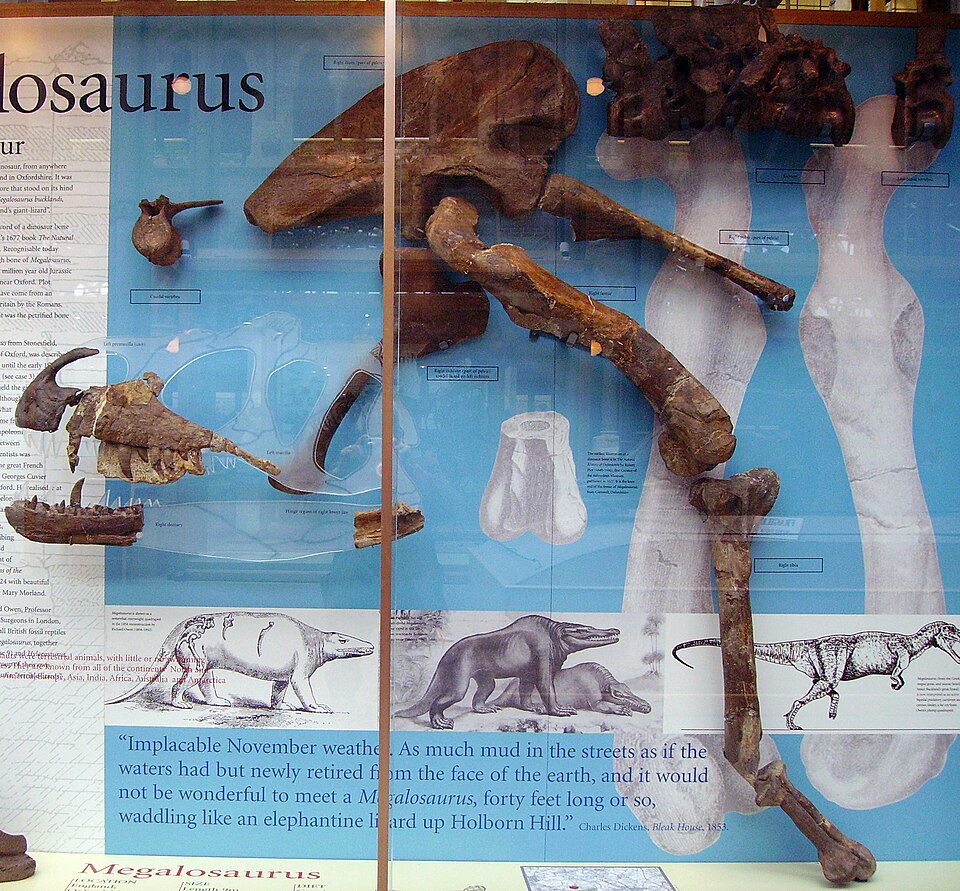
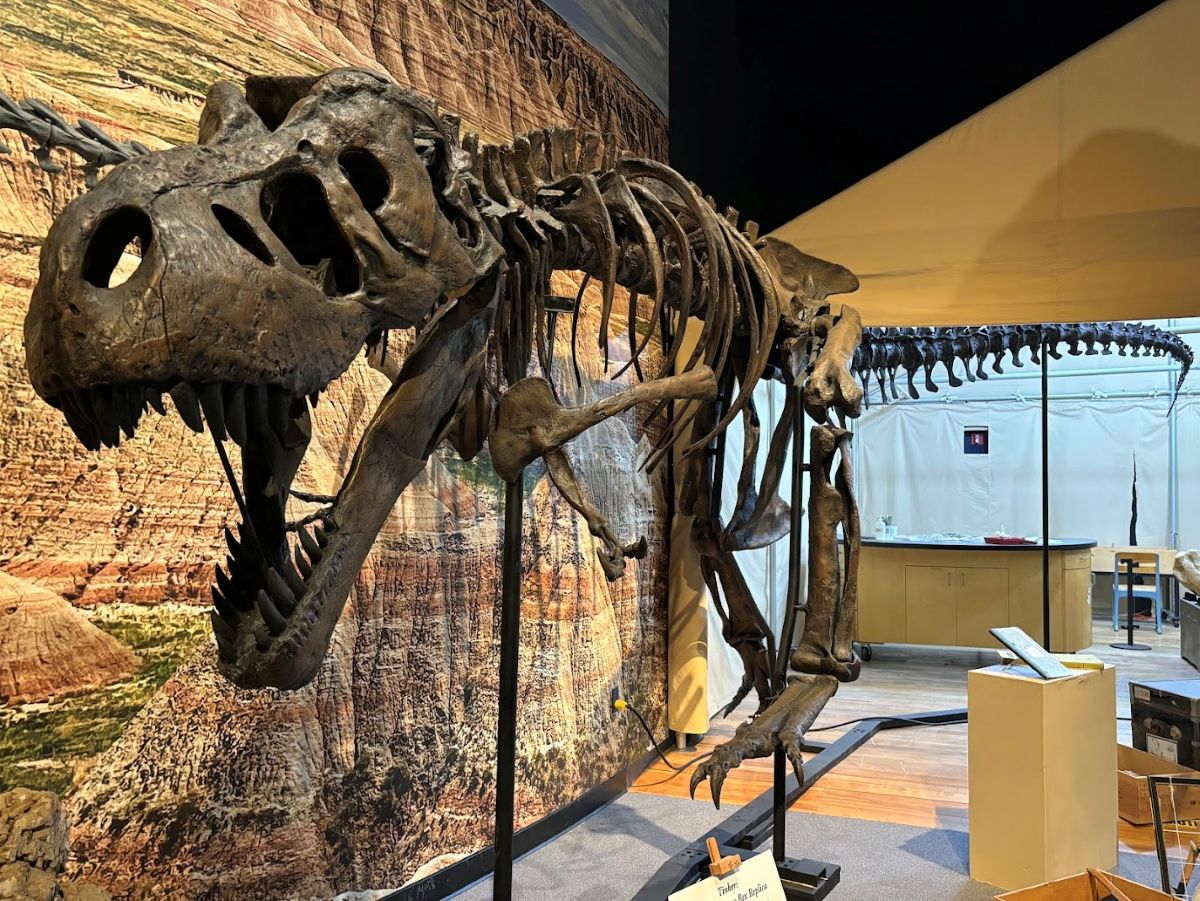
This could not be any further from the truth. First, 1841 is indeed the year when the word “dinosaur” was coined by Sir Richard Owen, but he used it to describe a group of animals already known to science from fossils. Megalosaurus was described and named in 1824. This was soon followed by the discovery and description of Iguanodon in 1825 and Hylaosaurus in 1833. Owen decided that these three species ought to be classified together based on the presence of certain skeletal characteristics they shared with no other animals.
Meanwhile, the theory of common ancestry was not popularized until Robert Chalmers’ 1844 work Vestiges of the Natural History of Creation, and even then the idea was very controversial among scientists. It was not until On the Origin of Species by Charles Darwin was published in 1859 that common ancestry became widely accepted by the scientific community. In fact, Darwin uses dinosaur fossils as evidence for his theory exactly…zero times.
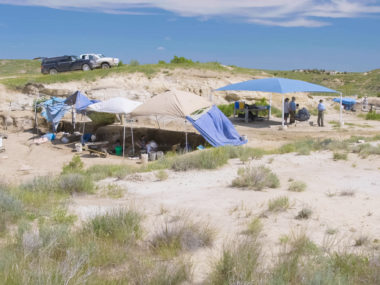
Perhaps the greatest irony with this misconception is that there are young-age creationists who not only have degrees in paleontology, but are actively involved in the discovery, excavation, and research of real dinosaur fossils. The Hanson Ranch Bonebed in Wyoming is one of the largest, almost single-species dinosaur bonebeds in the world, and excavations there are being headed up by creationists. Hot-off-the-press research on Carreras Pampa Tracksite in Bolivia by the Geoscience Research Institute is also being done by creation scientists.10 These are individuals who specifically reject the idea that every living thing evolved from a common ancestor that lived billions of years ago. Why would these individuals be involved in a conspiracy to get people to not believe the Bible?
Misconception #2: Dinosaur Fossils are Faked or Fabricated
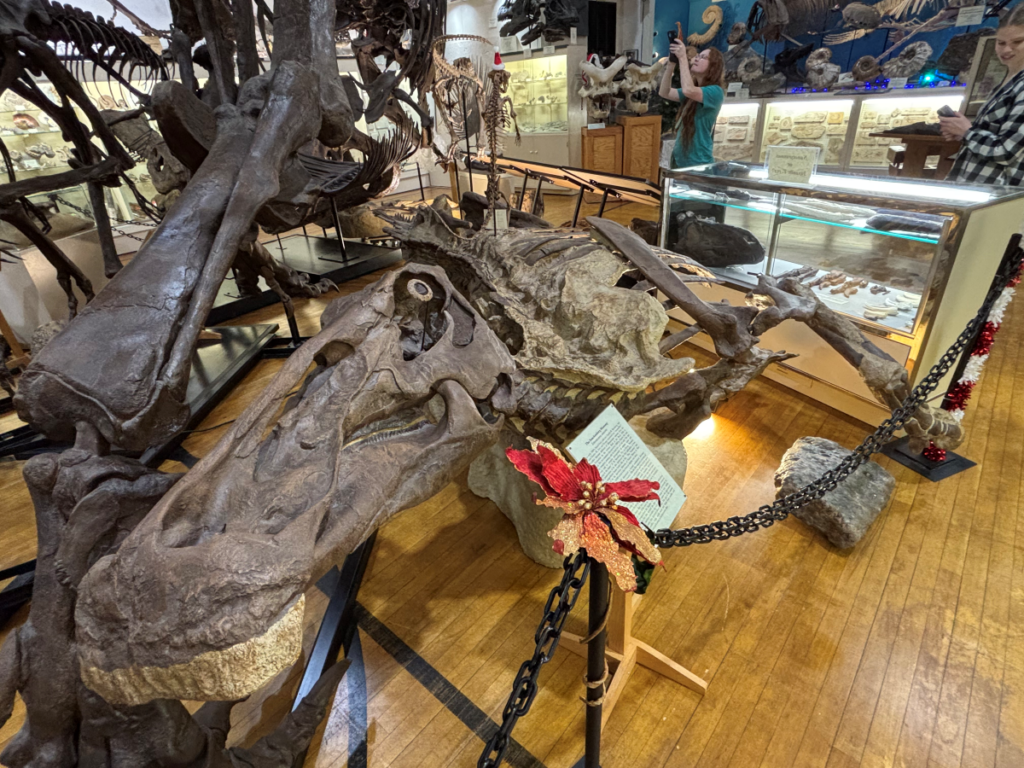
It is common for dinosaur deniers to claim that no complete fossilized skeleton of a dinosaur has ever been found. They point to museum skeletal displays which they claim are composed of mix-and-match bones from modern animals and plaster. As evidence, they state that museums even “admit” dinosaur skeletons on display are plaster, with the real bones being safely locked away from public viewing.
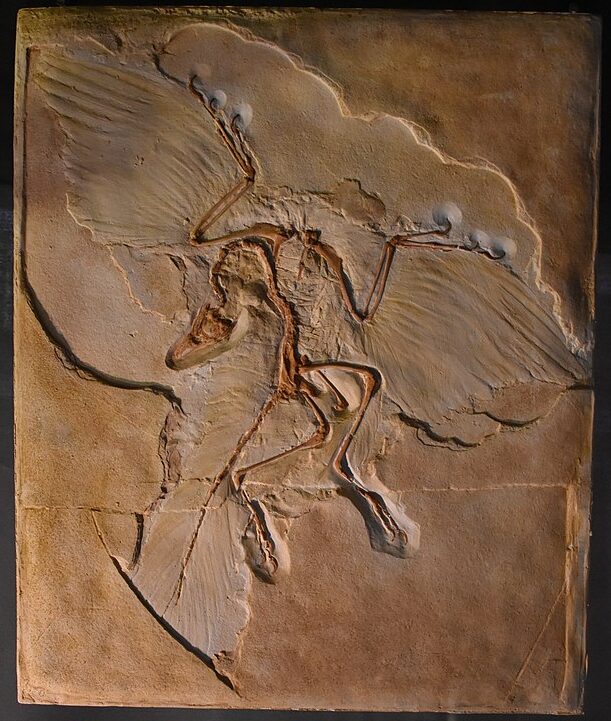
This is a half truth. While less common than fragmentary fossils, many complete and near-complete dinosaur skeletons are known. Certain fossil sites around the world, called Lagerstätte, are well-known for their ability to preserve complete specimens of small dinosaurs and other animals. For example, several head-to-tail Archaeopteryx specimens are known from the Solnhofen Limestone of Germany. The first complete dinosaur skeleton ever discovered, a Scelidosaurus, was found in the 1850s by quarry owner James Harrison in Charmouth, West Dorset, England.11 We have even found so-called dinosaur mummies, where the skin and other soft tissues have been preserved wrapped around the skeleton. These include the 1999 discovery of an Edmontosaurus nicknamed Dakota, and another in 2011 called the Suncor Nodosaur, a Borealopelta. The latter is so well-preserved that its skin color can be deduced by examining the pigment-producing cells under a microscope.
It is true that sometimes museums display dinosaur skeletons that are wholly or partially replicas of actual dinosaur skeletons. One reason for this is so that there are enough of a particular species or specimen for multiple museums and research teams to have one. (Only 50 T. rex specimens have been found so far and every dinosaur museum in the world wants one. You do the math!) Another is that sometimes the fossils are so fragile that they cannot be mounted on display. For example, Ebenezer, the Allosaurus skeleton at the Creation Museum discovered in 2000, is 56% complete. The skull on the actual skeleton is a replica because the museum did not want to hoist one of the most complete Allosaurus skulls ever found 10 feet off the ground. Instead, the actual skull can be viewed in a special, protective display case close to the ground.
Other times, fossil casts are used to fill in the gaps in a less-complete specimen. These replicas are not gap-filler bones concocted by the scientists out of thin air or bones snatched from modern animals. They are replicas from more complete dinosaur specimens or specimens from closely related species of dinosaurs.
Misconception #3: If Dinosaurs Really Existed, We’d Find Their Fossils Everywhere

People who reject the existence of dinosaurs often think that if dinosaurs really existed, we should find their fossils everywhere. Why would dinosaur fossils only appear in select places around the world?
First off, while not literally everywhere, we do find them over large portions of the world. To find out if dinosaur fossils are found in your area, you can look at maps similar to this one at the Paleobiology Database.
It also helps to know something about your region’s geologic history. For example, fossils are not commonly found in rock formed from the cooling of molten material, like lava or magma, called igneous rock. Regions like much of Washington, Oregon, and Idaho are underlain by the cooled and hardened lava rocks called the Columbia River Basalts. We would not expect to find dinosaur fossils there. Similarly, the bedrock of the Canadian Shield is composed of Precambrian igneous rocks and rocks that have exposed to extremely high levels of alteration through heat and pressure, called metamorphic rocks. Places like Florida were underwater and far offshore until very recently in geologic history. Thus, the only non-recent fossils found here are of marine creatures, not dinosaurs.
For a plant or animal to become a fossil, it usually must be buried in layers of sediment (like sand or mud) before it decays or is eaten by an animal. As such, it makes sense to look for places where layers of sedimentary rock were accumulating at the time dinosaurs were buried. This is why we find so many dinosaur fossils in the American West, between the Rocky Mountains and the Great Plains, a region that is extensively underlain by fossil-bearing sedimentary rock.
Misconception #4: Paleontologists are the Only People Who Find Fossils
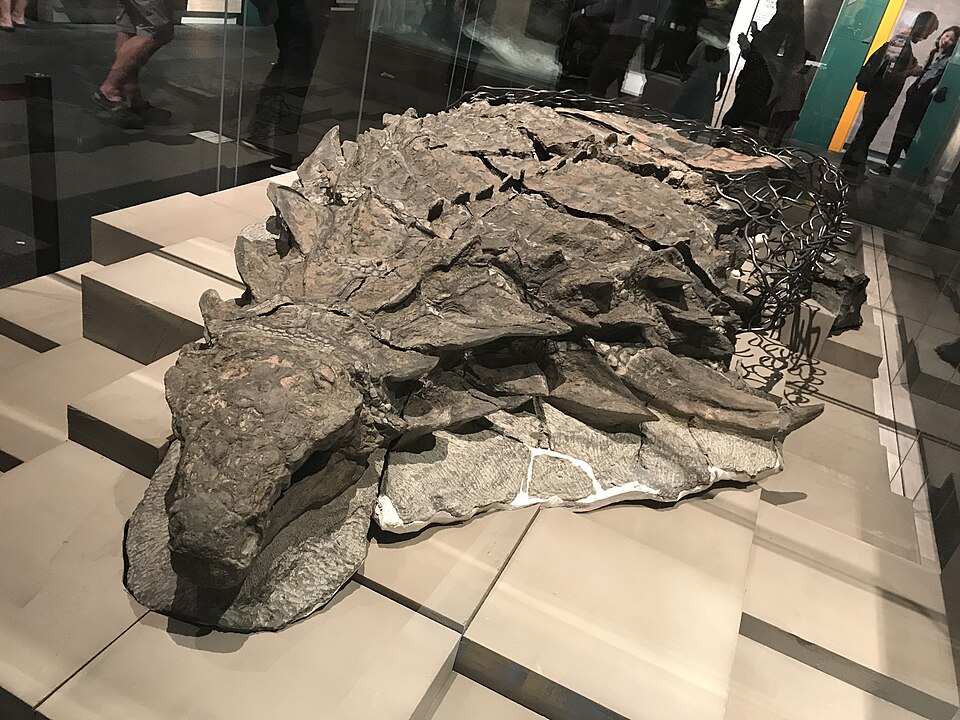
Dinosaur deniers will sometimes suggest it odd that dinosaur fossils are only ever found by the paleontologists. Why don’t regular, everyday people without a vested interest in dinosaur fossils ever find them? The answer is that they do!
An extensive dinosaur fossil trackway site was discovered by accident in St. George, Utah in 2000 by Dr. Sheldon Johnson, a retired optometrist. A father, his two sons, and their cousin were hiking the badlands of North Dakota in 2022 when they discovered the fossil leg bone of a Tyrannosaurus.12 The Suncor Nodosaur mentioned earlier was discovered by oil sands mine worker Shawn Funk in Alberta in a location no dinosaurs were expected to be.13 A man walking his dog in a forest near Montouliers, France happened upon a nearly intact skeleton of a long-necked titanosaur.14 The Hanson Ranch Bonebed in Wyoming is on privately-owned ranchland and was discovered by the ranchers themselves.
It is true that paleontologists find many fossils. But that is because they know how and where to look for them.
Misconception #5: No One Discovered Dinosaur Fossils Until After 1841.
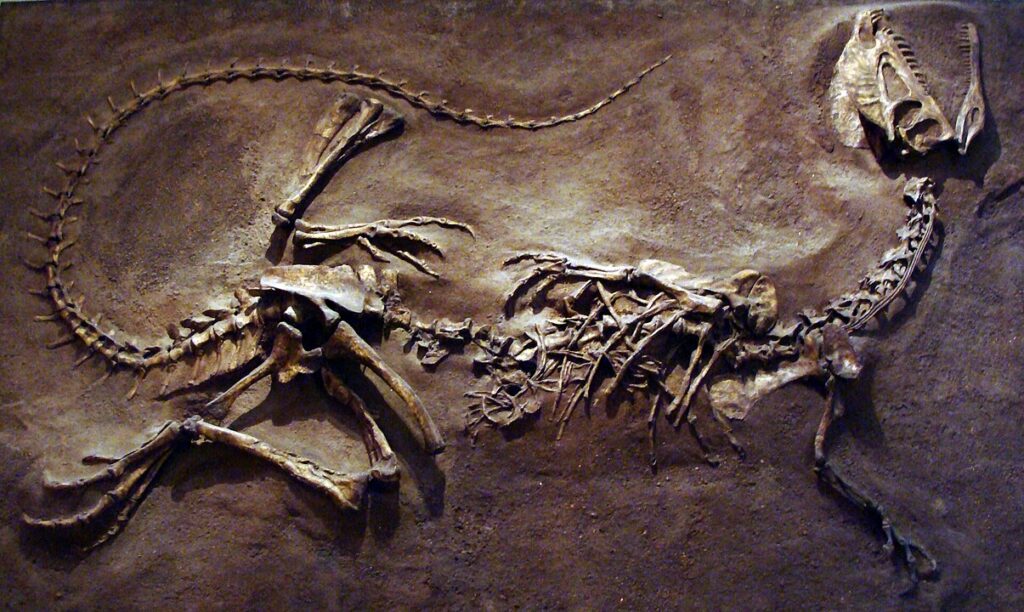
As mentioned above, 1841 only marks when the word “dinosaur” was coined. The first discoveries recognized as an unknown group of reptiles happened in the 1820s. But fossils we recognize today as having come from dinosaurs are not new. Historian Dr. Adrienne Mayor has demonstrated that knowledge of fossils of what we now call dinosaurs and other extinct animals existed in antiquity. For example, Native Americans were knowledgeable of dinosaur fossil localities. In Kansas and Nebraska, tribes collected mammoth and dinosaur fossils for various uses, including medicinal purposes. Some, like the Crow people, gathered scutes of armored dinosaurs, like Sauropelta, to use as hearths when they roasted pine nuts.15 They also attributed “spiritual power” to fossilized dinosaur eggs of Maiasaura found in eastern Montana.16
When scientists arrived in the New World and began looking for fossils, native Americans often showed them where they could be found. For example, the first discovered specimen of Dilophosaurus was discovered in northern Arizona’s Navajo County by Navajo Jesse Williams in 1940.17 When he realized paleontologist Charles L. Camp was leading a field party from the University of California Museum of Paleontology nearby, he brought three members of the expedition to the site.
Conclusion: Dinosaurs are Real and Straight
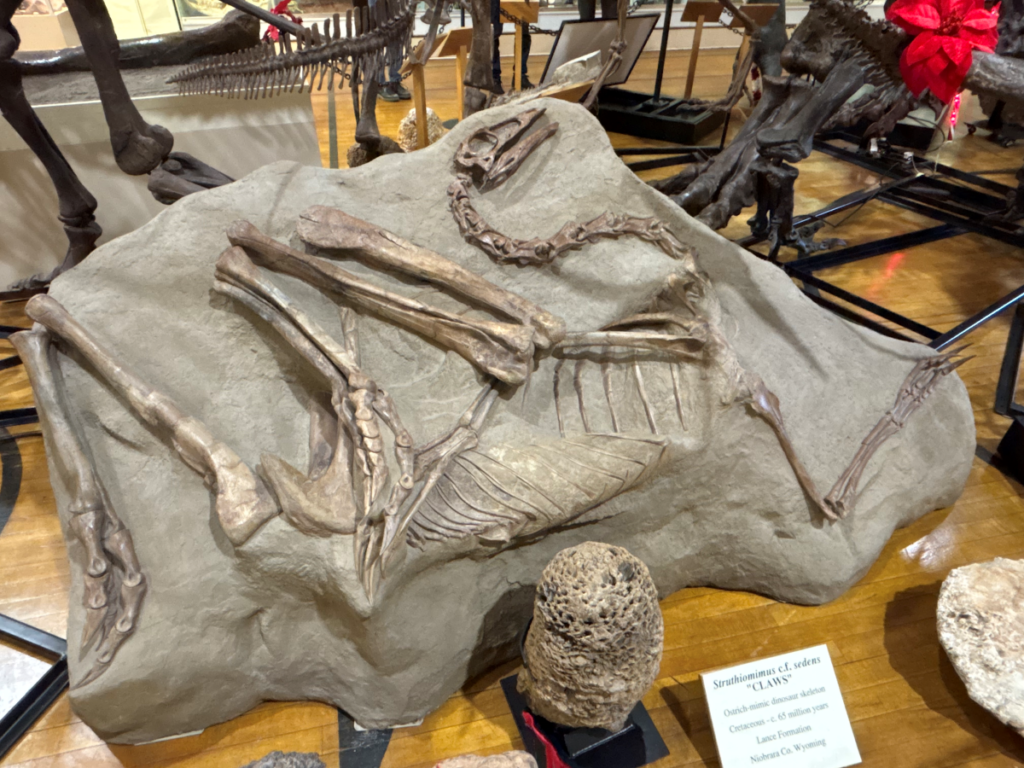
Thankfully, dinosaur denialism is not as prevalent as some other conspiracies. But it does exist and is frequently brought up not only by young-age affirming Christians, but also non-Christians. So it should be addressed confidently and without arrogance.
As 1 Thessalonians 5:21 says, we are to “…test everything; hold fast what is good.” From this discussion, we have seen that the talking points raised by dinosaur skeptics are based less on evidence, and more on speculation and misconceptions that fall apart even after a cursory amount of knowledge about how fossils form and the history of dinosaur paleontology. You don’t even need a PhD in paleontology!
Dinosaurs are not some evil scheme used to gateblock “the truth” from the masses. Rather, they are a gateway into a world full of curiosity and discovery. Let’s use them to explore!
You can even get involved with real dinosaurs yourself! Peruse our many articles about them on New Creation or watch films like Is Genesis History? You do not need to have a college degree to work with real dinosaur fossils either. Why not volunteer at a local museum or dinosaur dig? The Hanson Ranch Bonebed takes volunteers every summer. You can learn more about that at their website: https://swau.edu/dinosaur-museum/experience/.
Footnotes
- Jack Neel, “Candace Owens on Government Experiments, Eminem Diss, and Fake Dinosaurs,” interview video, July 21, 2024, posted July 21, 2024, by Jack Neel, YouTube. ↩︎
- James Walker, “Dolphins’ William Hayes Has Interesting Thoughts on Dinosaurs and the Moon,” ESPN (blog), March 11, 2017, accessed December 2025. ↩︎
- David Alvareeezy, “Mom Chooses His Perfect Match,” video, November 23, 2025, posted November 23, 2025, by David Alvareeezy, YouTube. ↩︎
- Allie Beth Stuckey, “I Don’t Know if Dinosaurs Were Real | Ep 670,” podcast episode video, August 31, 2022, premiered August 31, 2022, by Allie Beth Stuckey, YouTube. ↩︎
- David P. Wozney, “Dinosaurs: Science or Science Fiction?” archived web article, n.d., archived January 6, 2012, accessed December 2025. ↩︎
- Eric Dubay, “Dinosaur Hoax – Dinosaurs Never Existed!”, The Atlantean Conspiracy, September 9, 2015. Dubay later republished the same article on his WordPress site in 2018: Dubay, Eric. “Dinosaurs Never Existed.” EricDubay.com, July 8, 2018. ↩︎
- Neel, “Candace Owens,” (Footnote 1) ↩︎
- “Dinosaur denialism,” RationalWiki, last modified [December 1, 2025], accessed December 29, 2025. ↩︎
- Neel, “Candace Owens,” (Footnote 1). ↩︎
- Raúl Esperante et al., “Morphotypes, Preservation, and Taphonomy of Dinosaur Footprints, Tail Traces, and Swim Tracks in the Largest Tracksite in the World: Carreras Pampa (Upper Cretaceous), Torotoro National Park, Bolivia,” PLOS ONE 20, no. 12 (2025): e0335973. ↩︎
- Michael Irving, “First complete dinosaur skeleton reconstructed 162 years after discovery,” New Atlas, August 30, 2020 ↩︎
- Jacopo Prisco, “Three Young Boys Discover Rare T. rex Fossil in North Dakota,” CNN (news article), June 7, 2024, accessed December 2025. ↩︎
- Brown, Caleb M., Donald M. Henderson, Jakob Vinther, Ian Fletcher, Ainara Sistiaga, Jorsua Herrera, and Roger E. Summons. “An exceptionally preserved three-dimensional armored dinosaur reveals insights into coloration and Cretaceous predator-prey dynamics.” Current Biology 27, no. 16 (2017): 2514-2521. ↩︎
- Anna Lazarus Caplan, “Man Found 70 Million-Year-Old Dinosaur Skeleton While Walking His Dog — and Kept It a Secret for 2 Years,” People, March 10, 2024. ↩︎
- Adrienne Mayor, “Water Monsters and Thunder Birds on the Prairie and in the Badlands,” in Fossil Legends of the First Americans (Princeton, NJ: Princeton University Press, 2005), 273. ↩︎
- Mayor (2005); “Water Monsters and Thunder Birds on the Prairie and in the Badlands”, page 276. ↩︎
- University of California Museum of Paleontology, “Discovery of Dilophosaurus,” web page, n.d., accessed December 2025. ↩︎

 Noel Grimes
 Ken Coulson

 Kurt Wise

 Brittany Martin

 Peter
Peter
 Abigail L.