
 Abigail Van Huss
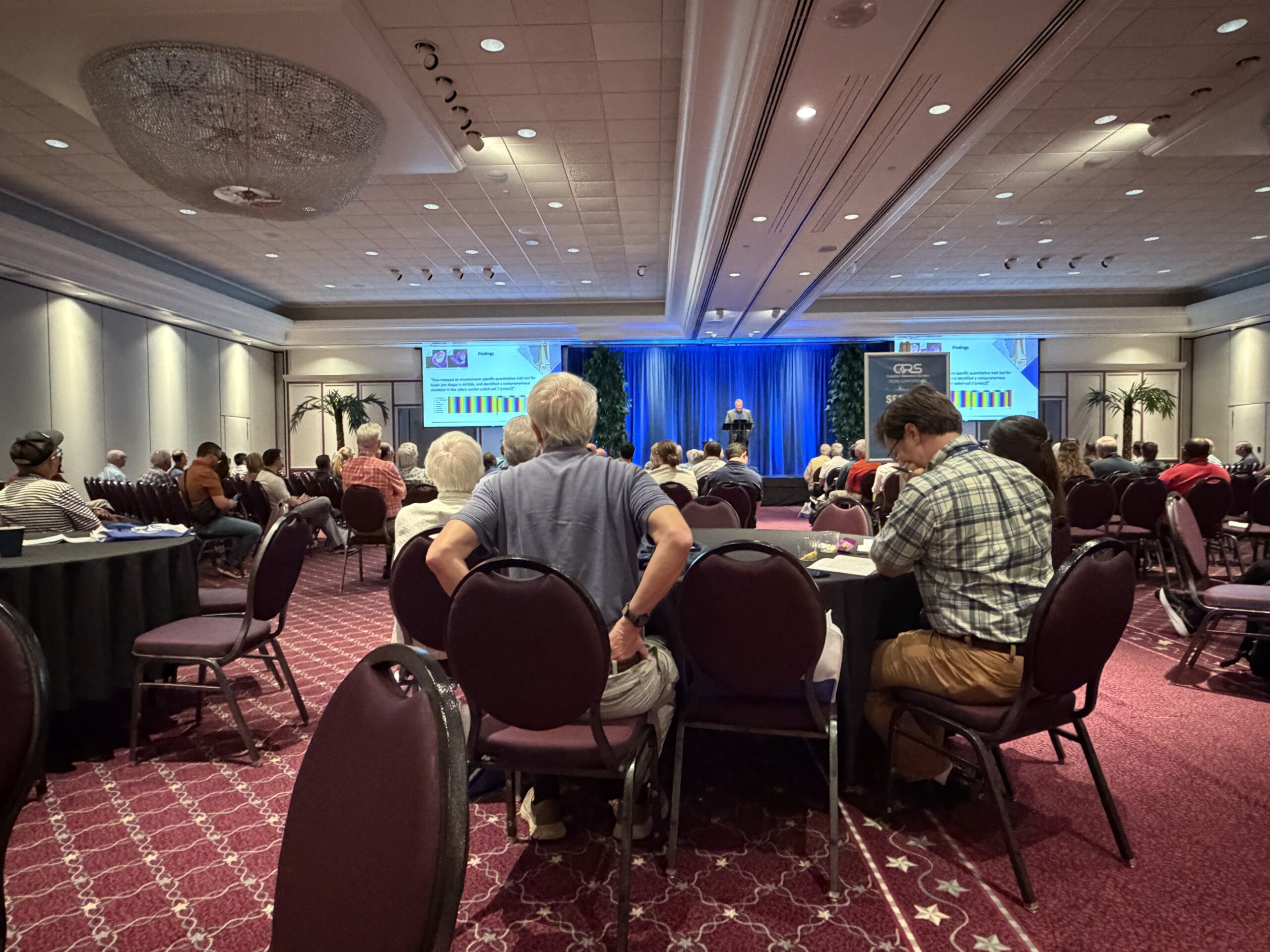
A few weeks ago, I had the privilege of attending my very first Creation Research Society (CRS) conference. The conference meets at a different location each year. This time it was in Pensacola, Florida. In addition to this being my first CRS conference it was my first time in Florida, so I got to experience the Sunshine State (it rained every day I was there).
The views expressed reflect those of the author, and not necessarily those of New Creation.
Due to a scheduling conflict, I wasn’t able to make it in time for the workshops on Thursday, but I attended both days of the main part of the conference. As an archaeologist, I am on the fringes of creation research, but I saw a number of people I knew. I was surprised at the number of lectures that bordered on the archaeological. I enjoyed reconnecting with old friends, meeting new people, and hearing about the latest in creation research.
Highlights from the Conference Sessions
The conference started each day with a plenary session. Throughout the rest of the day, there were three concurrent sessions. On Friday, there were no archaeological talks, but I enjoyed checking the schedule and choosing the sessions that sounded most interesting. On Saturday, however, one of the rooms was devoted to archaeological and chronological studies throughout the day. That is where I spent almost the entire day. Here are summaries of a few of my favorite CRS sessions.
The Great Appalachian Seashell Debate
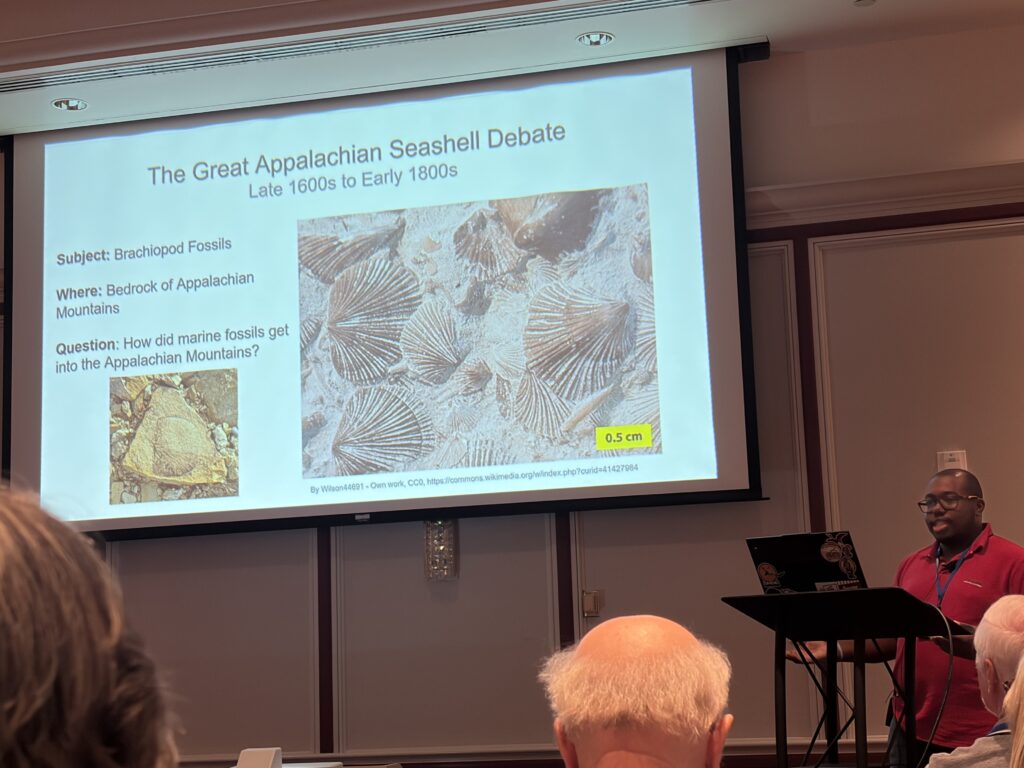
Our own Christian Ryan of New Creation Blog presented for the first time at CRS as a student member. His session focused on the history of the geological narrative. He traced the formation of the standard geological history through the Enlightenment movement, which emphasized human reason, observation, and skepticism.
In the late 1600s through the early 1800s, naturalists discussed brachiopod seashells that explorers had found in the Appalachian mountains. Those who held to a biblical view of Earth history assumed that Noah’s Flood had placed the shells there. But an increasing number of naturalists rejected this view. Emerging trends in this period included an increasing appeal to natural law, greater reliance on observation and present-day processes, and changing standards for acceptable geological processes.
Christian pointed out that “the importance of this debate is that it demonstrates how the early shift from a Noah’s Flood explanation of these strata and fossils was less based on the observable evidence itself, but more paradigm-driven.” He went on to explain that members of the Enlightenment movement were uninterested in developing testable hypotheses that might explain the data from the perspective of a Flood paradigm.
Chariot Wheels? Or No Chariot Wheels?
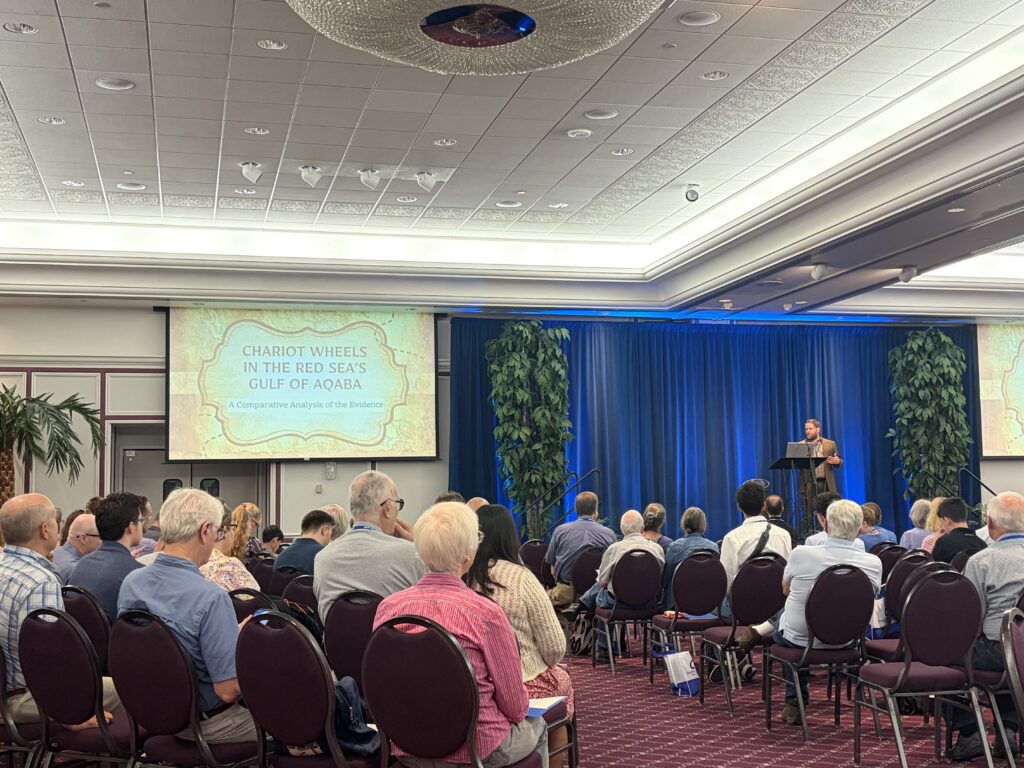
Nate Loper of Canyon Ministries kicked off Saturday’s sessions with a deep dive into Gulf of Aqaba research. His topic was a very sensitive one because he challenged a view that is very widespread in Christian circles. Almost everyone I know has heard about the chariot wheels that were reported to have been discovered at the bottom of the Red Sea’s Gulf of Aqaba. I remember hearing about them as a child and being encouraged in my faith. After all, if chariot wheels have been found at the bottom of the Red Sea, that proves that the Bible is telling the truth, right?
In his presentation, Loper very tactfully challenged the prevailing view. He pointed out that “if a claim is true, careful examination will strengthen it. If it is false, careful examination will replace it with something better.”
Loper examined two claims of chariot wheels at the bottom of the Gulf of Aqaba. One involved coral growing in the shape of an axle and wheel. The other concerned a metallic wheel visible on the floor of the Gulf. Loper showed that the coral growth that appears in the shape of an axle and wheel is a natural formation that is common in that part of the world. It is known as tabletop coral. Loper even called upon a marine biologist in the audience to explain why coral grows that way. It is because it maximises the animal’s ability to soak in sunlight.
Next, Loper examined the metallic wheel found at the bottom of the gulf. He showed examples of Egyptian chariot wheels from the time of the Exodus, both in ancient Egyptian artwork and preserved in tombs. The chariot wheels from that period looked nothing like the wheel from the Gulf. Then, Loper showed wheels that do match the one found in the Gulf—identically. Those wheels are pulley wheels made in India that are the very type used by cargo ships in the Gulf of Aqaba. It makes perfect sense that a pulley wheel might fall off a ship and into the Gulf.
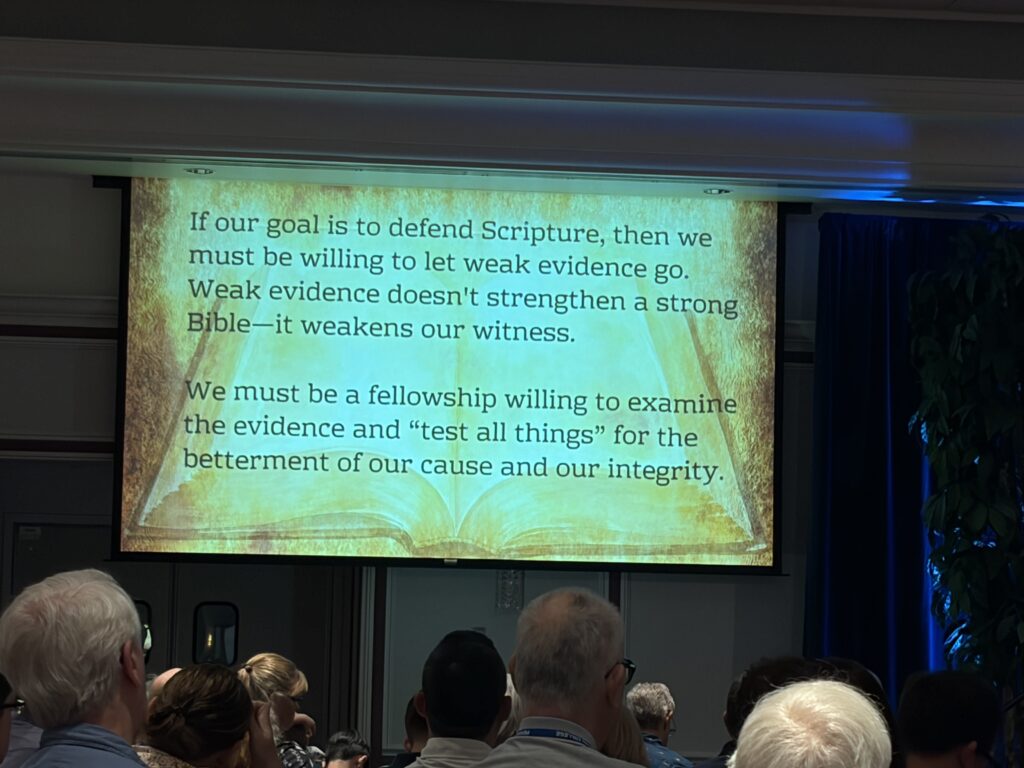
Loper concluded that even if the supposed chariot wheels at the bottom of the Red Sea are not chariot wheels after all, we should not be discouraged in our faith. After all, just because there are no chariot wheels, it does not mean that God did not part the Red Sea for the Israelites, just like the Bible says! Loper went on to point out that “if our goal is to defend Scripture, we must be willing to let weak evidence go. Weak evidence doesn’t strengthen a strong Bible—it weakens our witness.”
Multiple Tree Rings Per Year?
In Marshall Jordan’s session, he tackled the problem of the dendrochronology sequence. Dendrochronology is the study of tree rings, and researchers have been able to assemble a dendrochronological sequence that extends back 14,000 years. That is a problem for young age creationists who believe that the world is only 6,000–10,000 years old.
Scientists use dendrochronology to calibrate carbon-14 dates. Yet at about 3,000 years before present (BP), the tree ring calibration curve departs from the carbon-14 calibration curve, suggesting some kind of discrepancy in the dendrochronological sequence.
Jordan suggested that a simple solution for this problem is to consider the possibility that ancient trees may have formed more than one ring per year. This not only solves the discrepancy with the carbon-14 calibration curve, but also solves the problem of dendrochronology seemingly pre-dating the creation of the world.
But why would ancient trees produce more than one tree ring per year? Jordan suggests that it may have to do with solar cycles. Today, solar cycles last about 11 years. Sunspots, caused by magnetic solar fluctuations, create variations in carbon-14 present in the atmosphere. There is a magnetic pole reversal every 11 years or so that causes a burst in carbon-14 production in the atmosphere. These bursts in carbon-14 production can be tracked using Fourier Transform.
Jordan showed that the further back in time you go, the more tree rings there are in each solar cycle. For the past millennium, there were an average of 10.4 tree rings per solar cycle. In the first millennium BC, there were 13.2 tree rings per solar cycle, and between the years 3573–3459 BP there were 16.3 tree rings per solar cycle. Finally, for the years 3629–3501 BP, there were 16–18.3 tree rings per solar cycle.
This data offers two possible solutions. Either solar cycles have been growing shorter with time or trees produced more tree rings per year in the past. Jordan prefers the later interpretation since it solves at least two known problems with dendrochronology.
Who Was Job?
Job is a somewhat enigmatic character in the Bible. Biblical scholars have long debated Job’s identity, his geographical setting, and his chronological setting. In his session, Joel Tay tackled these questions and proposed an unusual but highly logical solution.
Tay pointed out that there are a number of clues in the text of Job that help locate his historical setting. For example, Job’s home in the land of Uz suggests a location in Edom (cf. Jeremiah 25:20–21; Lamentations 4:21). Tay further showed that Job’s four friends, Eliphaz the Temanite, Bildad the Shuhite, Zophar the Naamathite, and Elihu the Buzite were likely all from the family of Abraham. Eliphaz was Esau’s son (Genesis 36:4), and Zophar was Eliphaz’s son (Gen 36:11). Bildad was Abraham’s grandson or great-grandson through his concubine Keturah (Genesis 25:1–2). Finally, Elihu was likely the great-grandson or great-great-grandson of Abraham’s brother Nahor (Genesis 22:20–24).
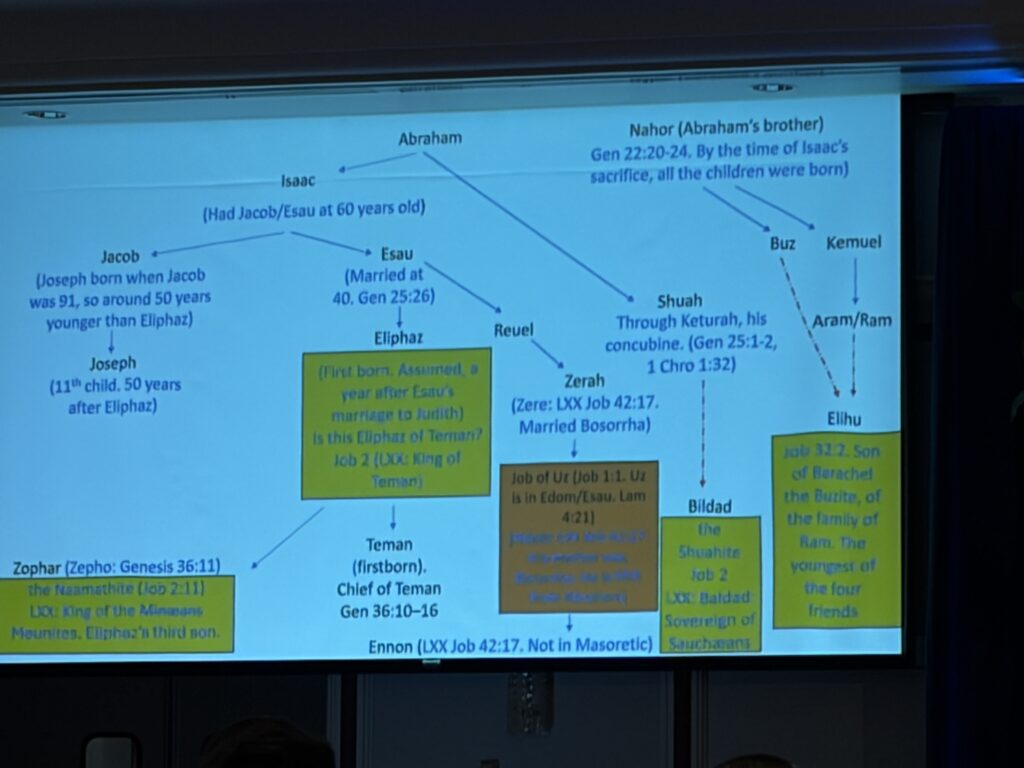
But what about the identity of Job himself? Tay identifies Jobab of Genesis 36:33 with Job. This makes sense for several reasons. First, Jobab was a great-grandson of Esau (cf. Genesis 36:17). As such, his location in the land of Uz makes perfect sense. Second, Job’s lineage sets him as an equal among his four friends, all of whom are descendants of or closely related to Abraham. Third, the Septuagint translation of the book of Job has a slightly longer ending than that of the Masoretic text (most English Bibles are based on the Masoretic text). The Septuagint translation specified that Job’s name was formerly Jobab.
Thus, Tay concludes that all evidence points to Job being Jobab, the great-grandson of Esau. Interestingly, chronologically, this places Job in the timespan between Jacob and Moses. In fact, as a youth, Job could have met Jacob before went to Egypt, and as an old man, he could have met Moses while Moses lived in Midean.
In Summary
I wasn’t sure what to expect from the CRS conference, but I enjoyed it very much. It was great to meet new people and hear the latest news in Creation research. I am excited about the direction that Creation research is taking, and I look forward to future conferences.
More Perspectives from the 2026 CRS Conference
- My Experience at the 2026 Creation Research Society Conference by Hannan Klein
- Go TEAM Creation! A Report from the 2026 Creation Research Society Conference by Christian Ryan


 Joshua Cedar
 Abigail Van Huss
 Christian Ryan
 Hannah Klein
 Kurt Wise

 Peter
Peter