
 Christian Ryan
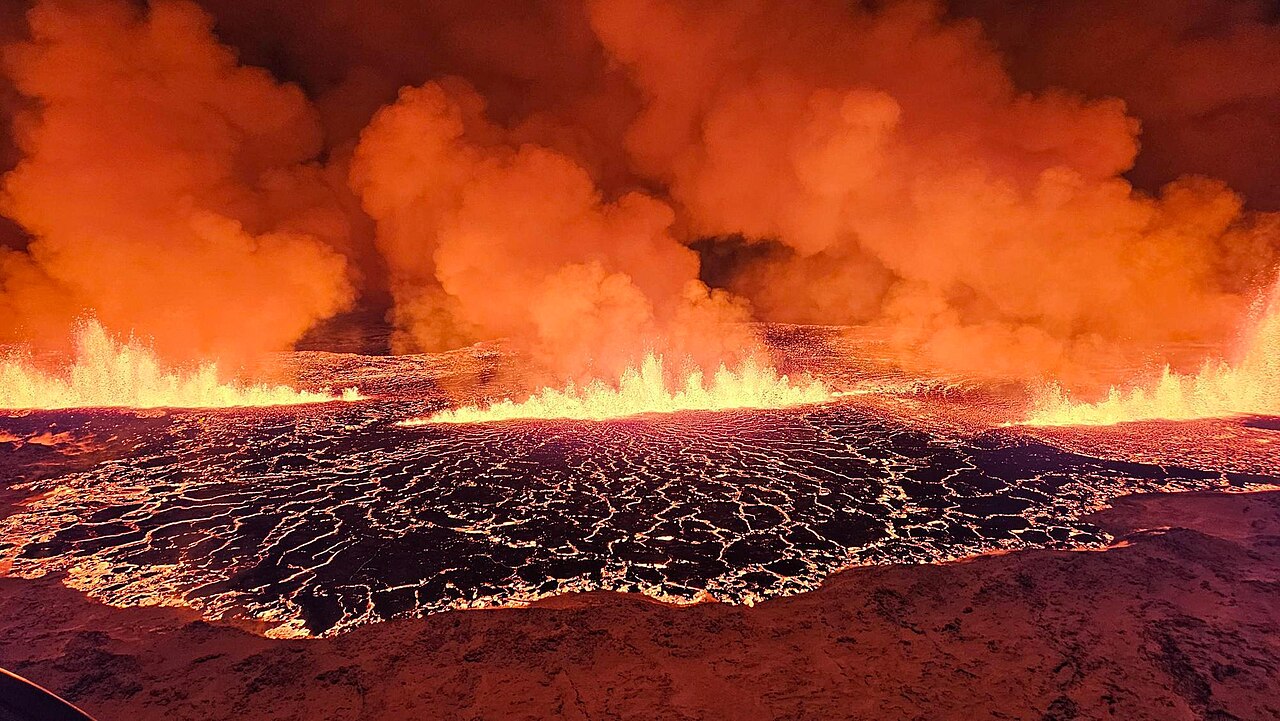
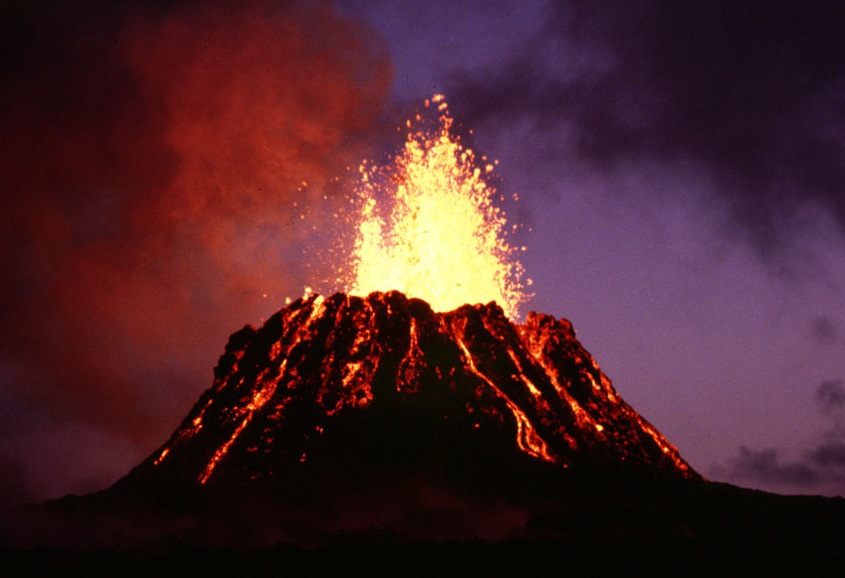
If you were under siege from an erupting volcano, your first thought would probably be to flee. But an average lava flow can travel at 20 mph and can catch you on fire even without actually touching you. This is because the heat radiating from the lava can be over 1000℉!
Now, imagine volcanoes going off all over the world. Not just on land, but underwater too. And imagine radioactive elements and extraterrestrial impacts like asteroids and comets. All of these phenomena would be radiating large amounts of heat as well. This was no apocalyptic nightmare. It’s something that really happened just a few thousand years ago during the biblical Flood of Noah’s time.
The views expressed in this article reflect those of the author, and not necessarily those of New Creation.
It goes without saying that the Earth would have been a pretty balmy place during the Flood. With so many sources of heat, we must ask why planet Earth did not experience the seemingly obvious consequences of so much heat exposure. According to current estimations, the volume of heat produced during the Flood would have been enough to boil the oceans. It was enough heat to melt portions of the Earth’s crust. The planet should have been inhospitable for life (well, maybe except for the tardigrades). Yet, somehow, none of that happened. Noah, his family, and the animal passengers aboard the Ark left the vessel to take on new lives after the Flood. We call the challenge of accounting for how the Earth survived all this heat exposure the “Heat Problem.”
What is the Heat Problem?
The Bible (Genesis 7:1–9) describes the Noahic Flood as a rapid and violent catastrophe of worldwide scale. Consequently, it involved a large-scale reworking of the Earth’s surface. Geologically speaking, we find evidence of tremendous volcanic activity, impact craters and debris, major continental rearrangement, and accelerated radioactive decay associated with the rock layers we think formed during the Flood. All these processes resulted in heat—and enormous quantities of it—that the Earth consequently absorbed into its crust, upper mantle, water systems, and atmosphere.
Despite all this, human and land animal life survived on the Ark. Despite countless deaths of plants and animals (as known from the fossil record), populations of marine life survived as well. So did plants and invertebrates, perhaps on floating vegetation mats and other debris. Somehow, all the heat produced by processes at work during the Flood did not wipe out all life on the planet. The study of the heat problem is an active research question with the goal of developing a coherent scientific description of how that happened.
The Heat Budget: How Hot Are We Talking?
“Feel the heat, so we started running”
– Sabrina Carpenter, “Smoke and Fire” (2016)
Before we decide how best to foot the bill, we must first know how much it costs. This has been the work of William Worraker of Biblical Creation Trust in the United Kingdom. Since 2018, Worraker has been accumulating data on the different geological processes at work during the Flood. This is helping him calculate how much heat each of these processes may have produced.
Cooling of Molten Rock
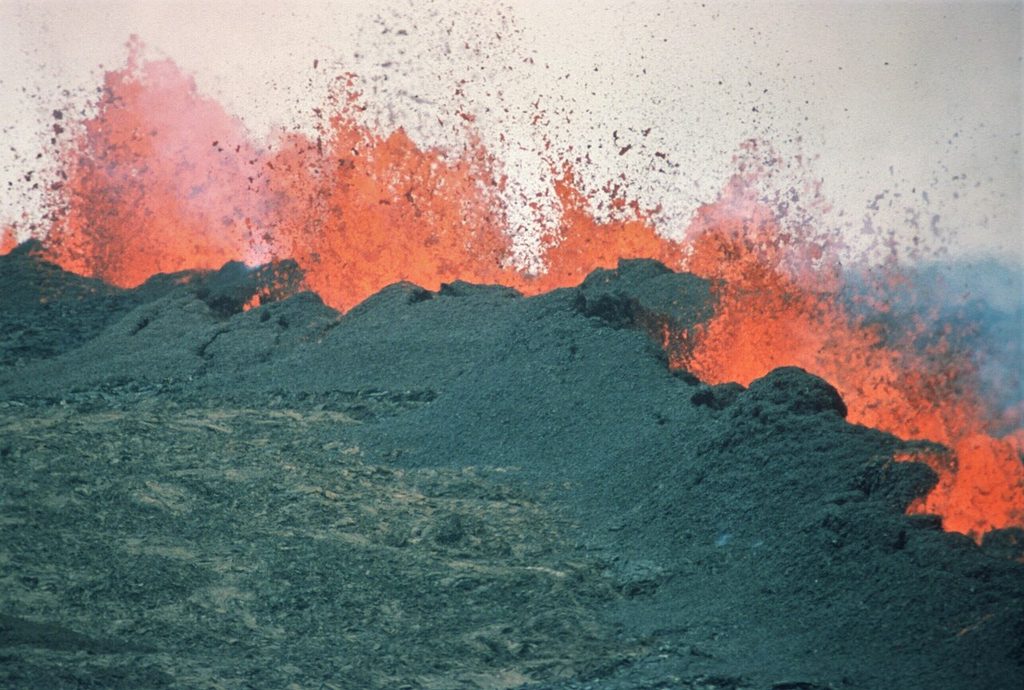
Molten rock goes by two names. When it occurs above ground, we call it “lava.” But when it occurs below ground, we call it “magma.” Both terms refer to rock that got so hot that it melted into a liquid. When it cools and solidifies back into rock, the heat does not actually disappear. The surrounding environment absorbs it.
If you were to remove the thick deposits of ooze, clay, and other sediments that cover the ocean floor, you would discover that basalt, a type of solidified molten rock, makes up much of the oceanic crust beneath. Great upwellings of magma generate new ocean floor along chains of underwater volcanoes called mid-ocean ridges. Through the plate tectonic process called seafloor spreading, new seafloor moves away from the spreading centers along these ridges. Elsewhere, old seafloor sinks back into the Earth’s mantle through a process called subduction. As the molten rock comprising the seafloor cooled, it released heat into the surrounding ocean. And a lot of it!
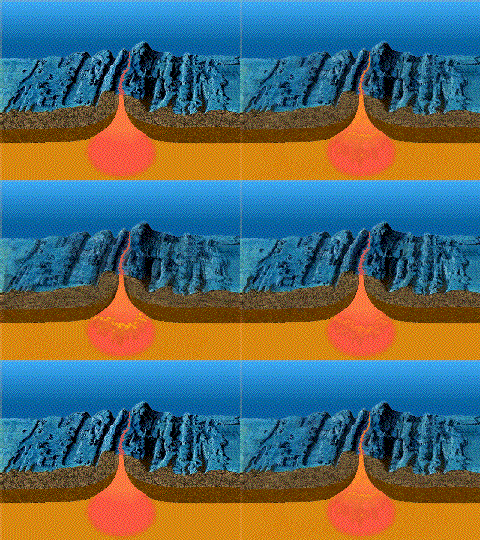
Other geologic processes also produced cooled molten rock, including giant volcanic eruptions such as the Deccan Traps in India. But these contributed relatively little to the total amount of heat released by cooling molten rock. The cooling of the seafloor accounts for most of Worraker’s estimate of the total amount of heat released by cooling molten rock. We cannot know with certainty exactly how much heat this process produced. Geologists think that previous seafloors formed, cooled, and eventually sank back into the Earth’s mantle via subduction, perhaps several times over. This means Worraker’s estimate is undoubtedly an underestimate.
From calculating these and other sources of cooled molten rock, Worraker estimated that the total amount of heat produced by this process was 1.4 x 1029 joules.1 This is enough heat and energy to completely boil off Earth’s oceans 30 times over!
Radioactivity

Certain elements in nature—such as uranium, thorium, and potassium—are unstable. This means they spontaneously release energy and particles of radiation in order to become stabilized. We call this process “radioactivity.” Granite and similar rocks in Earth’s upper continental crust commonly contain high concentrations of these unstable elements.
The RATE project (Radioisotopes and the Age of The Earth) was a young-age creationist research project carried out in the early 2000’s to investigate the phenomenon of radioactive elements in the rock layers we think formed during the Flood. The presence of helium in zircon crystals, radiohalos in granitic rocks, and other evidence convinced the RATE team that radioactive decay may have happened at an accelerated rate during the Flood. Based on their research, they estimated that 500 million years’ worth of radioactive decay happened during the Flood.
This would have produced 2 x 1029 joules of heat.2 To put this into perspective, this is enough to melt the upper continental crust of Earth several times.
Extraterrestrial Impacts
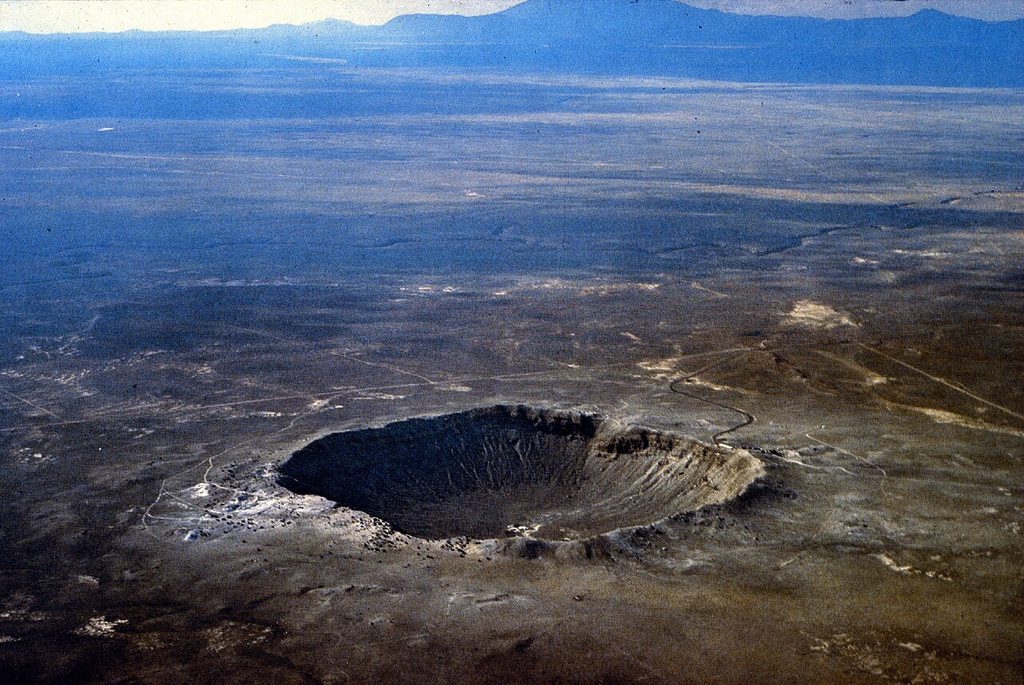
Earth often serves as a popular landing site for meteors from outer space. One of the most famous is undoubtedly the Chicxulub Impactor. It hit Earth along the edge of Mexico’s Yucatán Peninsula. Most scientists associate it with the extinction of the dinosaurs. But this is only one of the 190 or so craters known around the world. There were likely many more impact events than we have craters. This is because other geological processes, like erosion and subduction, have erased many of them. By looking at the number of craters on the Moon and other nearby planets (specifically Mars, Mercury, and Venus), we can estimate that Earth suffered tens of thousands of impacts forming craters at least 12–18 miles (20–30 kilometers) in diameter.
As you might have guessed, this process also generates a lot of heat. We cannot know the exact number of impact events on Earth. However, Worraker estimates that the known number of impacts generated at least 1028 joules.3 The actual value could be as many as 40 times this amount. This is enough energy to have a major effect on the environment.
Is the Heat Problem the Achilles’ Heel of Creationism?
Megamind: “Whoa, whoa, whoa, whoa, whoa! This isn’t how you play the game.”
Tighten: “GAME OVER!”– Megamind, 2010
According to Gutsick Gibbon (YouTube moniker), “…the heat problem has already killed young Earth creationism as a viable idea….”4 She further argues that the problem is now “killing the creationist enthusiasm for arguing that young Earth creationism is scientific.” Critics often echo this sentiment in their discourse about Noah’s Flood, the age of the Earth, and other related topics. But treating an unresolved problem as sufficient reason to declare an entire scientific model dead is not how science normally works.
Many secular and creationist scientific models are incomplete and have glaring, unresolved challenges. This is a normal and healthy part of the scientific process, even in something as foundational as fundamental physics.
Is Fundamental Physics Dead? (No)
The two most successful theories in fundamental physics are general relativity and quantum mechanics. Physicists regularly use both of them to understand and describe how various aspects of the universe work. General relativity describes how gravity affects the behavior of space, time, and matter. This is crucial for scientists studying the movements of stars and planets, and the behavior of black holes. Quantum mechanics is useful for scientists who study atoms and subatomic particles. This is because it describes how matter and energy operate at these extremely small scales. Both of these theories make incredibly accurate and precise predictions in their own natural areas of application.
The problem is that physicists cannot yet reconcile these two important theories into a single, coherent theory.This is no small issue. Under extreme conditions, physicists encounter situations where both gravity and quantum effects become important. Yet, no one has figured out how to fully describe such situations using a single coherent theory. This is why physicists still cannot describe the extreme conditions at the very beginning of the universe or what happens in the murky depths of a black hole.
Dark matter is similarly problematic. Despite decades of searching, scientists have yet to directly detect or determine what dark matter actually is. But this does not mean dark matter doesn’t exist. On the contrary, there is much observational evidence that supports its existence. Such evidence includes the unusual rotation of galaxies that cosmologists use dark matter to explain. These are glaring, ongoing issues in fundamental physics and cosmology. Yet, no one argues that they are “killing the physicist enthusiasm for arguing that fundamental physics is scientific.”
What Does This Have to Do with the Heat Problem?
To be clear, it is not being argued here that problems in fundamental physics are equivalent to the heat problem. Instead, they highlight a very important, underappreciated distinction: the existence of a serious unresolved problem within a scientific model does not, by itself, demonstrate that the model is false. This is why scientists, creationist or otherwise, involved in these areas of research do not see these unresolved challenges as showstoppers. They are launching pads for further investigation and refinement of the models in question.
Pay No Attention to that Evidence Behind the Curtain!
There is another issue with using the heat problem as an Achilles’ heel to creationism. Regardless of how great or small an issue the heat problem poses to the overall model, it does not make the other evidence disappear. There exists tremendous evidence from the geologic record that is consistent with a young-age creationist timeframe. These include the presence of original organic material in ancient fossils, lower than expected levels of bioturbation in the geologic record, and even rock layers that were folded without metamorphism, to name just a few.
While none of these alone “disprove” the idea that the Earth is old, they do demonstrate that Earth’s age is a complicated topic that deserves much nuance and intelligent discussion. True, many skeptics will interpret or weigh such evidence differently. But that demonstrates the point. Each piece of evidence must be weighed on its own terms. It is not impossible for an unresolved problem within a scientific model to lead scientists to reject that model. But deciding to reject a model is a decision best made after examining each piece of evidence used to support it. It cannot be just assumed because a scientifically satisfying solution has not yet been found. Hammering on the heat problem without recognizing that same nuance readily accepted elsewhere does not make for productive discourse.
Who’s Going to Pay the Heat Bill?
All the heat generated during the Flood had to go somewhere. A recent discussion by Dr. David Winsberg summarized the options in the five following points.5 It should be remembered that these possible solutions are not mutually exclusive, and one or several of them could be factors at the same time.
Conversion into Another Form of Energy
One possibility is that the heat given off by these geologic processes was not eliminated, per se, but altered into another, more life-friendly form of energy. In principle, this could be accomplished through a chemical reaction, a phase change, or a mechanical process. However, as per the 2nd Law of Thermodynamics, physical and chemical processes ultimately tend to convert usable energy into heat rather than heat into usable energy. This is why some researchers, like Worraker, view this as a non-starter.6
Transfer to Another Thermal Reservoir
A second way to deal with the heat is for it to be transported into a different location where it cannot detrimentally affect lifeforms. This could be accomplished through thermal conduction (transference through solid rock), magma convection (movement of still-molten rock), or through hydrothermal convection by means of groundwater flow (transference through pores and cracks in solid rock and/or overlying sediment layers). This approach would need further research to see whether it is a viable option for storing the heat.
Radiation into Another Dimension

Physical objects tend to move through empty space in three dimensions: 1) up and down, 2) left and right, and 3) forward and backward. But during the 2018 International Conference on Creationism, astrophysicist Dr. Russell Humphreys suggested that a fourth direction of space existed that is normally inaccessible to us. He proposed that the opening and closing of the “windows of heaven” (Genesis 7:11 and 8:2) during the Flood are temporary openings of this fourth dimension.7 According to this model, excess heat could radiate away from the atoms throughout hot objects (such as molten rock), rather than only from their surfaces. This allows them to cool much more rapidly than normal physics allows.8
Worraker contends that there are several unresolved scientific and biblical issues with Humphrey’s proposal.9 One scientific difficulty is that experimental research suggests that the components of atoms destabilize in four dimensional space. This would suggest that stable atoms cannot exist in such an environment. A biblical difficulty is that interpreting the “windows of heaven” as a fourth dimension is far from obvious within the water-saturated context of the Flood narrative. Another is that these “windows” close by the 150th day of the Flood (Genesis 8:2). But most young-age geologists think that many of the geologic processes we discussed above were still active well after this point during the Flood. So how could heat continue to be dissipated after Day 150 if the “windows” had closed? In order for Humphreys’ model to be considered viable, he must address these and other concerns Worraker raised.
Storage in Sub-Oceanic Crust
Dr. Winsberg provides his own proposal, at least for heat generated by the formation and cooling of the ocean floor basalts.10,11 He points out that while it would take far longer than the young-age timeline allows for all of this heat to dissipate completely. But it would also take time for heat buried deep beneath the seafloor to actually reach the surface. Therefore, Dr. Winsberg suggests that the oceanic crust itself could serve as a temporary heat reservoir, allowing the heat to escape gradually rather than entering the oceans all at once.
Based on his preliminary quantitative work, Dr. Winsberg suggests that the movement of hot groundwater is a potential mechanism for transporting stored heat into the oceans over a timespan of centuries following the Flood. Of course, this does not completely address the entire heat problem. But it removes Dr. Winsberg’s proposal from the hypothetically possible to something that is quantitatively testable. It provides a starting point for determining how much heat can actually be stored beneath the seafloor and how quickly it would escape into the surrounding ocean.
Disappearance by a Supernatural (or Otherwise Unknown) Process
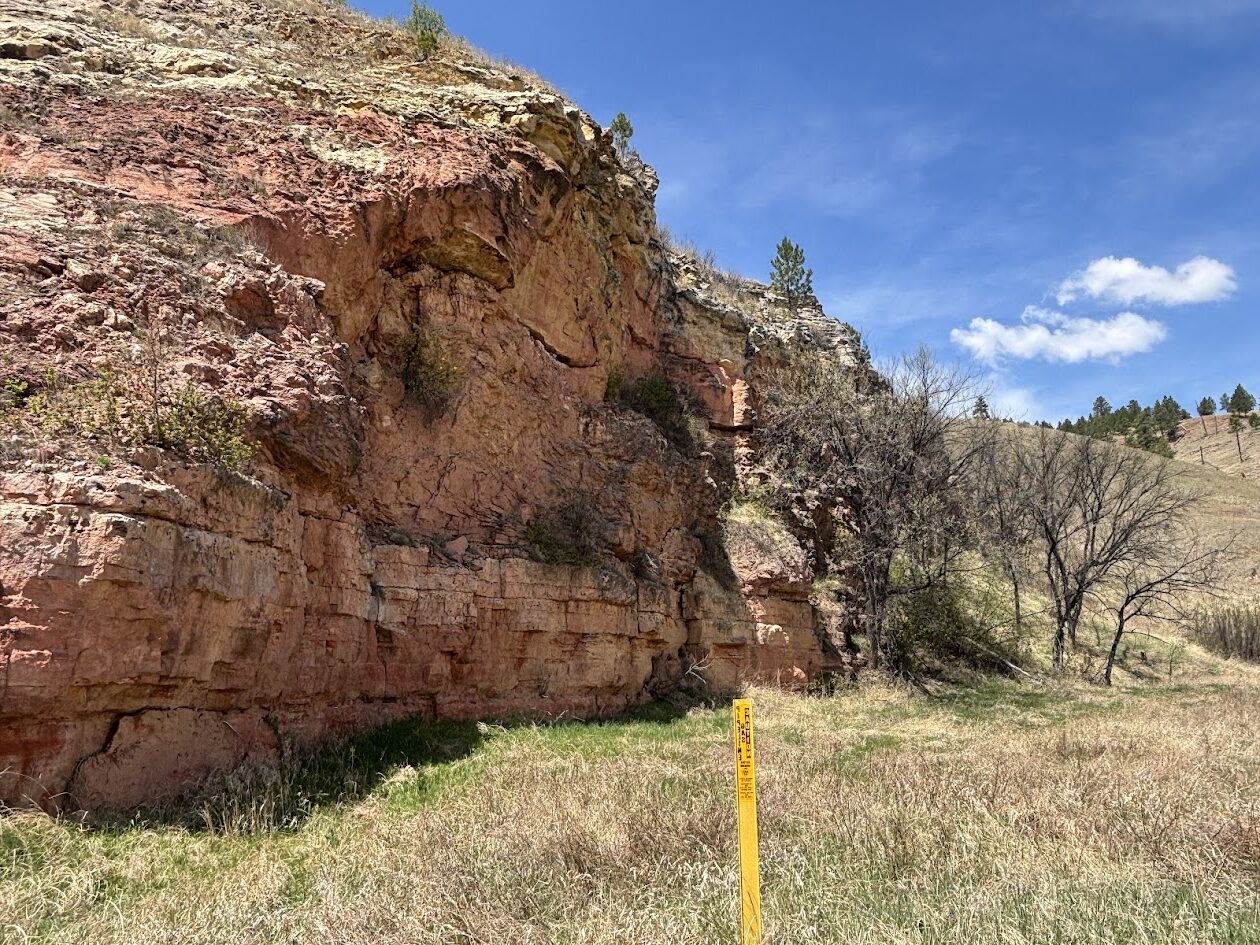
Another option is that the heat was dealt with by some supernatural or as-of-yet undiscovered physical process. Geophysicist Dr. John Baumgardner and Evan Navarro have proposed this as an explanation for the dissipation of heat produced by the catastrophic plate tectonics model he and his colleagues proposed.
Scripturally, Dr. Baumgardner points to 2 Peter 3:3–6, which speaks of God’s involvement during the Flood. He also observes the half dozen or so global-scale erosional unconformities dividing the five (or six) megasequences in the fossil-bearing geologic record as evidence for repeated cooling events during the Flood. Starting in 2023, Baumgardner realized that successive uniform cooling events of new oceanic floors throughout the Flood could explain these features, as opposed to a single cooling event at the end of the Flood. He proposes that each episode of cooling would cause a drop in sea level of almost 2,000 feet (600 meters), potentially producing the erosional unconformity observed at the base of each megasequence.12,13
While the process that caused these cooling events is unknown, Dr. Baumgardner and Navarro’s approach has the advantage of explaining evidence that they argue old-age geological models have difficulty explaining. Their research so far outlines how this could be physically and mathematically described and modeled. However, additional quantitative work is warranted to determine whether these cooling events they postulate can actually produce the geological effects proposed here.
How Can Science Study Supernatural and Unknown Processes?
Critics have argued that appeals to supernatural intervention or unknown processes take creation science outside the realm of scientific inquiry. However, Baumgardner’s proposal above demonstrates why this fails to observe an important distinction. It is certainly not possible to scientifically study or describe the mechanism behind a truly supernatural (or otherwise unknown) process. But if such a process interacted with the real, physical world, science can still investigate the evidence it left behind and test predictions about its physical consequences.
For a fuller discussion of whether claims originating in the supernatural can be scientifically investigated, please see our article, “Is Creation Science Really Science?”
Conclusion: The Path Forward
While the heat problem is as-of-yet unsolved, there remains a clear path forward for future research and open questions that demonstrate the matter is far from settled. Ongoing work is being done to quantify the actual heat budget during the Flood. Currently, estimates vary by a significant margin. Since the heat sources during the Flood were many and varied, it is unlikely that any one explanation will be suitable for all of them. Future work will also likely involve integrated modeling that combines multiple cooling mechanisms working together over time during and possibly after the Flood.
We will also need to re-examine assumptions about physical conditions at the time of the Flood. If these differed from those observed today, it could have massive ramifications for our modeling of the Flood-related cooling mechanisms. Importantly, these are not “magic fixes,” but are all testable within a scientific context.
And finally, we must explore both natural and supernatural frameworks of the Flood carefully. We do not want to exclude a priori supernatural explanations for the heat budget, especially since we know God was involved in the Flood, and He promised to keep Noah and everyone in the Ark safe. However, we must also not overlook possible natural explanations either, as our knowledge of modern processes is incomplete, and it is entirely possible that undiscovered processes could account for the heat problem.
Acknowledgement
The author is grateful to William Worraker for reviewing this article prior to publication and offering constructive feedback. Responsibility for the final content rests with the author.
Footnotes
- Worraker, William. “Heat Problems Associated with Genesis Flood Models—Part 4: Heat Deposited by Magmatic Activity.” Answers Research Journal 16 (2023): 201–251. ↩︎
- Worraker, William, and Richard Ward. 2018. “Modeling of Flood and Post-Flood Ocean Floor Cooling.” The Proceedings of the International Conference on Creationism 8 (1): 673–82. ↩︎
- Kring, David A., and Barbara A. Cohen. “Cataclysmic bombardment throughout the inner solar system 3.9–4.0 Ga.” Journal of Geophysical Research: Planets 107, no. E2 (2002): 4-1. ↩︎
- Gutsick Gibbon. “The Death of ‘Scientific Creationism’?” YouTube video, September 1, 2024. https://youtu.be/yT908HUZ7nI?si=gSQqrTwRkmLEeBEX&t=237. ↩︎
- Winsberg, David. “How to Boil the Oceans Part 1 of 3: It’s Impossible.” YouTube video, January 4, 2026. Posted by Standing For Truth. https://youtu.be/vcU8ESTmckg?si=lehfX81jJT4nZ0AI. ↩︎
- William Worraker, personal communication with author, August 2026. ↩︎
- Humphreys, Russell. 2018. “New Mechanism for Accelerated Removal of Excess Radiogenic Heat.” The Proceedings of the International Conference on Creationism 8 (1): 731–39. ↩︎
- William Worraker, personal communication with author, August 2026. ↩︎
- Worraker, “Heat Problems Associated with Genesis Flood Models—Part 4.” Footnote 1. ↩︎
- Winsberg, David. 2023. “Effects of Hot Post-Flood Groundwater Flow from the Sea Floor.” The Proceedings of the International Conference on Creationism, 650. https://doi.org/10.15385/jpicc.2023.9.1.56. ↩︎
- Winsberg, David. 2023. “Groundwater Flow and the Resulting Heat Transfer from the Sea Floor, Immediately After the Genesis Flood.” The Proceedings of the International Conference on Creationism, 651. https://doi.org/10.15385/jpicc.2023.9.1.57. ↩︎
- Baumgardner, John, and Evan Navarro. 2023. “The Role of Large Tsunamis in the Formation of the Flood Sediment Record.” The Proceedings of the International Conference on Creationism, 363–86. https://doi.org/10.15385/jpicc.2023.9.1.22. ↩︎
- Baumgardner, John. 2025. “How was the ocean lithosphere generated during the Flood cooled to its present state?” In J.H. Whitmore (editor), Proceedings of the 2025 New Scholars International Conference on Creationism, p. 6. Cedarville, Ohio: Cedarville University International Conference on Creationism [oral presentation]. ↩︎



 Jake Ramgren
 Sara Anne
 Ken Coulson
 Abigail L.

 Hannah Klein