

 Hannah Klein
Creation is Fallen: The Curse, Animal Suffering, and the Problem of Natural Evil | Coulson, Ken P. | 2026. Christian Focus Publications | 431 pp.
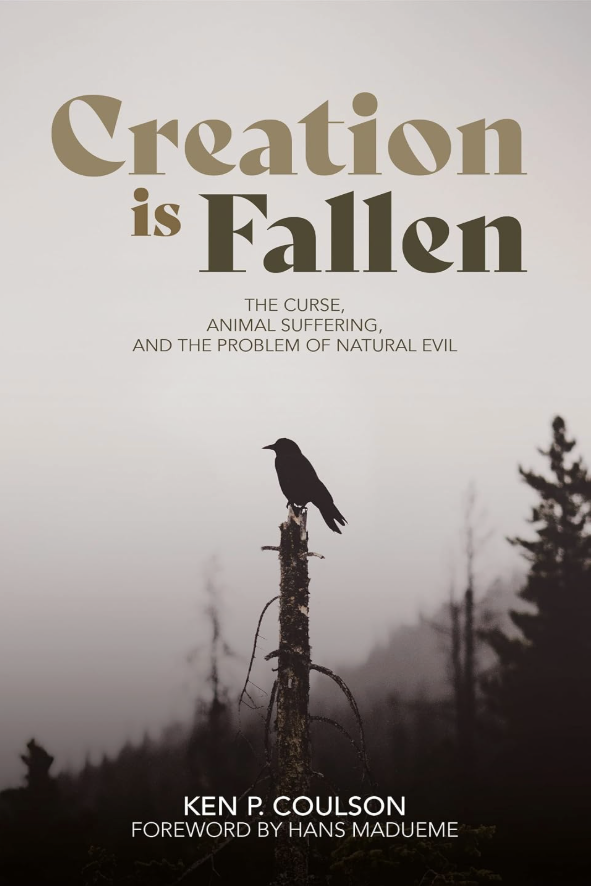
In this new book by Ken Coulson, we are brought face to face with the problem of natural evil. If the world was created by a benevolent, all-powerful Being, why is there so much wanton suffering in this world?
The question of how a good God can allow death and suffering in the world was a topic addressed in a 1993 debate between Christian apologist William Lane Craig and atheist Frank Zindler. Craig, as an old-earth creationist, accepts the evolutionary narrative of xmillions of years of death and suffering before Adam’s sin as part of the process by which God created the universe. Zindler responds to this position by stating that “a being that creates us over all these billions of years, with all the living and dying and blood shed of nature, red in tooth and claw, that is the description of a devil if this is indeed the result of a conscious agent.”1
The Whole Creation Groans
To fully grasp the nature of this problem, we need a clear picture of how much animal suffering exists in the world. Coulson paints for us this picture of the bleakness of natural evil. He doesn’t shy away from the brutality of natural disasters, carnivores, parasitic insects, and so forth. While some forms of animal suffering may render some sort of positive “good” (such as the suffering of a gazelle providing for the hunger of a lion), other examples appear to be purely gratuitous, adding nothing to the positive experience of any creature. As a vivid example of this unnecessary suffering, Coulson dwells long on the Australian bush fires of 2019, in which billions of animals perished, their deaths in no way mitigated by substantial benefits to the outback.
Truly, the whole creation groans. As Christians who believe in an omnipotent and perfectly good God, how do we understand this state of affairs?
Whence Cometh Evil?
A defense, or answer, to the question of how a good God could allow pain and suffering is called a theodicy. In the opening chapters of this book, Coulson devotes particular attention to theodicies presented by theologians and scholars who have adopted interpretations of Genesis that cooperate with the evolutionary history of the universe.
Evolutionary Theodicies
Coulson gives three chapters to assessments of evolutionary theodicies, that is, theodicies which “seek to explain how the evolutionary process, dependent as it is upon copious waste, intense suffering, and extensive extinction, is still compatible with a good, beneficent God”.2 He points out that for most of these, “the final determinative authority seems to rest on reason as it is applied to the rigors of science and philosophical argumentation”3 instead of Scripture.
Some evolutionary theodicies describe natural evil, not as a result of mankind’s sin per se, but rather the necessary process needed for creatures to develop into their full potential. The “kenotic free process” denies the orthodox views of God’s omniscience and sovereignty and explains natural evil as part of the divinely endowed “creaturely freedom.” The “only way” theodicy asserts that death and suffering are necessary evils, allowed to further a greater good. The Cosmic Cross uses some convoluted implications to state that Christ’s incarnation included the entire creation, and thus, natural evil is linked to His sacrifice on the cross.
In addition to these attempts to remove natural evil from any sort of moral responsibility, other evolutionary theodicies try to ground natural evil as the result of sin, while maintaining the beginning of death and suffering before sin. The “retroactive curse” theodicy holds that God, being outside of time, allowed natural evil as a response to the sin that He knew mankind would commit. The Satan Hypothesis tries to remove responsibility from God by suggesting that natural evil is the result of satanic supernatural activity in the creation.
Evil? What Evil?
A more recent player in the field is the “no theodicy required” camp, which holds that the creation, as it is, with its evolutionary history of millions of years of death and suffering, is good – very good, in fact – and fulfills God’s original creational purpose. In other words, all of the goodness and beauty of creation is dependent on and brought about by necessary death and suffering. Such lines of reasoning “often usurp Genesis 1:31’s ‘very good’ and conflate it with these greater goods, a tactic that frequently encourages a non-critical apathy to natural evil.”4 Coulson addresses this by reminding us of the concept of “meritorious justice,” that is, “the recipient of the suffering must, at least in some sense, merit the justice and affiliated suffering.”5
Beyond the tactic of overlooking natural evil as a necessary condition of a “very good” creation, some scholars have gone so far as to dismiss the problem of natural evil and animal suffering entirely. This is effectively neo-Cartesianism: “animal pain, if it can even be called that, is just not as objective, and thus as significant, as humans make it out to be.”6 Proponents of this viewpoint downplay animal suffering as they assert that natural evil, albeit with perhaps less hostility toward humans, was a part of God’s original, very good universe. Coulson’s response to this approach emphasizes the Biblical passages which speak of God’s desire for animals to be treated without cruelty (Proverbs 21:20, Exodus 23:12, Deuteronomy 25:4). He also points out that proponents of this viewpoint tend to gloss over some very grisly behaviors of predatory or parasitic animals.
Of Man’s First Disobedience

After this treatment of various evolutionary theodicies, Coulson takes us through several relevant Biblical passages that speak to the Edenic era and the effects of the Fall. In Genesis 1-8, we learn about what Eden was like, and the changes that resulted from Adam and Eve’s sin and the subsequent curse. The entrance of death into the world is morosely emphasized with the genealogical refrain: “and he died,” repeated over and over in the detailing of Noah’s family tree.
Between clean and unclean
Coulson also takes some time to consider the clean and unclean animals of the Levitical law, and what these passages (Leviticus 11 and Deuteronomy 14) might tell us about the effects of the Fall. Coulson takes the approach that many of the divisions between clean and unclean creatures are related to predatory behaviors in the animal kingdom, which makes sense if animal predation was absent in the “very good” creation. He further suggests that the unclean classification of bottom-dwelling aquatic creatures and crawling insects reflects the curse upon the serpent (Genesis 3:15).
How Wonderful are Your Works
Some people use Psalm 104 and Job 38-39 to support animal predation and suffering in God’s original creation. In these passages, God is glorified for majestic and awe-inspiring animals which reside at the top of the food chain – lions, birds of prey, and the Leviathan. Coulson argues that these passages are clearly speaking of God’s providential care in the post-Fall world, and do not tell us what Eden was like. In fact, the prophetic passages of Isaiah 11 and 65, which speak of a future world in which “the wolf will dwell with the lamb,” illustrate God’s intended and desired relationship between animals in His ideal creation. And, Coulson argues, Romans 8 speaks of the effects of the Fall impacting the whole of creation, contra the “no theodicy required” position.
Subdue and Have Dominion
Evolutionary theologians often use the dominion mandate given to Adam in Genesis 1:28 as evidence that the pre-Fall creation was a wild, dangerous place, in need of subjugation. Coulson devotes an entire chapter to the discussion of the Hebrew words “kabash” and “radah,” translated in Genesis 1 as “to subdue” and “to rule.” Coulson uses the example of the Messianic King of Psalm 72 to illustrate that the rule and subjugation of Genesis 1 can be expressed in a kingly and benign way, and doesn’t imply violent or harsh subjects, needing domination. Specifically, Coulson argues that the verb “kabash” (“to subdue”) is only used in Genesis 1 in reference to plant life, and speaks to the agriculture necessary to maintain and keep the garden which was given into Adam and Eve’s charge.
All was Perfect Good

What does “very good” look like, in the divine definition of the term? This is the next question Coulson tackles in this book. The repeated motif of God looking over His creation and seeing that “behold, it was good” is meant to contrast with Genesis 3 and its account of the entrance of sin into the perfect world. Coulson urges us to “allow Genesis 3 to fulfill its divinely intended purpose – to defend God and His goodness. Genesis 3 is a theodicy.”7
Coulson addresses an understanding of the phrase “very good” that is often circulated in young-age creationist circles – the idea that “very good” is equivalent to “perfection.” This idea has been used to promote some rather awkward ideas about the Edenic era. For example, the second law of thermodynamics is also known as the law of entropy: entropy (or disorder) increases over time. Some young-age creationists have argued that this entails decay, and therefore, couldn’t have been a part of the “very good” (or perfect) creation. The problem is that the second law of thermodynamics fundamentally speaks of the exchange of energy from higher energy to lower energy environments. Thus, the Sun shines light on the Earth via the second law of thermodynamics. Clearly, we have to distinguish between God’s assessment of “very good” and an arbitrary concept of perfection.
Furthermore, the Hebrew word translated “good” (“tob”) doesn’t necessarily convey the concept of perfection. There are Hebrew words that carry this idea, but these are not what Moses uses in the Genesis account. The goodness of the original creation speaks to its complete fulfillment of God’s intended purposes: “these things are all ‘good’ and ‘very good’ because they are working in accordance with God’s divine command.”8
Contextualizing “Very Good”
The meaning of “very good” is also emphasized by considering the immediate context of Genesis 3 and the following chapters. Human death, increased pain in childbirth, thorns and thistles, physiological changes in at least snakes (and possibly the other animals) were a direct result of part of the judgement for Adam and Eve’s sin in Genesis 3. From elsewhere in Scripture, it also appears that predatory behaviors among animals and natural disasters are also directly related to the effects of the Fall. Specifically, Paul’s discussion of the futility to which creation has been subjected (in Romans 8) is contextually linked to the Genesis account, further strengthening the argument that “the whole creation groans” (Romans 8:22) as a result of Adam’s sin.
Did Adam Step on an Ant Before the Fall?
Of course, the young-age creationist assertion of the original “goodness” of the pre-Fall world raises the question of random accidents: “did Adam step on an ant or scratch his arm on a twig? And if he did, was pain and/or suffering involved?”9 Coulson acknowledges that this is a valid concern which young-age creationists don’t address enough. After surveying some of the different ways creationists have grappled with this question, Coulson presents his preferred answer: the working of God’s “meticulous providence.” God’s providence, he explains, “describes His governance over all things, specifically as that governance fulfills His divine purposes.”10 This effectively means that nothing in the universe is left to chance.
Coulson brings before us the account of Ahab’s divinely orchestrated death in 1 Kings 22 to illustrate this concept. Prior to going up in battle against Ramoth-Gilead, Ahab consults with a prophet who foretells his death in battle. In 1 Kings 22:34, we learn that Ahab was indeed killed when “a certain man drew his bow at random and struck the king of Israel in a joint of the armor.” Thus, though his death was foretold, the actual means of Ahab’s death was by a seemingly random shot. “God used many different facets of the natural world themselves spread over thousands of years of seemingly ‘random’ events to bring a single wooden arrow, haphazardly fired from the bow of a non-collaborative soldier to hit its mark down to the nearest millimeter.”11
Thus, Coulson argues, God’s meticulous providence, working through the normal operations of the natural world, could have ensured a perfectly safe habitation for Adam and Eve, as well as the rest of creation. This mirrors what we expect in the eternal state, described in Revelation 21, a place without “any mourning, or crying, or pain” (Revelation 21:4).
Could Adam Stub His Toe Before the Fall?
Another related question concerns the presence of “good” pain. Certain forms of pain are necessary for preventing bodily injury or physiological damage. While some have argued an entirely pain-free Edenic era, Coulson makes a distinction between pain and suffering. Some forms of pain, such as the pain of hunger, are healthy and important for our well-being; in the case of hunger pains, reminding us to eat. Hunger pains don’t become suffering unless the body is kept from nourishment, which, in the Garden of Eden, wouldn’t have occurred. We can infer the presence of certain forms of natural, “good” pain from the curse to the woman, where God tells Eve that He will “multiply” her pain in childbirth (Genesis 3:16). The use of the word “multiply” implies that childbirth already involved some measure of pain, albeit not at a level where it would be considered suffering.
Earth Felt the Wound

While Scripture is clear in its teaching that human death is the result of sin, there is no such unambiguous teaching regarding animals before the Fall. Many young-age creationists look to passages such as Romans 5 to argue for the immortality of not only humanity, but the animal creation, before sin. Coulson demonstrates that this is an incorrect interpretation; Romans 5 is speaking only of humanity’s subjection to death.
However, an argument for animal immortality before the Fall can be made by considering the connection between animal death and suffering and human sin. Coulson presents several passages from the Old Testament which link animal suffering to the sin of the nation of Israel. “These passages plainly support the doctrine that God judiciously inflicts suffering on animals as a result of human sin. When these Bible texts that explicitly link human sin to animal death are combined with Romans 8:18-23 and Genesis 3, we have a strong, convincing, and articulate theodicy that ties all animal suffering to the fall as is recorded in Genesis 3.”12 Thus, while young-age creationists may be misguided in trying to use Romans 5 as a statement of animal death as a result of sin, the concept that animal death and suffering are related to the Fall is supported by the tenor of Scripture.
And as for the viper
Perhaps one of the greatest challenges for the young-age creationist understanding of the Fall is posed by the exquisite, well, design of predatory animals. From the pit vipers to T. rex, we see evidence of finely crafted killing machines, animals that literally are designed to thrive on a carnivorous diet. How did such creatures fit within the Edenic world, with its deathless economy?
Coulson evaluates, and finds wanting, the young-age creationist claims that such creatures were designed to use their sharp teeth to cut through thick-rined fruits, or that obligate carnivores were able to subsist on vegetation since the time between Creation and the Fall was so brief. Instead, he argues that we can’t escape the conclusion that there were some massive physiological changes instituted at the time of the Fall. While some Christians have been historically bothered by the idea of God designing vicious predators, Coulson reminds us that “Scripture is very clear that God is glorified both in salvation and in judgment.”13
As far as the scientific implications of the rapid biological diversification necessary to explain the full-featured design of predatory creatures, Coulson relies on the concept of “mediated design”, which “explains the expression of biological adaptations that, although genetically latent during Creation Week, arose through historical processes.”14 In other words, God created the genomes of animals with the information necessary to develop predatory characteristics, but these were not expressed until after the Fall.
Justifying the Ways of God to Men
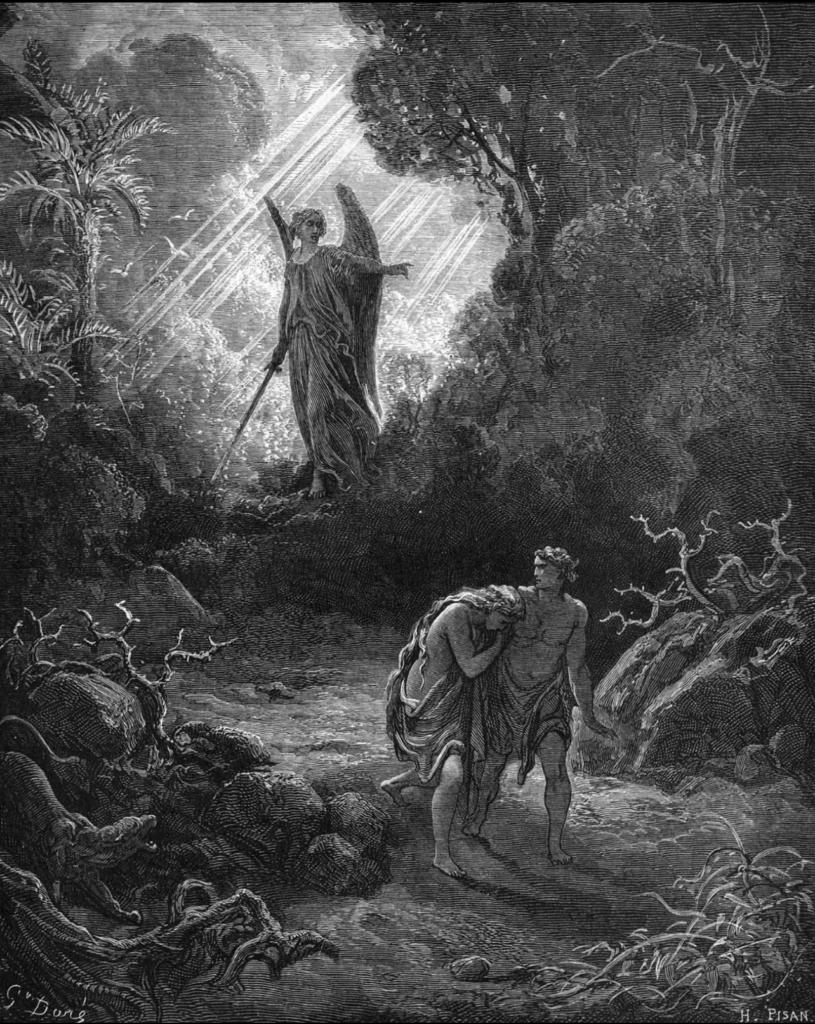
How we answer the question of how a good God can allow death and suffering in the world has very significant implications. Scripture presents us with a clear picture of a “very good” creation, wherein death and suffering were strangers; a world where the sin of the first humans unleashed God’s catastrophic judgement. Every attempt to fit animal death and suffering into this world, before sin, ends up tainting the character of God by redefining His pronouncement of a “very good” world.
In contrast, the young-age creationist theodicy rightfully describes all of the fallenness of creation – human death and suffering, the seemingly meaningless suffering of the animal kingdom, natural disasters – as the direct judgement of God for human sin. It also looks forward to the day when the curse is reversed, when “all things are made new” (Revelation 21:5), and paradise lost makes way for paradise restored.
Footnotes
- Craig, W. L. (1993, June 27). Atheism vs. Christianity: Where does the evidence point? [Debate]. Willow Creek Community Church, South Barrington, IL, United States. 1:40:22. ↩︎
- Coulson, K. P. (2026). Creation is fallen: The curse, animal suffering, and the problem of natural evil. Christian Focus Publications. Page 42. ↩︎
- Coulson, K. P. (2026). Creation is fallen: The curse, animal suffering, and the problem of natural evil. Christian Focus Publications. Page 42. ↩︎
- Coulson, K. P. (2026). Creation is fallen: The curse, animal suffering, and the problem of natural evil. Christian Focus Publications. Page 111. ↩︎
- Coulson, K. P. (2026). Creation is fallen: The curse, animal suffering, and the problem of natural evil. Christian Focus Publications. Page 117. ↩︎
- Coulson, K. P. (2026). Creation is fallen: The curse, animal suffering, and the problem of natural evil. Christian Focus Publications. Page 121. ↩︎
- Coulson, K. P. (2026). Creation is fallen: The curse, animal suffering, and the problem of natural evil. Christian Focus Publications. Page 225. ↩︎
- Coulson, K. P. (2026). Creation is fallen: The curse, animal suffering, and the problem of natural evil. Christian Focus Publications. Pages 220-221. ↩︎
- Coulson, K. P. (2026). Creation is fallen: The curse, animal suffering, and the problem of natural evil. Christian Focus Publications. Page 264. ↩︎
- Coulson, K. P. (2026). Creation is fallen: The curse, animal suffering, and the problem of natural evil. Christian Focus Publications. Page 267, emphasis original. ↩︎
- Coulson, K. P. (2026). Creation is fallen: The curse, animal suffering, and the problem of natural evil. Christian Focus Publications. Page 267. ↩︎
- Coulson, K. P. (2026). Creation is fallen: The curse, animal suffering, and the problem of natural evil. Christian Focus Publications. Page 304. ↩︎
- Coulson, K. P. (2026). Creation is fallen: The curse, animal suffering, and the problem of natural evil. Christian Focus Publications. Page 318. ↩︎
- Coulson, K. P. (2026). Creation is fallen: The curse, animal suffering, and the problem of natural evil. Christian Focus Publications. Page 321. ↩︎


 Christian Ryan
 Noel Grimes
 Abigail L.
 Paul Garner
 Todd Wood
 Ken Coulson
 New Creation Staff

 Peter
Peter
I don’t usually agree with atheists, but I think Frank Zindler had a valid point.