
 Peter
PeterEarlier this year, The National Museum of Czechia displayed the famous “transitional fossil” Lucy. The fossil was on temporary loan from the National Museum of Ethiopia. Lucy’s bones were incorporated into a new exhibit entitled “People and their Ancestors.”11 I had the privilege to visit the exhibition in October, along with a couple of creation scientists.
The views expressed in this article reflect those of the author mentioned, and not necessarily those of New Creation.
Lucy was discovered fifty-two years ago, in 1974. But creationists are still struggling to understand the fossil. Some large creationist ministries argue that Lucy was a knuckle-walking ape like modern chimpanzees. Many creationists believe that Lucy is a fake; they claim that her skeleton is a mix of human and ape bones. A few people on the other side of the spectrum argue that Lucy was a short human!
Like the creationists mentioned above, I believe that God directly created humans just thousands of years ago. But my research has led me to a different understanding of Lucy. Years of careful anatomical study have led me to conclude that Lucy was just an ape, unrelated to humans. But unlike chimps and gorillas, Lucy walked upright. She was able to stand and walk on her hind legs like a human. Seeing the original fossil was an amazing experience that confirmed my interpretation. I am extremely grateful to the Genesis Fund and its contributors for supporting my trip. Thanks to them, I was able to familiarize myself with the original fossils and gather data for my research.
Lucy in Prague
I first learned about Lucy’s exhibition from Dr. Todd Wood this past August. We have been studying human origins together since 2020. Together, we have carefully measured and analyzed replicas of Lucy’s bones. Dr. Wood and I often dreamed of seeing the original skeleton. But since 2013, her bones have been stored in the war-torn country of Ethiopia. This fall, Lucy’s skeleton was on display in Prague. And Lucy didn’t make the three-thousand-mile journey to Czechia alone! A baby Australopithecus nicknamed “Selam,” accompanied her. I knew I couldn’t pass up the opportunity to see both of these famous fossils!

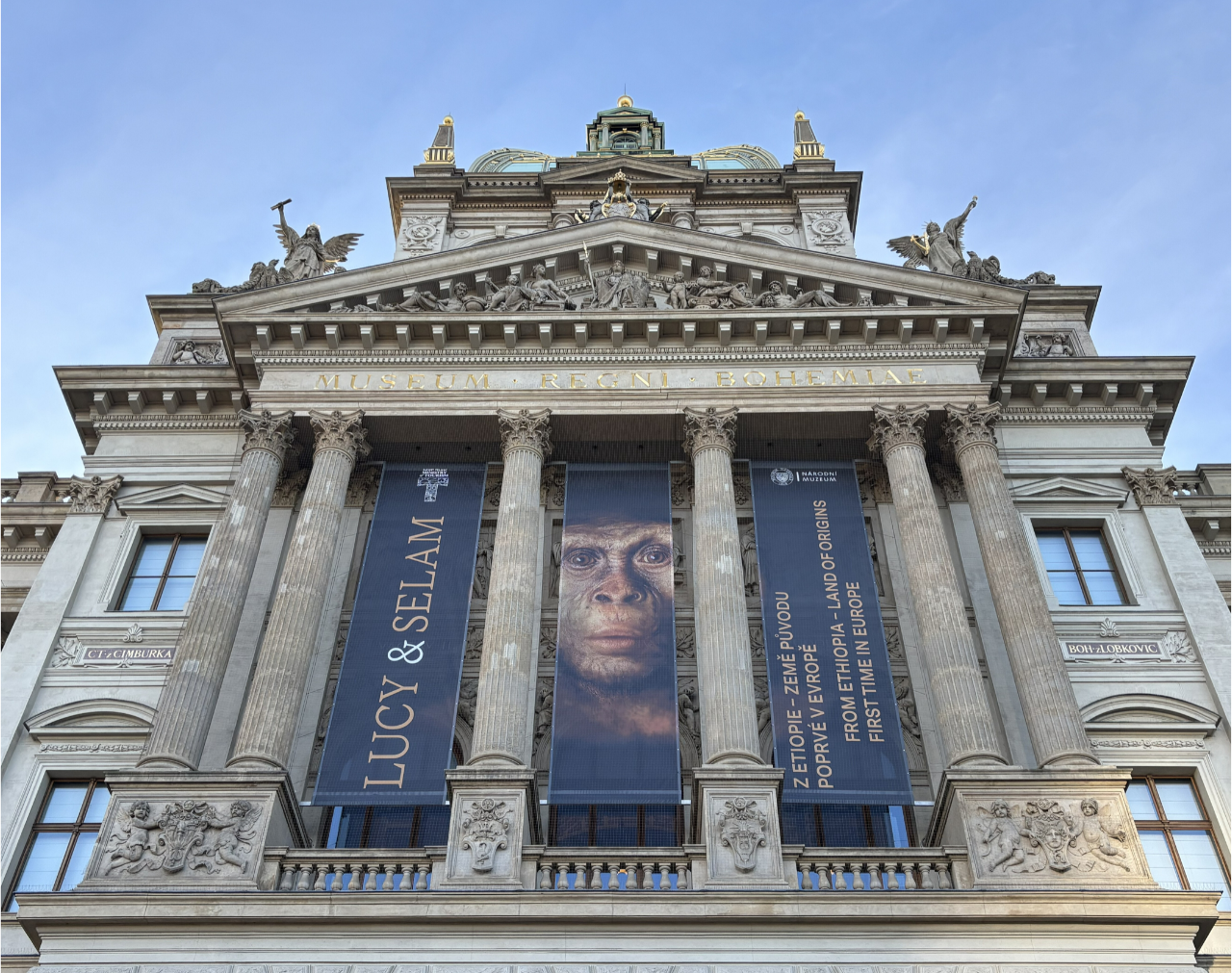
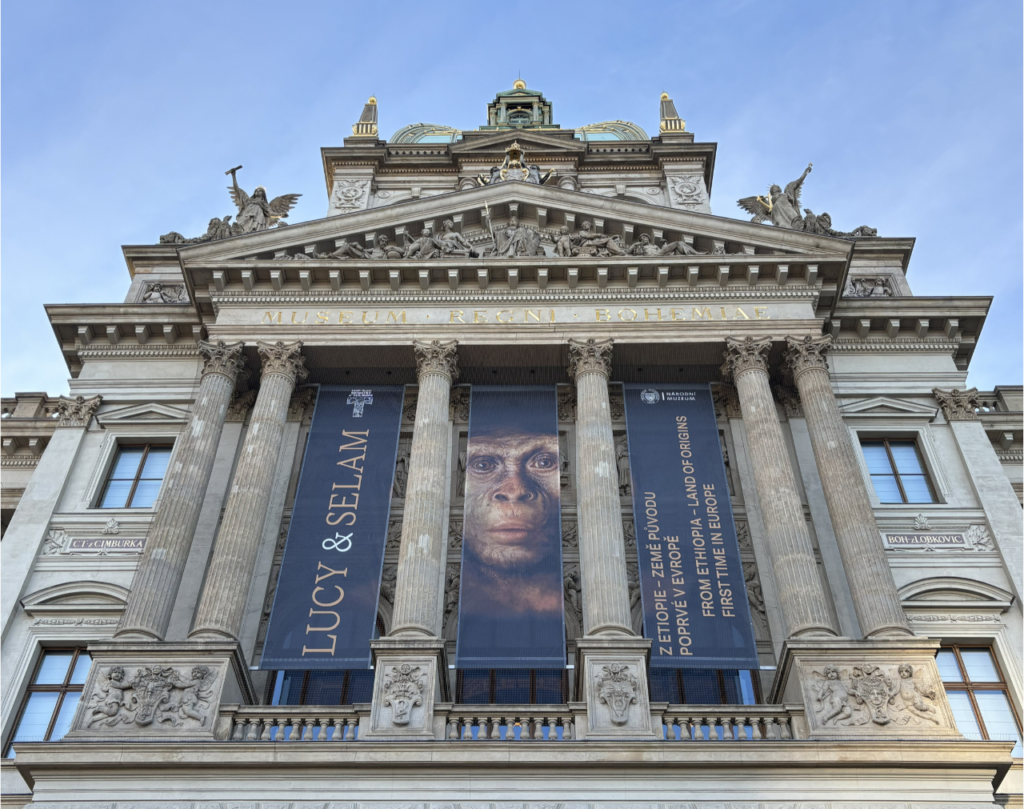
Sixty days later, I stood outside the National Museum in Prague. The sky was overcast and gray, but the morning air was pleasant. Banners advertising Lucy’s exhibition flew far above, between the museum’s stone columns. A small group of museum goers had already gathered by the doors. Clamoring voices rose from below the plaza as several groups of school children began to climb the stairs to the museum entrance. Dr. Todd Wood, geologist Paul Garner, and I joined the growing line. At nine o’clock, an elderly gentleman opened the doors and welcomed the crowd in.
The People and Their Ancestors Exhibition
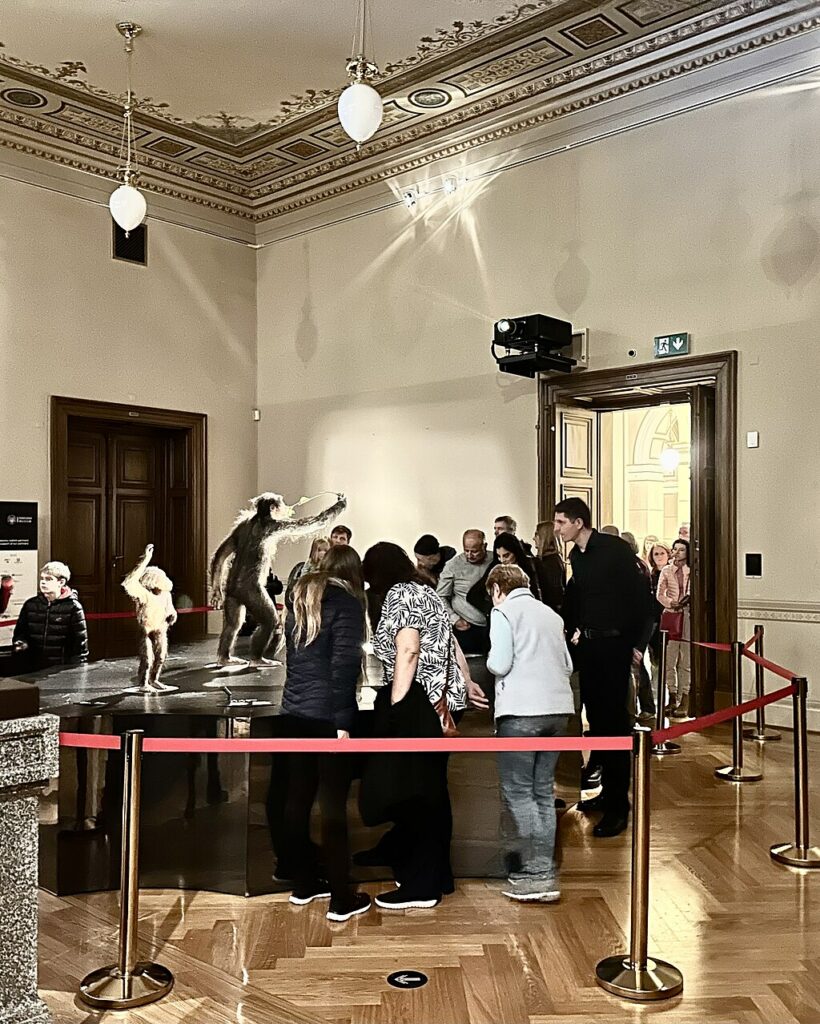
Pavel.motejzik, https://creativecommons.org/licenses/by/4.0/deed.enWe scanned our tickets and climbed the museum’s central staircase. The stairway was flooded with natural light from the glass ceiling several stories above. A final flight of stairs brought us to the entrance of the People and their Ancestors exhibit. A tall wooden doorway framed the exhibit’s entrance. Although the museum had just opened, a line of visitors already extended out of the exhibit hall and into the corridor. Large black poster boards explaining the exhibition flanked the doorway. Docents in maroon shirts managed the growing crowd and reminded us that photography was not allowed inside the exhibit.
I joined the line and inched forward into the dark room. A projector screen hung from the ceiling at the back of the exhibit. It displayed a rotating model of Lucy’s skull. As I approached the center of the room, I saw a large black display case. It was shaped like Ethiopia; the country’s rivers and lakes were etched into its surface. A reconstruction of Lucy stood atop the case. Her hairy, apish body stood upright. She held a leafy twig in her right hand. Lucy’s lips puckered, preparing to strip off the tasty leaves. Ropes encircled the display case, forcing the crowd to move around it in a clockwise direction. Security guards in black uniforms stood on either side of the exhibit, just outside the ropes. They were quick to shout at visitors who pulled out their phones or tapped the glass. The line shifted forward again, and I caught my first glimpse of Lucy.
Meeting Lucy and Selam
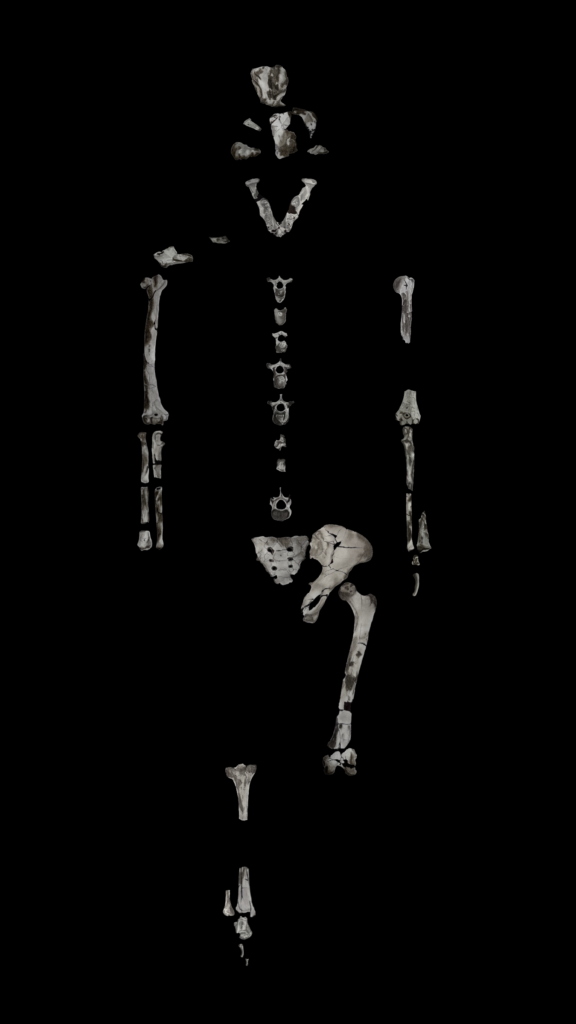
Lucy’s skeleton was beautiful and petite. The bones were a light tan color, dotted with splotches of purplish brown. Lucy’s teeth were a lovely deep brown color that seemed almost opaque. Each bone was deeply familiar to me; I have spent many hours studying photos, casts, and 3D models of Lucy. But for the first time, I could see small spidery cracks weaving through certain bones. I appreciated the smooth, well-defined facets where bones connected to each other. After a few moments, the crowd pushed forward again, and Selam’s skeleton came into view.
Selam was just two and a half years old when she died. Her delicate little skull faced me, its eyeless sockets staring straight forward. Selam’s bones were a deep tannish brown color compared to Lucy’s. Her backbone lay in a single, twisting piece beneath her skull. Ribs splayed outwards at odd angles. Selam’s tiny limb bones were still at an early stage of development. At the end of the case sat Selam’s foot. It was tiny, much smaller than I expected. All the little foot bones could have neatly fit inside a pill bottle. The line progressed, and I circled around the display case back into the bright museum hall.
How Accurate are Replicas?
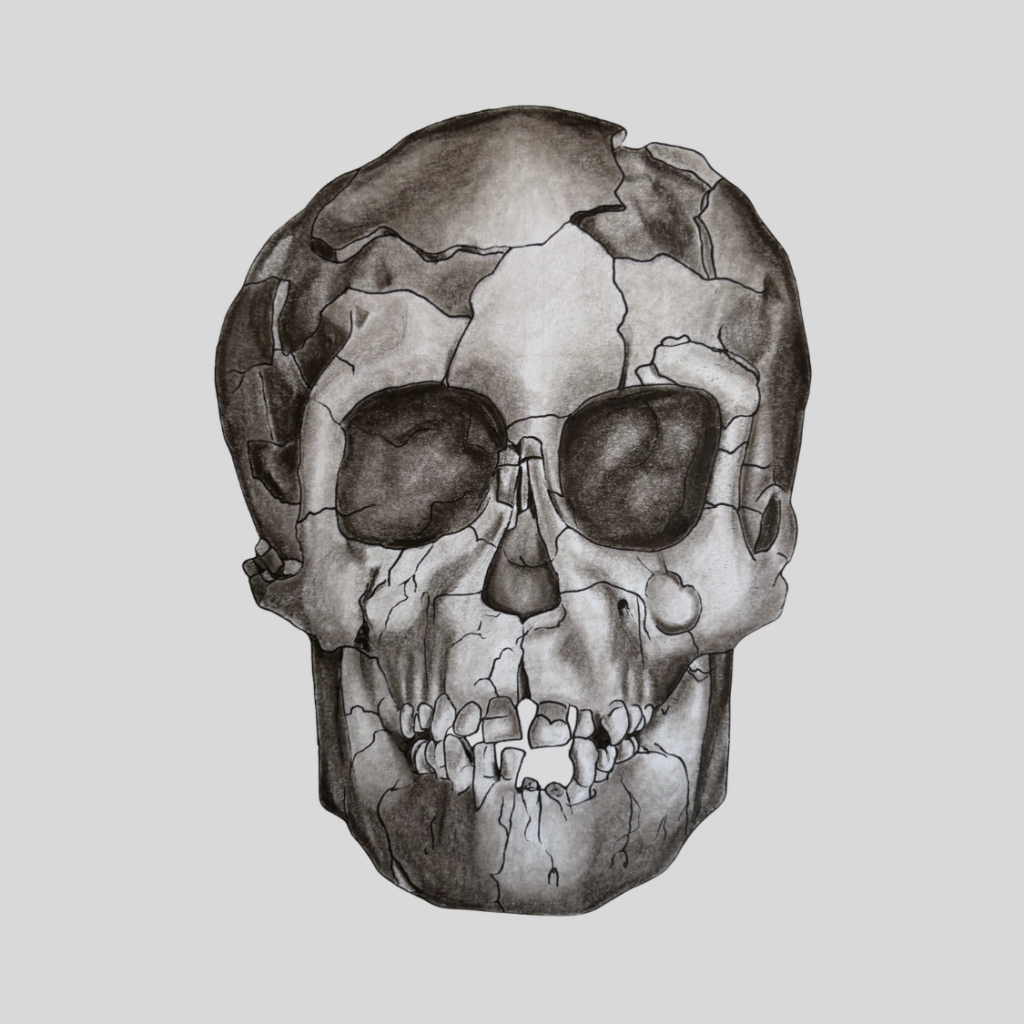
Several years ago, I purchased a cast of Lucy’s skeleton from a retired museum curator. Seeing Lucy’s original bones helped me judge the accuracy of this replica. I regularly use this cast in my research. But replicas cannot replace the original fossil. It is important to double-check observations made on casts by looking at the actual specimen. I brought photos of my cast to the exhibition and compared them to Lucy’s bones. In general, my cast was accurate. Bones appeared very similar in length, width, and shape. Before entering the exhibit, I suspected that a couple of bones in my cast were distorted. My suspicions were confirmed when I saw Lucy’s bones. For example, my cast of Lucy’s ankle bone had a bump and ridge that were not present in the original. These types of observations helped me understand which parts of my cast are reliable and which are not.
Did Lucy Have Ape-like Limb Proportions?
The relative length of Lucy’s arms and legs can help us understand how she behaved. Chimpanzees have very long, muscular arms which they use for climbing and knuckle walking. Their legs are comparatively short. When a chimpanzee stands upright, its hands hang down to its knees. In contrast, humans have long legs and shorter, weaker arms. We rarely use our arms to get around, but our long legs allow us to cover ground quickly.
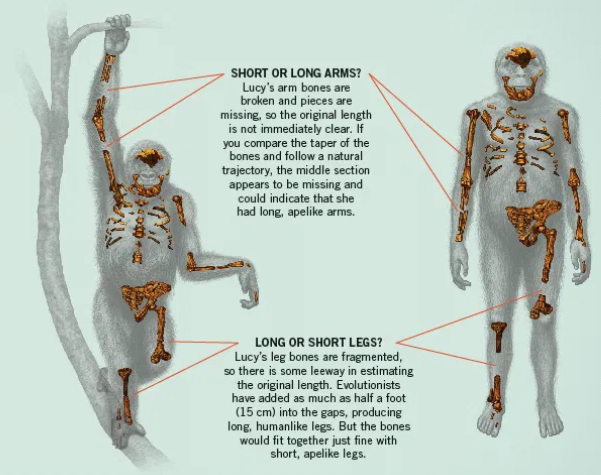
Unfortunately, Lucy’s arm and leg bones are broken. Creationist researchers at Answers in Genesis have claimed that Lucy’s limb bones can be reconstructed in either a chimp-like or a human-like way. Their diagram, shown on the left, displays two alternative reconstructions of Lucy’s limbs. It implies that Lucy had long arms and short legs like a chimpanzee.
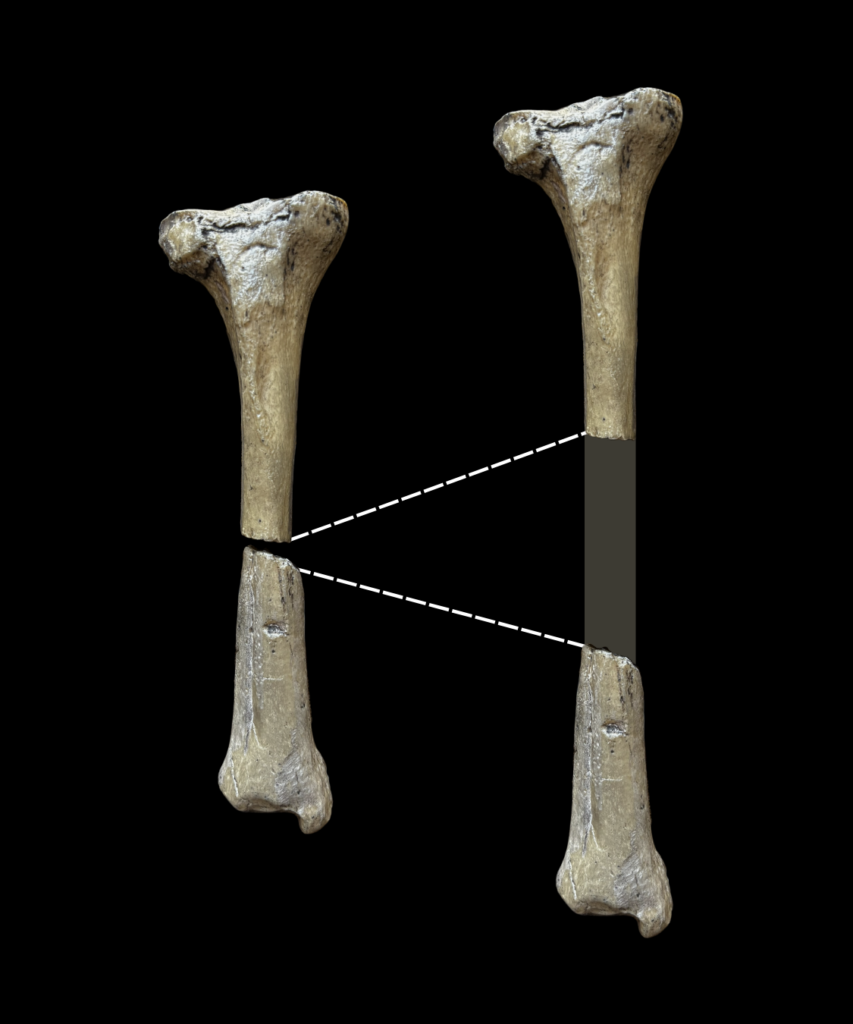
As I looked at Lucy’s bones, it became obvious that the “ape-like” reconstruction proposed by AiG is inaccurate. I saw that the bones of Lucy’s right arm fit neatly together. There were no gaps between the fragments of the arm bones. Each segment had a distinctive break matching the piece below. Lucy did not have a short, stumpy leg either. AiG’s diagram implies that the upper and lower pieces of Lucy’s shinbone fit directly together. However, these fragments do not connect. The lower portion of the shaft is much thicker than the upper portion. The size difference indicates that a large portion of the bone’s shaft is missing. Lucy’s lower leg was longer than creationists claimed.
Reliable reconstructions show that Lucy’s legs were longer than her arms.23 Like humans, she walked on her hind legs. But her arms were not as short as a modern human’s. The length of Lucy’s arms indicates that she may have engaged in a limited amount of climbing. But unlike chimpanzees, Lucy was habitually bipedal. She likely spent much of her time standing and walking.
Conclusion
Seeing Lucy and Selam was a dream come true! Ancient hominin fossils are extraordinarily rare, and are not usually on public display. I was delighted to see the skeletons and compare them to my cast. After seeing Lucy, I am even more confident in my conclusion that she walked upright. This appears to be an example of common design. God gave Lucy many of the same anatomical features He gave humans, because He intended that both be bipedal.
Footnote
- National Museum of the Czech Republic, “The Iconic Human Ancestor Australopithecus afarensis ‘Lucy’, Together with ‘Selam’ Will Visit Prague in August,” National Museum of the Czech Republic press release, February 5, 2025, nm.cz, accessed November 26, 2025, https://www.nm.cz/en/media/press-releases/the-iconic-human-ancestor-australopithecus-afarensis-lucy-together-with-selam-will-visit-prague-in-august-the-national-museum-and-the-ministry-of-tourism-of-ethiopia-will-present-to-the-public-some-of-the-most-valuable-and-ancient-paleoanthropologic. ↩︎
- Milford H. Wolpoff, “Lucy’s Lower Limbs: Long Enough for Lucy to Be Fully Bipedal?” Nature, 304, no. 5921 (July 7, 1983): 59–62. ↩︎
- William L. Jungers, “Lucy’s Limbs: Skeletal Allometry and Locomotion in Australopithecus afarensis,” Nature, 297, no. 5867 (June 24, 1982): 676–678. ↩︎
 Christian Ryan
 Noel Grimes
 Ken Coulson

 Kurt Wise


 Abigail L.
What do you think of the hypothesis that Lucy was killed by a fall from a tree?
Hi, I think it is reasonable to conclude that Lucy might have been killed by a fall. The hypothesis seems to fit with the way in which her bones are broken. I am careful not to generalize this interpretation to reconstruct Australopithecine behavior. Even if Lucy died by falling out of a tree, this does not mean that her species regularly climbed trees.
There is evidence that Australopithes moved by brachiation
Zeresenay Alemseged, Fred Spoor, William H. Kimbel, René Bobe, Denis Geraads, Denné Reed and Jonathan G. Wynn
Nature 443, 296-301 (21 September 2006)
Hi Marc, thanks for sharing. Australopithecines undoubtedly have some traits associated with arboreal locomotion. However, the presence of these traits does not erase the evidence for bipedality. The reasonable conclusion is that Australopithecines could climb and walk upright. However, the shape of their foot, limb proportions, etc.. imply that they were more at home on the ground.
Why do you think it is that there are no bipedal apes around today?
We don’t have any hard evidence indicating why Australopithecus and Paranthopus went extinct. It seems possible that humans could have played a role, but that is just speculation. Some apes alive today, like gibbons, walk bipedally whenever they are on the ground. But gibbons do not walk the same way as humans or Australopithecines did.