
 Jake Ramgren
Imagine an airplane is flying on autopilot. The plane is steady, programmed to go in a certain direction. Suddenly, in its direct path, a mountain appears through the clouds. The plane’s sensors go off, alerting the mechanical pilot that an obstacle is in the way. The plane’s system assesses the new information and automatically instigates a response: fly higher! The plane tilts upwards, gaining altitude until it is high enough to cruise over the mountain. After it clears this mountain, the plane slowly returns to its normal altitude, adjusting back to equilibrium.
The plane on autopilot reflects a complex array of skill and engineering. The designer of the plane programmed the machine to sense changes in its environment, evaluate the required response, and then physically alter its course to account for the change. This scenario is a perfect parallel to how organisms function in the world, at least according to a new theory developed by scientists from the Institute for Creation Research (ICR).
What’s the Big Idea?
The theory Continuous Environmental Tracking (CET) offers a new approach to looking at organisms. Instead of interpreting all species as a result of environmental forces acting on living things and shaping them through natural selection, CET suggests that organisms are already designed or programmed to constantly sense environmental changes and immediately adapt in response to them.1 Each environmental change is like a mountain in front of a plane. The organisms (the plane) sense the change and physically change to adapt to the new conditions. This theory’s greatest strength is how it treats animals and plants: as things that were designed and engineered by a Creator to live in this world.
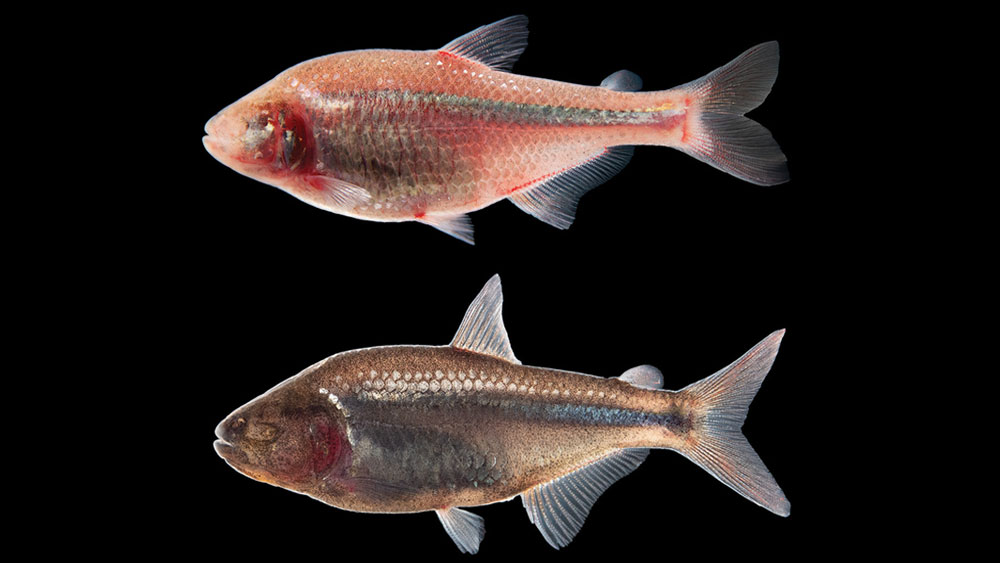
Another strength of CET is prevalent real-life examples of animals adapting rapidly after sensing environmental changes. Most notably, ICR continues to show rapid adaptive processes in cavefish, including dramatic morphological change without natural selection or other Darwinian processes.2 Some research outside ICR shows lizards quickly changing the lengths of their legs when introduced to a new island.3,4 These two cases did not require many generations of “survival of the fittest” but rather occurred immediately (sometimes in a single generation) triggered only by the organism’s internal ability to sense (or “track”) changes in their immediate environment.
What Does This Mean for Creationism?
Continuous Environmental Tracking is growing in creation circles. Its findings in nature are fascinating and helpful in explaining rapid post-Flood diversification. Similar to Darwin’s ideas in the 1850s, the scale or scope of CET is controversial and there are still many aspects to discuss. Is this the only mechanism for diversification? Or do Darwinian forces also impact species? In other words, perhaps our airplane analogy is incomplete; maybe some airplanes do not have perfect sensory systems and crash into mountains, leaving the functioning planes to continue to survive by rebuilding functional and effective planes (i.e. “survival and reproduction”).
Is CET single-handedly responsible for adaptation and diversification? Or is it complementary to other mechanisms (natural selection, sexual selection, mutations, etc.)? These questions are at the center of ongoing discussions among creationists. Either way, CET is a powerful biological theory that effectively explains today’s biodiversity by treating animals as engineered and designed entities rather than sculpted by harsh Darwinian forces.
Footnotes
- Guliuzza, R. J., & Gaskill, P. (2018). Continuous environmental tracking: an engineering framework to understand adaptation and diversification. In Proceedings of the International Conference on Creationism (Vol. 8, No. 1, p. 11). ↩︎
- Boyle, M. J., Thomas, B., Tomkins, J. P., & Guliuzza, R. J. (2023). Testing the Cavefish Model: An Organism-focused Theory of Biological Design. In Proceedings of the International Conference on Creationism (Vol. 9, No. 1, p. 17). ↩︎
- M. Eloy de Amorim, T.W. Schoener, G.R.C.C. Santoro, A.C.R. Lins, J. Piovia-Scott, & R.A. Brandão, Lizards on newly created islands independently and rapidly adapt in morphology and diet, Proc. Natl. Acad. Sci. U.S.A. 114 (33) 8812-8816, https://doi.org/10.1073/pnas.1709080114 (2017). ↩︎
- Gulliuzza, Randy. Engineered Adaptability: Adaptive Solutions Are Targeted, Not Trial-and-Error. Institute for Creation Research. 2018. Engineered Adaptability: Adaptive Solutions Are Targeted, Not Trial-and-Error | The Institute for Creation Research
↩︎


 Christian Ryan
 Noel Grimes
 Paul Garner
 Todd Wood


 Abigail L.

 Hannah Klein
Thank you for an interesting article, I have myself called this adaptability for “adaptive packages” but the idea is the same. What I wonder is, is whether you think this ability can be accounted solely by epigenetics or if something more is needed.