
 Hannah Klein
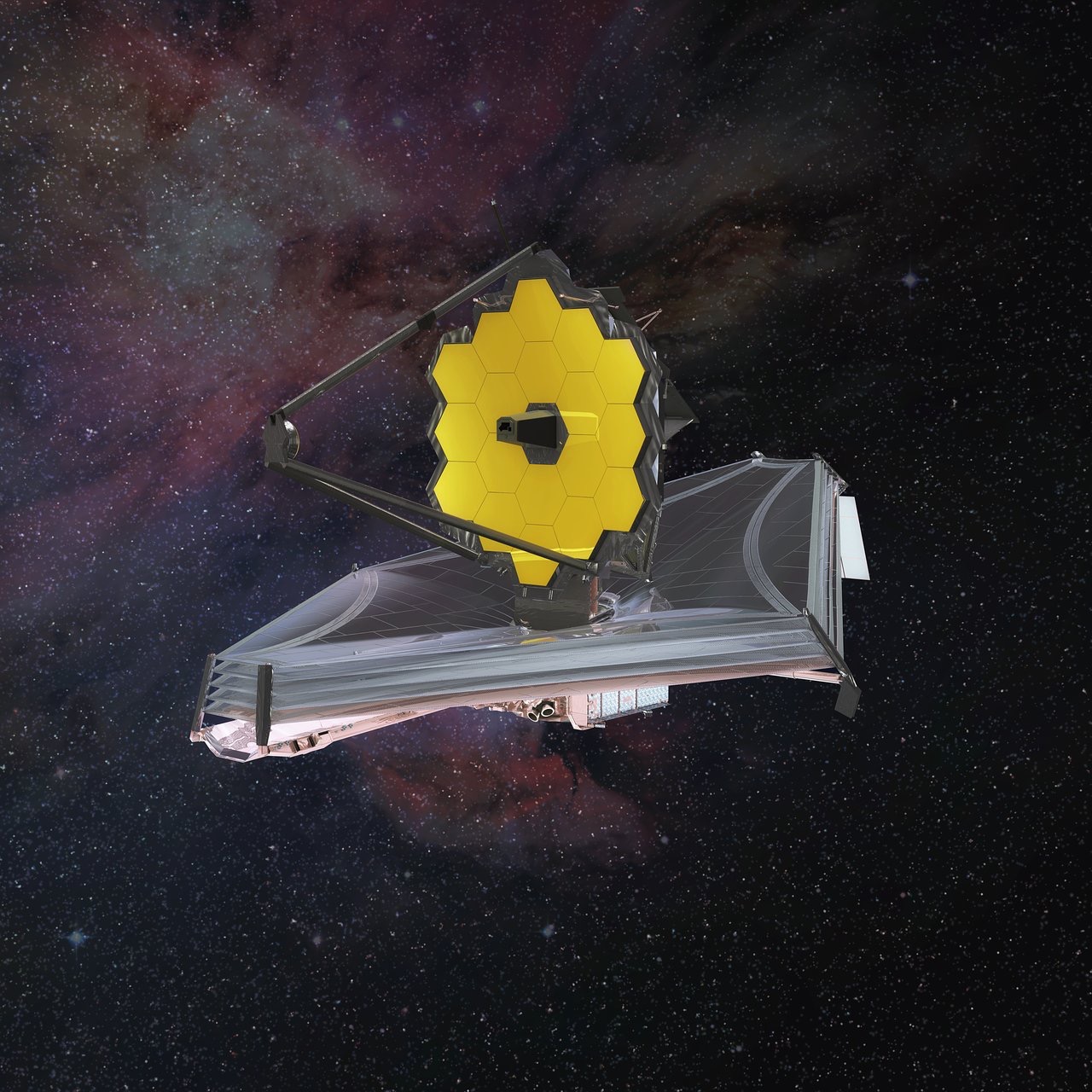
In May of 2025, the James Webb Space Telescope broke the record for the most distant object observed in our universe with the discovery of a galaxy (given the memorable name of MoM-z14) at a distance of 13.5 billion light-years away. Such discoveries raise the question: how can we determine distances of galaxies at such large scales? The answer is cosmological redshift.
Doppler Shifts
You’re probably familiar with the idea of the Doppler effect. It’s the reason why you can hear the direction of a car driving past. While the car is moving toward you, the sound waves generated by the car’s engine are being compressed as they travel toward your ear. This results in a higher pitch in the sound. Then, once the car passes by, the sound waves emanating from the car are now being stretched out. This results in a lower pitch.
This same idea applies to light as well. Light is a wave, and the waves traveling from a light-emitting object will be stretched or compressed depending on their motion relative to an observer. The spectrum of visible light goes from red to violet. Red has the longer wavelength, and violet has the shortest. Now, this isn’t as intuitive as it sounds. While the stretching or compressing of lightwaves does make the light from the star appear redder or bluer, the effect is generally too subtle to pick up visually – despite the terms “redshift” and the corresponding “blueshift”. Rather, we use study of the light spectrum, spectroscopy, to determine the amount of shifting experienced by the light ray.
Absorption Lines
As a star emits light, the elements within the star leave a distinct signature on the light’s spectrum. These appear in the form of absorption lines. Absorption lines are places in the light spectrum where certain wavelengths are missing due to the elements selectively absorbing photons with a specific energy level. (There exist emission lines as well, which are sort of the opposite phenomenon. But we can simplify it for our purposes here.) Scientists can study the composition of stars by spreading starlight into its spectrum (like a prism creating a rainbow). Then, they can identify the absorption lines within the spectrum.
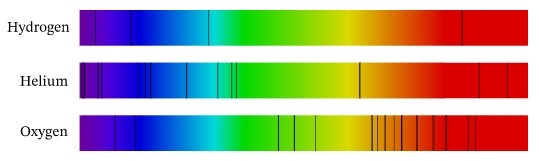
Redshift and blueshift affect the location of these absorption lines. Absorption lines have specific patterns in thickness and spacing. These patterns allow us to identify them regardless of where they appear in the spectrum. So when we observe a star’s spectrum and see that the absorption lines indicative of helium, hydrogen, and so forth have been moved into the redder part of the spectrum, we can deduce that the star is moving away from us. We say that its light has been redshifted. If, instead, we find the absorption lines have been moved into the bluer part of the spectrum, then the light has been blueshifted. This is interpreted as the star moving toward us.
This effect is called the Doppler shift. It is used on local scales to determine if galaxies are moving toward us or away from us. It’s also used to measure rotation speeds in galaxies. That in itself doesn’t tell us the distance of celestial objects, however. But it also isn’t the whole story with redshift.
Cosmological Redshift
In addition to the redshift or blueshift observed in nearby galaxies, astronomers discovered that there is a relationship between increased distance and redshift. In other words, the more distant an object is, the greater its redshift. This has become known as the Hubble relation. The most straightforward explanation of the Hubble relation is the expansion of the universe.
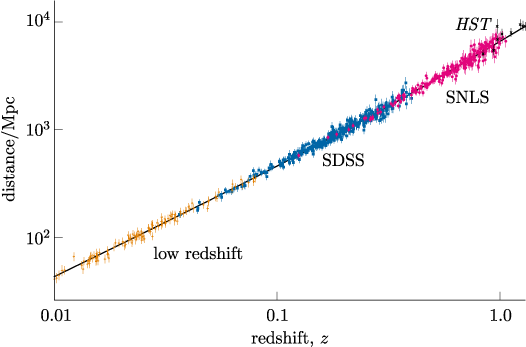
As the universe expands, it carries light with it. This means that lightwaves are being constantly stretched as they travel through space, which results in what’s known as cosmological redshift. (While it’s the same mechanism as Doppler shifts, the cause is very different.) We have to be careful to notice that this isn’t describing stars moving through space, away from Earth. Rather, space itself is spreading out and carrying the stars, and the light they emit, with it. When the Hubble relation is interpreted as evidence of the expansion of the universe, then cosmological redshift becomes a useful way of determining distances. The farther an object is from us, the more its light has been redshifted.
This interpretation of the Hubble relation is often viewed with suspicion by young-age creationists even though the logic involved doesn’t actually contradict the young-age position. For more information about the history of the discovery of the Hubble relation, the case for an expanding universe based on cosmological redshift, and how this fits into young-age creationism, I refer you to Dr. Danny Faulkner’s paper on the topic in the Answers Research Journal.
To summarize, cosmological redshift is an observed stretching of light waves due to the expansion of the universe. The Hubble relation, which relates the amount of redshift to the distance traveled by the light wave, allows us to determine distances of celestial objects using cosmological redshift.


 Todd Wood
 Ken Coulson


 Peter
Peter
 Christian
 Joshua Cedar
 New Creation Staff