
 Peter
PeterLouis and Mary Leakey were a pair of famous fossil hunters. The couple worked together for years, excavating sites in East Africa. Many of their most famous finds came from Olduvai Gorge, Tanzania. The gorge yielded the tools, bones, and teeth of early humans. The Leakeys believed that intelligence and tool use had developed early in the course of human evolution. They were vindicated when Mary uncovered the base of a paleolithic hut which was far older than any other man-made structure. Today, creationists sometimes use this structure as evidence that modern humans lived alongside their supposed ancestors. But is this stone circle actually the base of the world’s oldest building?
The views expressed in this article reflect those of the author mentioned, and not necessarily those of New Creation.
Discovery
In 1962, Mary Leakey began to excavate a new site at Olduvai Gorge. The site was named Douglas Korongo, abbreviated DK. As she carefully dug through layers of claystone and tuff, she uncovered an ancient ground surface. Animal bones and stone tools covered the surface. At one end of the excavation trench, the team found a pile of rocks. The rocks weren’t seen as important, so the team removed them after drawing them onto the site map. But as the excavation widened, Mary found that the stone pile stretched into adjacent trenches. Slowly, she and her crew uncovered a ring of cobbles 14 feet across. Mary recognized the stone pile as an ancient hut or windbreak. She reconstructed the circle and set the excavated blocks back into place.1
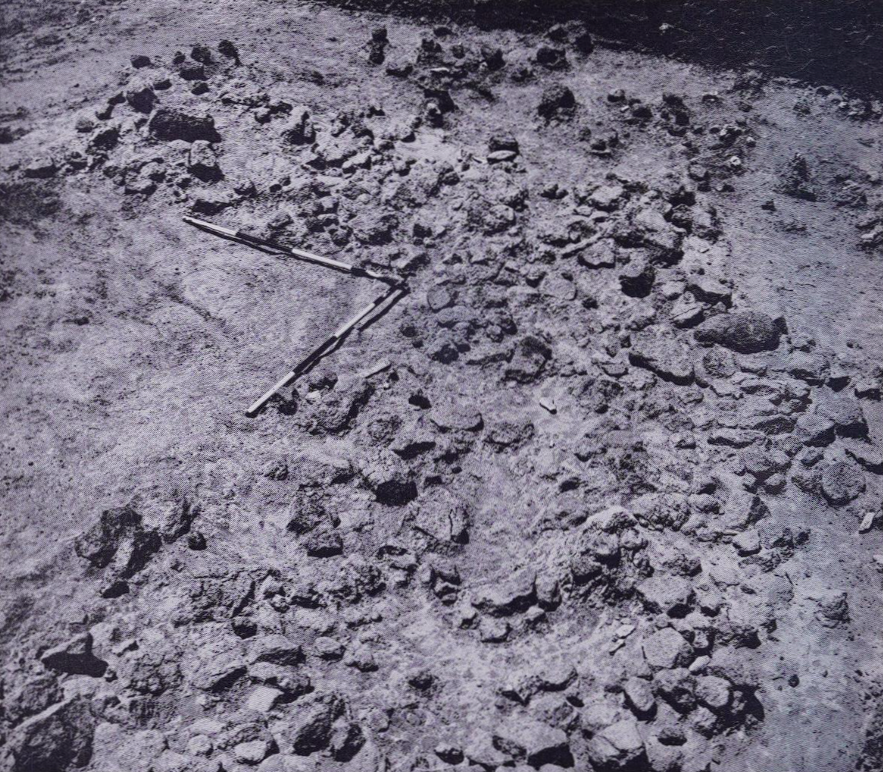
Two years later, in 1964, Mary’s husband described a new species based on fossil finds from Olduvai.2 Homo habilis was a small-bodied human with a tiny brain. It was thought to have a human-like hand, enabling it to create the tens of thousands of stone tools scattered across the gorge. The Leakeys viewed Homo habilis as a settled hunter gatherer. They believed that the “living floors” (ancient surfaces covered in artifacts) were Homo habilis bases. Fossils of Homo habilis were found at some of these sites, including DK. According to radiometric dates, the stone circle sits on a surface about 1.8 million years old.3 The circle is older than any other known man-made structure.
Three pieces of evidence supported Mary’s interpretation of the stone circle. First, the site appears to have been inhabited or regularly visited by ancient humans. The ancient surface on which the circle sits is littered with bones and stone tools. Second, the circular arrangement of stones seems to require deliberate placement. It seems unclear how natural processes could arrange rocks in a neat ring. Third, the stone circle appears to have affected the distribution of artifacts. Bones and tools are plentiful outside the circle, but only a few sit inside the ring. This might be evidence that humans intentionally threw their trash outside the circle.
Creationist Interpretations
Young age creationists widely accept Mary Leakey’s interpretation of the stone circle. Apologists commonly use the circle as evidence that intelligent humans lived alongside their supposed ape-like ancestors. They argue that only an intelligent human would have been capable of building the circle. Creationists assume that Homo sapiens, the species to which modern people belong, must be responsible. Our species must have created the stone tools, butchered the animals, and built the circle. If modern humans lived at the same time as Homo habilis, we cannot have evolved from them. Duane Gish presented an early version of this argument in 1975:
“Even more astounding (to evolutionists) was Leakey’s report that he had found the remains of what appeared to be a circular stone habitation hut right at the bottom of Bed I! It has long been held that deliberate manufacture of shelters could have been performed only by modern Man. This evidence clearly indicates then that Australopithecus (and the so-called H. habilis), H. erectus, and modern Man were contemporary inhabitants of the same area.”4
In the 2004 edition of his landmark work, Bones of Contention, Marvin Lubenow erroneously stated that the Olduvai circle was built from non-native stone. He wrote that: “The stones themselves are lava rocks that are not indigenous to what was a lakeshore when the structure was built. The several hundred rocks were brought from a source some miles away. Other stones on the occupation site are scarce and haphazardly scattered.”5
The stone circle is actually composed of a local basalt. The circle sits on top of a thin layer of sandstone overlying an ancient lava flow. The top of this basalt layer is fully exposed in parts of the DK site.6 Contrary to Lubenow’s claim, similar lava rocks litter the surface on which the circle sits. Lubenow concluded that, “The conceptual ability required to make such structures, the physical ability to carry hundreds of large stones several miles, and the fact that similar structures are made by humans today constitute strong evidence that true humans were on the scene at Olduvai at about 2 Mya on the evolution time scale.”
Christopher Rupe and Dr. John Sanford repeated the stone circle argument in their 2017 work, Contested Bones. Like Gish, they assumed that modern humans must have created the circle. “Further evidence demonstrating the presence of modern humans came from the lowermost sequence of Bed 1 (DK layer), dating nearly 2.0 million years old. Mary Leakey discovered something that she was initially very reluctant to accept—the world’s oldest man-made structure. She found a circle of stones forming a windbreak shelter.”7
Genesis Apologetics has repeatedly used the Olduvai circle as evidence against human evolution. They referenced the circle on their website, in a 2020 movie (Genesis Impact), and a series of short apologetic videos released in 2023 (the Classroom Series). On their webpage they state, “The evidence that humans were actually the inhabitants of this site is also confirmed by a 12-foot circular foundation made of lava stones for a hut shelter they found in the same archeological bed where Homo habilis bones were found.”8
Apologists commonly argue that the Olduvai circle was created by modern humans, people who look like you and me. But even if we assume that the circle was man-made, there is no reason to think it was created by modern humans. In fact, the circle predates any fossil evidence of modern humans. Two extinct human species, Homo erectus and Homo habilis, were present at Olduvai during this time. Creationists generally agree that Homo erectus was fully human, though his anatomy differed from modern people. Curiously, creationists seem to overlook Homo erectus as a possible candidate.
Unfortunately, the stone circle has never been the subject of peer reviewed creation research. Creationist authors seem to unanimously accept Mary Leakey’s interpretation of the site and her conclusion that the circle was man-made. But mainstream scientists never accepted Mary’s interpretation of the stone circle. Their understanding of the DK site has evolved significantly since Mary’s initial publications. It is necessary for creationists to reexamine the DK site in the context of new findings and models. Below, we will critically examine Mary’s claims about the stone circle.
The Living Floor Hypothesis
The Leakey’s excavations uncovered multiple “living floors” in Olduvai Gorge. The so-called “living floors” were places where stone tools and bones lay scattered across an ancient ground surface. The Leakeys interpreted these sites as bases. They thought that Homo habilis occupied or regularly visited these locations. Hunters brought their kills back to camp, littering the area with bones and butchery tools. From this perspective, the appearance of permanent living places did not seem unlikely. If primitive hunter gatherers lived in a set location for a period of time, they might be expected to create stable shelters. But the Leakey’s paradigm quickly collapsed under scrutiny.
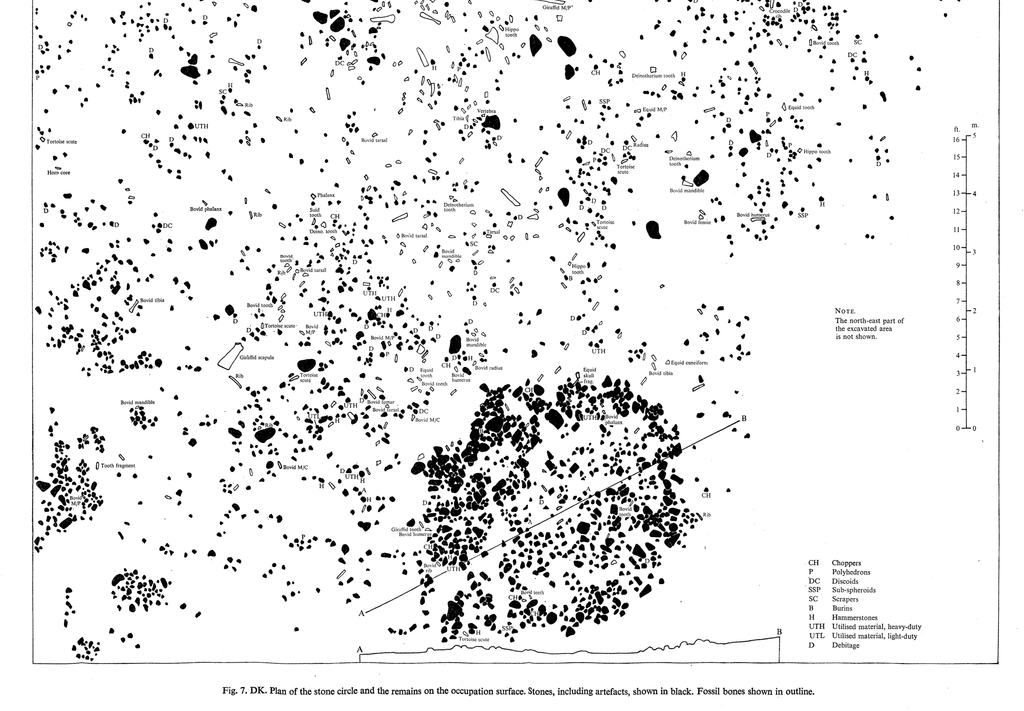
Later work showed that Leakey’s interpretation of the DK site was incorrect. Artifacts had not simply accumulated on the surface over time. The position of bones, tools, and rocks was not random. Most artifacts and rocks lay at similar angles. Their long axis was aligned in a northeast – southwest direction. This finding indicates that the artifacts were deposited in a flow.9 When oblong bones and tools are moved by water, they tend to become oriented perpendicular to the path of the flow. At the DK site, the artifacts were transported by a lahar. Lahars are mudslides containing volcanic ash and debris. The DK site is at a lower elevation roughly eleven miles from the Ngorongoro crater, an extinct volcano. Aa mudflow swept downhill towards a prehistoric lake, burying the site. Scholars believe the mudflow blanketed the ground in roughly three feet of sediment. This sediment hardened and compacted over time, forming a rock layer just over a foot thick.10
Artifact Distribution
The lahar appears to have affected the distribution of artifacts at the DK site. As it flowed towards the site, the lahar swept through a freshwater pool. There, the lahar picked up sediment and faunal remains like crocodile teeth, which it deposited around the stone circle.11 Uphill from the site, stone tools and bones are only sparsely distributed. But downhill, towards the stone circle, artifacts become more common. Small limb bones, which are easily transported, are especially frequent past the stone circle. The variety of animal remains also increases down the slope.
The lahar’s activity makes it difficult to determine where artifacts originally lay. Some of the small animal remains and tools may have been transported downhill to the site. Large bones probably weren’t swept too far due to their shape and weight. Some of the material seems to have been picked up near the stone circle and deposited beyond it. But archaeological evidence only supports a general association between the stone circle and the artifacts. It is not clear whether the bulk of the artifacts initially sat near the stone circle.
Leakey noted that only a few stone tools and bones were present inside the stone circle. Just north of the circle, the ground is blanketed with artifacts. Some argue that the absence of artifacts in the circle is evidence of occupation. The human occupants are thought to have discarded food and tools outside the hut. But the activity of the lahar complicates this picture. We cannot be sure how many artifacts initially lay inside the circle. Bones and tools that initially lay inside the ring may have been swept downhill a few meters contributing to the accumulation outside the circle.12 The distribution of artifacts cannot be used as evidence of occupation since we do not know where they originally lay.
Describing the Stone Circle
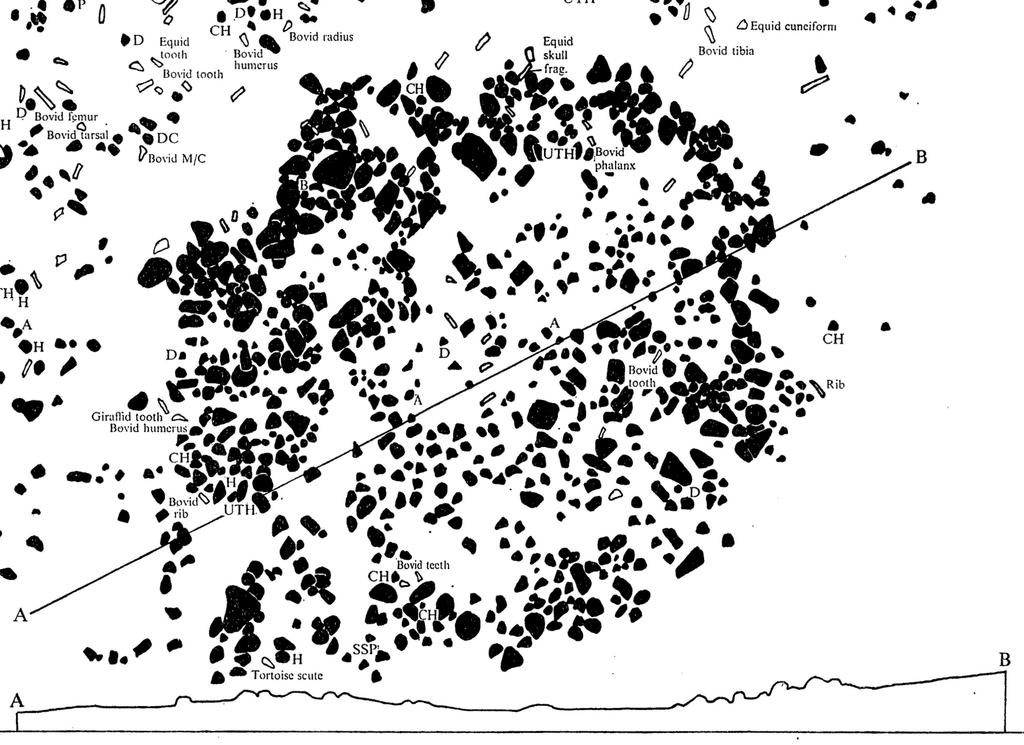
Mary Leakey described the stone circle in her 1971 monograph on Olduvai Gorge. The stone circle is really a large oval, fourteen by twelve feet in diameter. It comprises basalt blocks of various sizes. These blocks are concentrated on the edge of the oval, forming a ring. Mary claimed that on one side of the circle, stones were arranged into six regularly spaced “heaps”. The ring of stones surrounds a very slight depression in the ground. Leakey wrote that “the circle resembles temporary structures often made by present-day nomadic peoples”. She thought that the circle could be the remains of a “low stone wall” or a “base to support upright branches which are bent… and covered with… skins or grass.” She suggested that the small stacks of rocks might have anchored the branches supporting the structure’s roof. Leakey likened the structure to the huts of the Okombambi tribe (pictured below).13
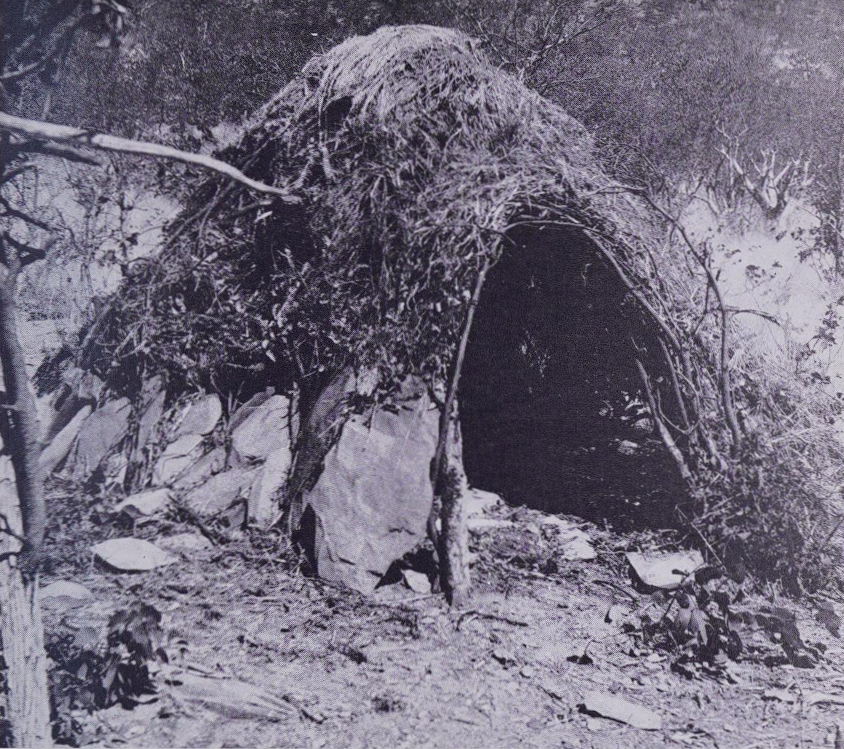
Leakey’s claim was based on the general ring-like arrangement of stones. While the stones do follow a roughly circular pattern, there is little apparent order in their placement. The stones are not neatly stacked, placed snugly next to one another, or aligned to form sharp boundaries. The position of each stone seems random in relation to neighboring stones. Blocks of basalt are also scattered inside the ring, giving it the appearance of a filled circle. There is no obvious space for a doorway into the circle. In stone huts this often appears as a distinct gap in the stone ring. The random, messy distribution of stones calls Leakey’s assessment of the structure into question. There is no obvious way to distinguish stone blocks that are part of the “structure” from those that may have been swept into the area.
Leakey also argued that small stone “heaps” in the ring were designed to anchor support poles for the structure’s roof. She described six piles of stones along the northern wall of the circle. The stones were arranged in little stacks between six and nine inches tall. She claimed that these stacks were evenly spaced by about two and a half feet. These rock piles are poorly documented; they cannot be recognized in the site plan or publicly available photos. Donald Johanson mentioned the heaps in his 1989 book, Lucy’s Child.14 He notes the existence of “small heaps” but does not comment on their spacing. It is unclear whether the height and spacing of the heaps is distinctive enough to require human construction. Other forces, like the mudflow may have been capable of sweeping rocks into piles.
Mary Leakey’s interpretation of the stone circle as a hut was sensational. But stone rings and piles can have much more mundane explanations. The stone circle may simply be a man-made rock pile, called a cairn. Ring-shaped cairns have been discovered across East Africa.15 Cairns can be used as landmarks, mark trails, and designate burials. But the “messy” nature of the circle leads most anthropologists to believe it was not man-made.
Built by a Tree?
Several anthropologists believe that a tree may have created the Olduvai circle.16, 17, 18 The roots of a tree growing on the paleo surface would have quickly encountered the basalt layer underlying the soil. Its roots might have grown into the basalt, fracturing the stone into blocks. When the tree fell, its root mass could have been pulled up along with stones. As the roots decayed, stones scattered across the surface. The tree root hypothesis might be able to explain the indistinct nature of the ring, and the stone scattered inside. The presence of a large tree could also explain why so many artifacts were deposited at the site. Carnivores and hominins would likely have gravitated towards the tree’s shade.
The tree root hypothesis has not yet received sufficient testing. Since the hypothesis states that the stones were pulled up by tree roots, the underlying layer of basalt should be heavily fragmented. Archaeologists have not yet excavated through the paleo surface to observe the surface of the basalt flow. When trees fall, they create a pit and mound, neither of which are visible at the DK site. The pit is the hole from which the tree’s roots were pulled. A corresponding mound contains the dirt, roots, and stones from the hole. If the tree root hypothesis is correct, we might expect to find an infilled mound beneath the stone circle. But modern studies of tree fall have not produced evidence supporting the creation of natural stone rings in the type of environment present at Olduvai. Despite its poor support, the tree root hypothesis will likely remain dominant until archaeologists return to the site and perform exploratory excavations inside the circle.
Conclusion
At first glance, the stone circle at Olduvai seems to provide striking evidence that early humans were intelligent. Mary Leakey’s interpretation of the site implies that stone age people created and lived in permanent structures. But this claim is weak, and poorly supported by the archaeological evidence. Hopefully future researchers will reexamine the stone circle. Further excavation and analysis of stone distribution and piling may allow us to test the natural hypothesis of formation and determine whether the circle was man-made.
Footnotes:
- Mary D. Leakey, Olduvai Gorge: Volume 3, Excavations in Beds I and II, 1960–1963 (Cambridge: Cambridge University Press, 1971). ↩︎
- L. S. B. Leakey, P. V. Tobias, and J. R. Napier, “A New Species of the Genus Homo from Olduvai Gorge,” Nature, 202, 4927 (4 April 1964), 7-9. ↩︎
- A. L. Deino, “40Ar/39Ar Dating of Bed I, Olduvai Gorge, Tanzania, and the Chronology of Early Pleistocene Climate Change,” Journal of Human Evolution, 63, 2 (2012), 251–273. ↩︎
- Duane T. Gish, “Man…Apes…Australopithecines…Each Uniquely Different,” Institute for Creation Research, November 1, 1975, https://www.icr.org/content/manapesaustralopithecineseach-uniquely-different ↩︎
- Marvin L. Lubenow, Bones of Contention: A Creationist Assessment of Human Fossils, rev. and updated ed. (Grand Rapids: Baker Books, 2004). ↩︎
- I. G. Stanistreet et al., “Lahar Inundated, Modified, and Preserved 1.88 Ma Early Hominin (OH24 and OH56) Olduvai DK Site,” Journal of Human Evolution, 116 (March 2018), 27–42. ↩︎
- C. Rupe and J. Sanford, Contested Bones, 1st ed. (FMS Publications, 2017). ↩︎
- Genesis Apologetics, “Homo habilis: Early Human Ancestor?” Genesis Apologetics, October 9, 2024, https://genesisapologetics.com/faq/homo-habilis-early-human-ancestor/ ↩︎
- Alfonso Benito-Calvo and Ignacio de la Torre, “Analysis of Orientation Patterns in Olduvai Bed I Assemblages Using GIS Techniques: Implications for Site Formation Processes,” Journal of Human Evolution, 61, 1 (July 2011), 50–60. ↩︎
- Stanistreet et al., “Lahar Inundated,” 27–42 (Footnote 6). ↩︎
- Stanistreet et al., “Lahar Inundated,” 27–42 (Footnote 6). ↩︎
- Stanistreet et al., “Lahar Inundated,” 27–42 (Footnote 6). ↩︎
- Leakey, Olduvai Gorge Vol. 3 (Footnote 1). ↩︎
- Donald C. Johanson and James Shreeve, Lucy’s Child: The Discovery of a Human Ancestor (New York: William Morrow & Co., 1989), 152–54. ↩︎
- Matthew I.J. Davies, “Stone Cairns Across Eastern Africa: A Critical Review,” Azania: Archaeological Research in Africa, 48, 2 (2013), 218–240. ↩︎
- Richard Potts, “Home Bases and Early Hominids: Reevaluation of the Fossil Record at Olduvai Gorge Suggests That the Concentrations of Bones and Stone Tools Do Not Represent Fully Formed Campsites but an Antecedent to Them,” American Scientist, 72, 4 (July–August 1984), 338–47. ↩︎
- Stanistreet et al., “Lahar Inundated,” 27–42 (Footnote 6). ↩︎
- Johanson and Shreeve, Lucy’s Child, 152–54 (Footnote 14). ↩︎

 Christian Ryan
 Joshua Cedar
 Kurt Wise
 Abigail Van Huss