

 Hannah Klein
Perspectives on the Historical Adam and Eve | Keathley, Kenneth D. (Ed.) | 2024. Brentwood, TN: B. & H. Academic | 240 pp. | $24.99
This book review was originally published in the Spring 2025 issue of Pneumatikos: The Journal of Chafer Theological Seminary. It was been lightly edited for this blog post.
Introduction
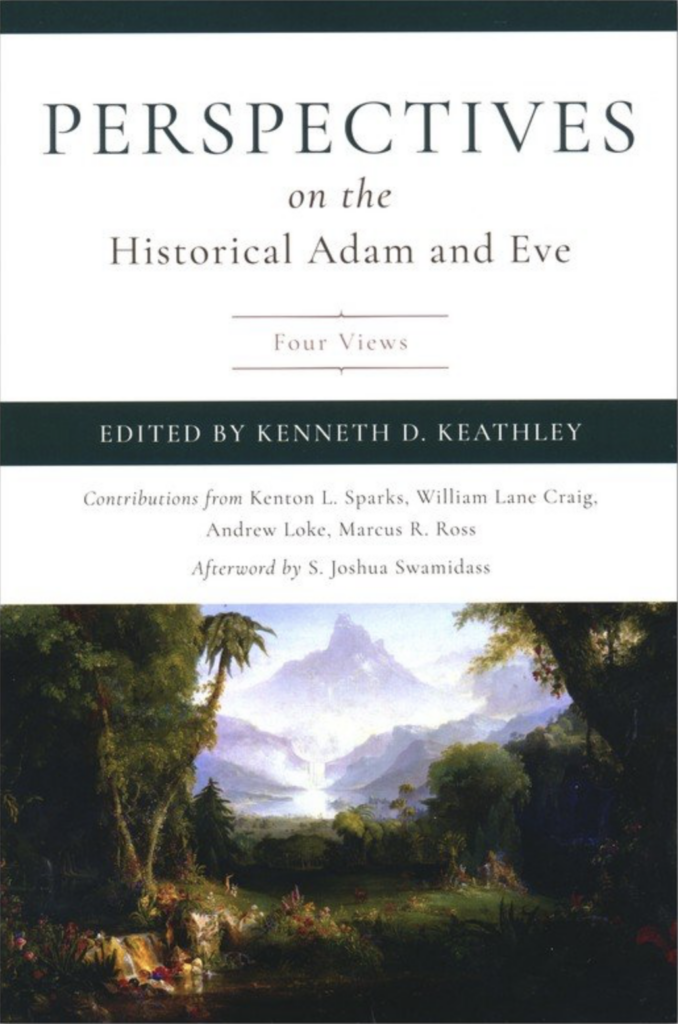
This new book about origins, creation, and the Bible documents the proceedings of a 2022 colloquium at Southeastern Baptist Theological Seminary (Wake Forest, NC) concerning the historical Adam and Eve. Four Christian scholars presented their views to an audience of theologians, scientists, philosophers, and other scholars. The book is composed mainly of the four papers presented. The overall tone is one shaped by a genuine effort toward Christian charity and understanding. Even though the four participants strongly disagree with each other on the topic under discussion, the presentation and responses are done in a spirit of mutual respect and consideration. This steers the conversation away from unhelpful rhetoric and allows for a clearer presentation of the various approaches themselves.

Kenton L. Sparks believes that Genesis portrays Adam as a historical character but he does not affirm the inerrancy of Scripture. This is because of textual reasons (outside of Genesis 1–11) which he argues demonstrate that Scripture contains errors as well as morally objectionable laws (pp. 23–24). Sparks holds that “the Bible’s authority is derivative rather than final,” by which he means “the Bible is not the ultimate source of theology but rather one of several penultimate sources that depend on God as the ultimate source of authority and insight” (p. 45). With this approach, Sparks maintains that we are not required to accept Scriptural evidence of the historicity of Adam; we should, instead, “believe whatever it is that God has allowed us to understand through our careful reading of Scripture and our careful study of God’s world” (p. 42).
To be clear, Sparks holds that the scientific data is more objective than biblical data, and, therefore, should hold precedence as we consider the Adam question. He writes, “though interpretation is involved in our assessments of both biblical and scientific evidence, the scientific evidence tends to force everyone towards the same kinds of answers, whereas the biblical evidence does not” (p. 26).
While acknowledging that the authors of the New Testament considered Adam and Eve to be historical figures (p. 31), Sparks argues that we should not judge the historicity of Genesis and Adam and Eve on the basis of what the New Testament authors did with the text (p. 33). In fact, “nothing in particular from the stories of Adam and Eve must be historical” (p. 42).
Sparks’s approach is interesting, because by freeing himself from any claim of the inerrancy of Scripture, in his judgment, he is able to interpret it in a natural, grammatico-historical approach. Thus, while on the opposite end of the spectrum from the so-called young-earth perspective (discussed later), the two positions interpret Scripture in similar ways.
The Mytho-historical Adam View
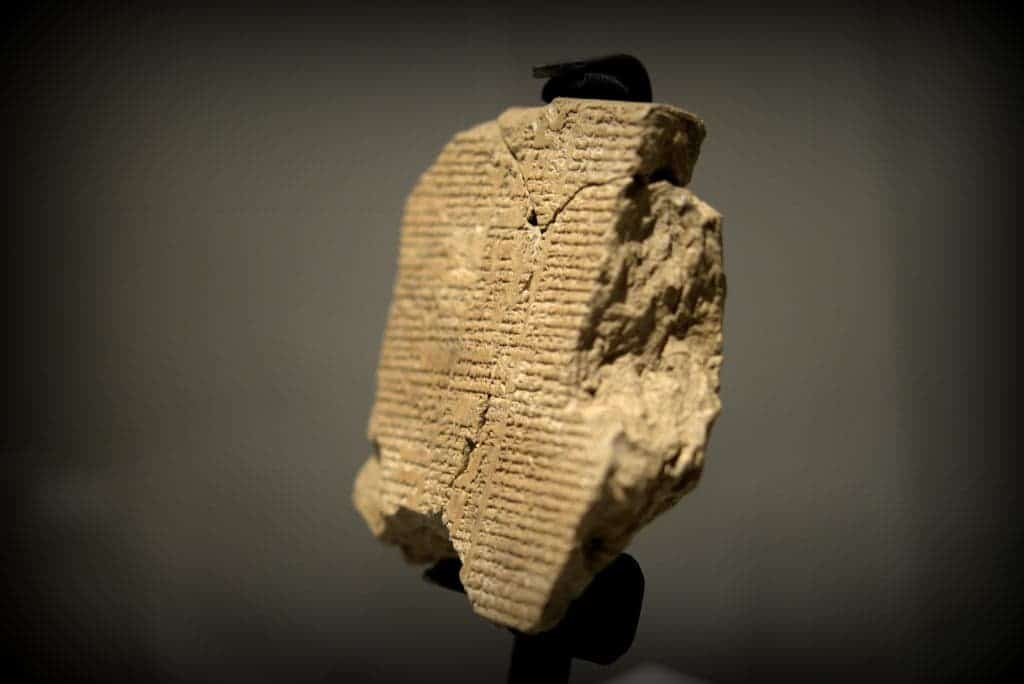
William Lane Craig contends that the first few chapters of Genesis must be understood “against the cultural backdrop of the ancient Near East [ANE]” (p. 70). Genesis 1–11 features a collection of Israelite ‘myths’ as a means to “explain present realities by anchoring them in the prehistoric past and so to validate a culture’s contemporary institutions and values” (p. 70).
This classification is made via a set of “family resemblances” (p. 71), criteria shared by mythologies of various cultures. In other words, Craig argues that while the narratives of Genesis 1–11 are not derived from the ANE myths, they are similar in that they are both trying to give an origin story for the universe. “Myths seek to anchor present realities … in a primordial time” (p. 71).
Moreover, Craig further develops the concept of “mytho-history” by factoring in the concern for history that is seen in Genesis 1–11. This is evident within the genealogical histories (Genesis 5, 9, and 11, for instance), as well as the narrative which “melds seamlessly into the historical period of the patriarchs” (p. 75). This mytho-historical genre allows him to classify parts of the narrative as historical, and others as mythological. Craig argues that “if Genesis 1–11 functions as mytho-history, then these chapters need not be read literalistically” (p. 77).
The New Testament authors can base teaching on this mytho-history in the same way that we may allude to Greek mythology without endorsing its historicity (p. 79). There are some cases in the New Testament where the historicity of Adam cannot be disputed: Craig admits that Romans 5:12–21 “does imply the historicity of Adam and his fall into sin. An action that is wholly internal to a fiction cannot have effects outside the fiction” (p. 81). That said, Craig argues that most of the mentions of Adam in the New Testament can be considered as references to mythology.
With the mytho-historical genre, Craig removes himself from any obligation to the text of Genesis 1–11, while maintaining his belief in the inerrancy of Scripture. Craig defers the objective details of Adam’s existence to science. “Given the mythical nature of Genesis 1–11, it is to modern science that we must turn” in order to determine when Adam lived (p. 82). In this section of the paper, Craig outlines various criteria by which we might determine whether a hominid population was human or non-human. He then surveys the anthropological evidence of Neanderthals, suggesting that Adam and Eve belonged to the most recent common ancestor of Neanderthals and Homo sapiens, around one million to 750 thousand years ago (pp. 82–90).
The Genealogical Adam and Eve Model

Andrew Loke presents the Genealogical Adam and Eve (GAE) perspective: “The essential feature of the GAE model … is its appeal to the science of genealogical (rather than genetic) ancestry, which implies that there are a large number of common ancestors today, one of whom is Adam” (pp. 108–09). Loke reminds us that the Bible and modern science are not in contradiction as long as a possible means exists to harmonize them (cf. pp. 107–08).
The necessity of a historical Adam is clear from the genealogical records of the Pentateuch, which include Adam as a real, historical figure, and is reinforced by the New Testament (p. 110). Loke argues for the compatibility of the historical Adam with “evolutionary biology” by distinguishing between “an anatomical Homo possessing the image of God… and an anatomical Homo which did not possess the image” (p. 109). Adam is distinguished as the first bearer of God’s image (p. 110) who was selected from a population of hominids which were anatomically Homo for this purpose. Adam and his offspring intermarried with other, non-image bearing Homo, with the result that “all people living today are indeed descendants of Adam”. This is how Loke is able to assure us that “all humans in our world today… possess the image of God” (p. 122). In this way, Loke argues that we can find a level of compatibility between Scripture’s account of a historical Adam and Eve, and evolutionary biology’s claim that the most recent common ancestor of humanity was from a large population of Homo.
Consistent with Loke’s goal of providing a possible means of reconciling Scripture and science (but not necessarily a final, definitive answer), Loke leaves some matters undecided. Questions as to whether Adam was recent or ancient (p. 125), or whether intermarriage between image-bearing and non-image-bearing Homo counts as bestiality (pp. 122–124), are left open.
The Recent Adam and Eve View: A Modern Young-Age Approach

Marcus Ross surveys relevant Scriptural passages to illustrate the importance of the historical Adam. From Genesis 1–2, we learn that humans are a unique creation of God, the only creatures marked in the “image and likeness” of God (as compared to “according to their kinds”) and the only humans at the beginning of creation. Genesis 3 teaches that the Fall brings death and cosmic consequences. The reality of death is emphasized in Adam’s genealogy of Genesis 5 (p. 155). Moreover, the cosmic consequences of the Fall are “subtly but powerfully displayed” by the divine curses pronounced on the serpent and on the ground. These represent “the two responsibilities given to humans: dominion and work” (pp. 155–156).
In Genesis 6–9, we learn of the worldwide, global judgment of the Flood and Noah’s role as the restarter of humanity. Romans 5 gives us Paul’s “methodical contrast of Adam and Jesus” (p. 160). The connections between Adam and Jesus strongly point to the historicity of Adam and his role as the one man who brought sin (and thus death) into the world. “Paul’s argumentation makes use of the singular person of Adam and his specific sin/trespass, contrasted with the singular person of Jesus and his specific act of righteousness” (p. 161). 2 Peter 3 presents “the Flood’s inescapable history” (p. 164), in an argument about God’s future judgment of the world which relies on the historicity of the Genesis Flood account: “Peter appeals to creation and the Flood as the tangible, historical evidences that justify expectations for Jesus’s return” (p. 165).
After laying out the Scriptural demands regarding Adam, Ross turns to science, using “the historical data of Genesis … to provide a temporal scaffold to guide our investigations of the natural world” (p. 166). In the geological record, Ross demonstrates that placing Adam anywhere within the conventional timeline of earth history (millions of years) undermines key tenets of Scripture’s teaching about Adam (pp. 170–171).
In contrast, young-age creationists (YAC) approach most of the geological record in a post-Fall context. Ross states that “those searching for Adam in the hominin record are unknowingly looking among the scattered remains of Noah’s descendants” (p. 172). With this view of the geological record, the question arises of which hominid remains are descendants of Adam, and which are not. Ross briefly outlines the science of statistical baraminology (creation according to their kinds ≠ species), which allows researchers to distinguish between human and non-human fossil hominins. He also presents broader criteria for making this distinction (pp. 177–184).
Ross concludes by pointing out the practical implications of taking Scripture’s account at face value and allowing it to frame our scientific endeavors, emphasizing the clarity and consistency of Scripture (p. 187). While the previous participants tend to allow science the greater objectivity and evaluate Scripture in that light, Ross grants Scripture first priority in building an interpretive framework through which science is then evaluated.
Afterword: This Conversation and the Next

S. Joshua Swamidass wraps up this volume with a reflective overview. Swamidass gives his own view on the colloquium behind this book, saying that a “particular hallmark of evangelicalism,” is “how it navigates diversity and disagreements” (p. 202). He lays out the recent scientific developments that have revised the way Adam and Eve fit into the conventional evolutionary narrative (pp. 206–208). According to Swamidass, the evangelical positions on Adam and Eve can be grouped into three primary approaches (pp. 208–209): 1) No-Adam approaches, denying a historical Adam; 2) Models that invoke a genealogical Adam and Eve (GAE), either in a) the ancient past or b) recently, within the “apparent biblical timescale”; and 3) Creationist approaches, which reject evolutionary origin models.
Swamidass advises that participants in this broader discussion think through what they would consider to be their second-best view (p. 214). If your current understanding of Adam and Eve turned out to be incorrect, to which other understanding would you most likely turn? This intentional effort to “try on the assumptions, values, and beliefs of others” may perhaps lead to “greater agreement realized” (p. 215).
Conclusion
Perspectives on the Historical Adam and Eve offers a fresh look at some current ideas circling in the debate around the historical Adam. It gives us a look into various methods with which Christian scholars are handling Scripture and science (the beaker and the Bible), allowing us to see the ways the two influence each other.
It is insightful to consider specifically the viewpoints of Scripture in each of the participants’ presentations. Sparks denies the inerrancy of Scripture, which allows him to embrace a more literal interpretation of Genesis 1–11 than many other Christian scholars accept, as he is unencumbered by a duty to allow Scripture to influence his view of science. Craig, while affirming inerrancy, classifies the opening chapters of Genesis as mytho-history (a non-traditional category), thus allowing him to accept a historical Adam without being bound to affirm the entirety of the Genesis narrative. Loke accepts a historical Adam as part of a minimalistic set of historical claims from the primordial narrative, which, in his mind, means we no longer need to find any specific harmonization between Scripture and science. Thus, how we interpret certain (particular) details of Scripture is not as critical to the discussion. Ross’s approach errs more on the side of putting the burden of proof on the scientific side, allowing Scripture to guide scientific theories as opposed to the other way around. Much hinges here on presuppositions and hermeneutics.
In an area of ambiguity and unanswered questions, one can give the benefit of the doubt to either Scripture or the conventional scientific paradigm. It appears in this volume that the majority of these scholars are choosing to give science the benefit of a doubt; whether by denying the inerrancy of Scripture (cf. 2 Tim. 3:16 and 2 Pet. 1:21), imposing a different genre of literature to the Genesis 1–11 text (mytho-history), or by a treatment of the text which brushes over big questions by proposing only possible harmonizations. From my perspective, only the young-age (YAC) position rightly places the weight of objectivity on Scripture, allowing it to frame the interpretation of the scientific evidence and not vice-versa.
In the multi-faceted (and oft-heated!) discussion surrounding the historical Adam and Eve, this volume provides a valuable contribution. It gives a clear representation of each of the major views in the debate at the current moment while modeling how Christian disputes and disagreements over unanswered theological and scientific questions should look.

Pneumatikos: The Journal of Chafer Theological Seminary
Since 1995, Pneumatikos (formerly the CTS Journal) has shared biblical exegesis and exposition with readers seeking in-depth Bible teaching. The articles in each issue of Pneumatikos are approved through a double-blind peer review and deemed as theologically consistent with the seven theological distinctives of Chafer Theological Seminary:
- Literal Hermeneutics
- Dispensational Theology
- The Sufficiency of Scriptures
- The Freeness of God’s Grace
- Full Counsel of God’s Word
- Emphasis on Greek and Hebrew Exegesis
- Comprehensive Worldview Based on the Bible
For an explanation of each of these distinctives and to view all of the doctrinal statements for Chafer Theological Seminary, please visit their website at Chafer.edu.

 Abigail L.
 Peter
Peter




 Christian Ryan
 Joshua Cedar