
 Christian Ryan
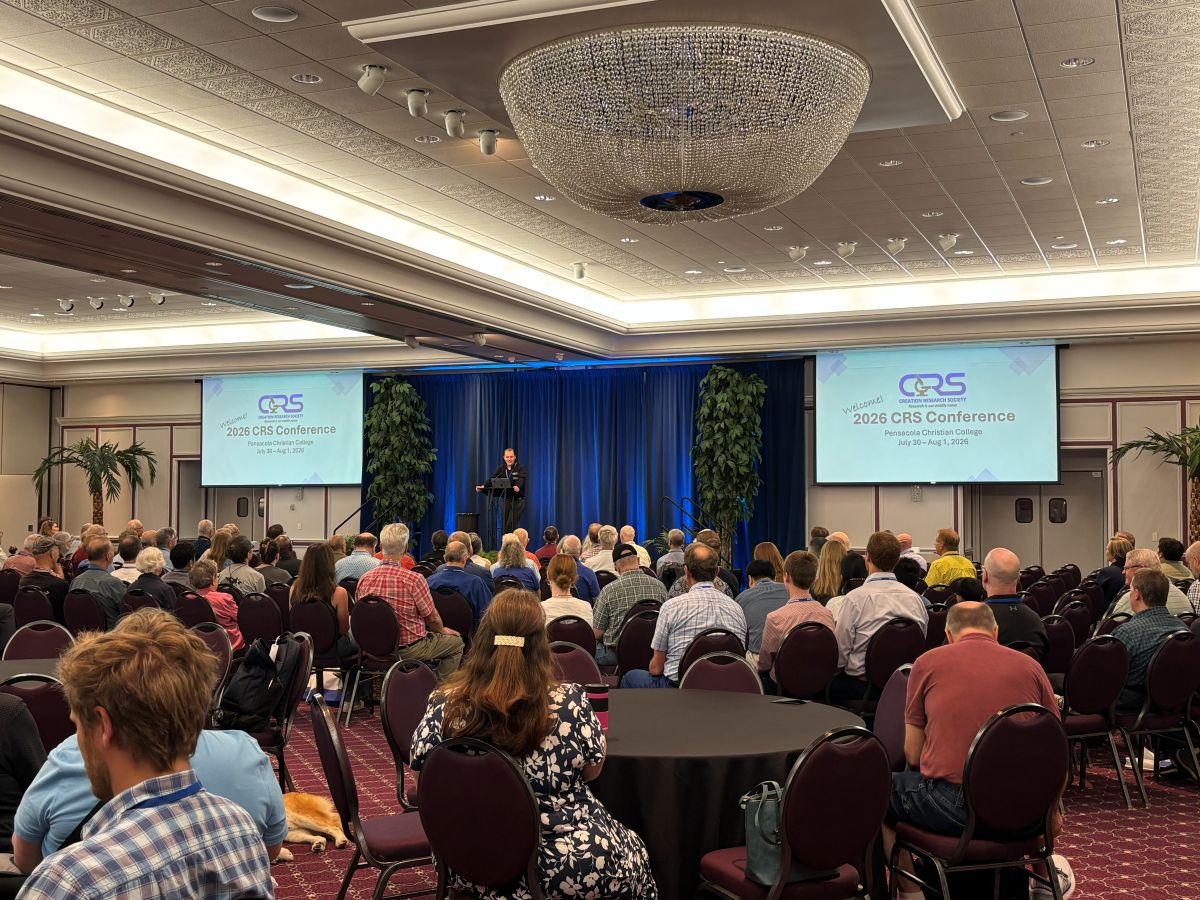
After a three-hour ping-pong from one terminal to the next (five times), an additional one hour wait for my connecting flight to arrive, and a two hour flight over the Gulf of Mexico (oops, Gulf of America), I finally exited the airport. My glasses instantly fogged up. This was my warm and humid welcome to Pensacola, in the panhandle of our very own sunshine state! But the stress of travel was worth it. I was here for the 2026 Creation Research Society Conference!
The views expressed in this article reflect those of the author mentioned, and not necessarily those of New Creation.
This summer, I felt a bit like I was playing “Where in the World Is Carmen Sandiego?” Except, I was Carmen Sandiego. One week, I was punting down the Cam River in Cambridge. The next, I was talking about my preliminary research on the British fossil record of ammonites in London. And another week found me listening to a research presentation on crocodile impersonators in Southern California at the Origins conference. To top it all off, I spent my final trip of the summer in Pensacola, Florida.
I was not there alone. Joining me were two other New Creation writers, Hannah and Abigail. Check out their articles for their experience, as well. From July 30th until August 1st, we would be in attendance at a gathering of young-age scientists, students, and other researchers in a wonderful opportunity for fellowship, sharing research, and discussion.
Go Team Creation!
Now I know it’s customary for these sorts of articles to go in chronological order. But there was one overarching theme of this conference that I noticed at play from the beginning of the workshop to the last presentation. And that theme is this: creationists are on the same team whether or not we agree on everything. We’re all players on TEAM Creation.
Eric Hovind of Creation Today Ministries summed this up excellently during his plenary talk on the last day of the conference. This is something that we try to drive home here at New Creation, something that was, in fact, a major factor in starting the New Creation Blog. So it was refreshing to see that others were arriving at the same sentiment. If there’s something we creationists often do, it’s argue about things. A lot. We argue about whether or not some dinosaurs had feathers. Sometimes we’ll argue about the location of the Flood/post-Flood boundary, or whether the Masoretic or Septuagint textual traditions best reflect the genealogies of Genesis 5 and 11. But at the end of the day, we are brothers and sisters in Christ first. And that is something all of us should be able to agree on.
We have all sorts of disagreements. But Hovind leaned into the idea of disagreement as something that actually strengthens creation research rather than dividing those engaged with it. His acronym TEAM (for TEAM Creation!) encouraged us to Tell the Truth about the other position, Examine our own assumptions, Attack the argument rather than the person, and finally, Maintain Christian love. The goal of our disagreements should not be to obliterate opposing viewpoints, but to sharpen one another as “iron sharpens iron” (Proverbs 27:17). As Hovind put it, “I don’t know whether I’m on Team Feathered Dinosaur or Team Scaly Dinosaur. But I’m on TEAM Creation.”
And I think this overwhelming sense of unity and fellowship, despite our differences, beautifully summed up my own feelings about the conference. I encountered a great deal of openness toward competing ideas and a genuine willingness to understand opposing viewpoints. Don’t get me wrong, we still had a lot of disagreements (and I’ll get to those later!). But it was those disagreements that I think made the conference better. It forced us as researchers to defend our ideas, reconsider our assumptions, and hear perspectives that we probably would have otherwise overlooked. That is how good science works. And when those disagreements are handled with humility, honesty, and charity, it is a reflection of how Christians are supposed to treat their brothers and sisters in Christ.
Geology Workshop: Reading the Record Backwards
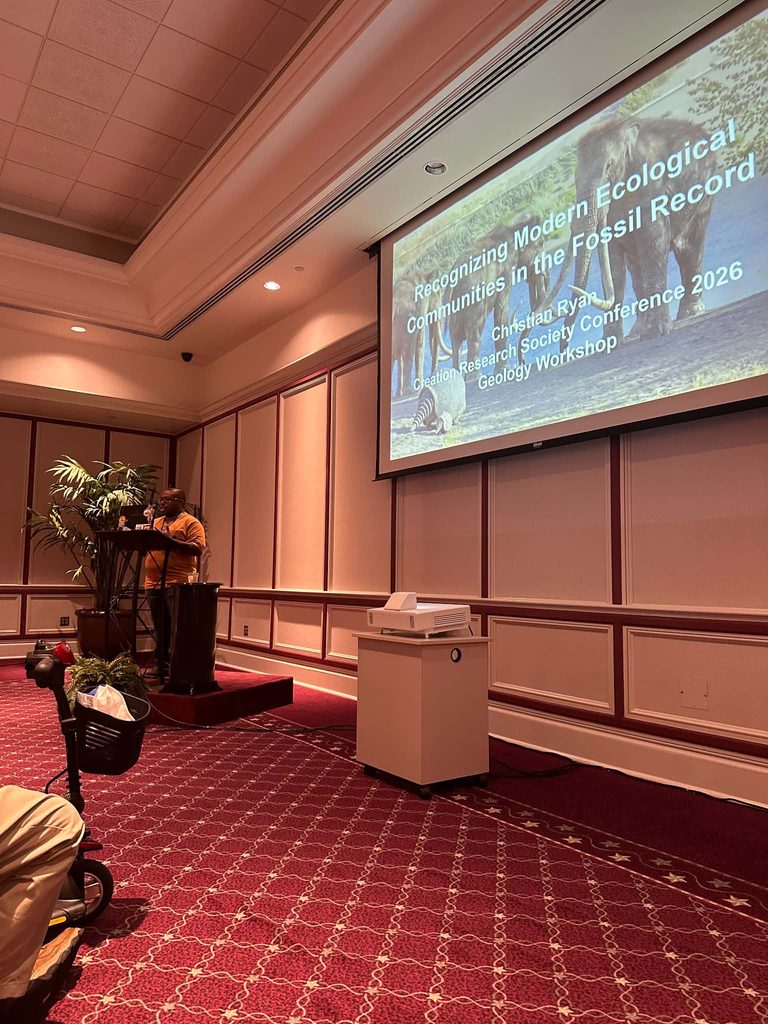
The first day’s activities comprised interactive workshops. Each one covered a different field of science: research and engineering, biology, astronomy, and geology. To the surprise of absolutely no one, I was at the geology workshop. The focus of this year’s geology workshop was on the world after the Flood, with the goal of identifying unanswered questions and figuring out what sorts of observations or models would be needed to improve our understanding of this elusive period in Earth’s history. Contributions weren’t just limited to geology, either; archaeology, biology, climatology, and other relevant fields were welcome as well.
Understanding this time period is important. Assuming gapless genealogies in Genesis 5 and 11, the post-Flood era represents the longest span of time on the young-age timescale, extending from the end of the Flood to the present. During its earliest centuries, Earth had to recover from a worldwide catastrophe while plants, animals, and eventually humans recolonized the world.
To help tackle some of the many questions surrounding the early post-Flood period, participants were encouraged to present six- to eight-minute talks highlighting research, observations, and unanswered questions about this period. These talks served as jumping-off points for what followed: an interactive brainstorm session about identifying open questions and potential pathways for future research. Several major ideas kept recurring, including how geological processes wind down after the Flood and whether the post-Flood world could still produce features we normally associate with the Flood. Yours truly presented a talk on the occurrence of modern ecological communities in the post-Flood fossil record and what this might inform us about the early post-Flood world. This generated a lot of discussion afterward, especially during the Q&A portion.
All in all, I found the workshop a very fruitful experience. I even have ideas for research I might present at next year’s International Conference on Creationism.
A Peek Inside the 2026 CRS Conference
How Long Did It Take Large Dinosaurs To Grow Up?
Presented by Dr. Jake Hebert
For the past several years, Dr. Jake Hebert from the Institute for Creation Research has been gathering research on the growth, development, and lifespans of fossil organisms. He thinks this might give us a window into what a long-lived human before the Flood might have experienced biologically and, perhaps, provide indirect evidence of pre-Flood longevity in humans. This specific presentation was on the longevity of large dinosaurs, specifically four species of sauropods (the long-necked dinosaurs) and Tyrannosaurus rex.
Scientists estimate dinosaur ages and growth rates by studying growth bands in their bones, somewhat like tree rings. The problem is that as bones grow and remodel themselves, an unknown number of the innermost growth bands are erased. This could potentially cause scientists to underestimate the ages of older dinosaurs. Newer statistical methods have attempted to compensate for these unknown years when reconstructing dinosaur growth patterns. According to this new research, Apatosaurus may not have reached 99% of its adult body mass until it was about 104-143 years of age. The even larger Alamosaurus was estimated to take 72-88 years. Meanwhile, Tyrannosaurus may have taken as many as 40 years to reach maturity. It should be remembered that these estimates only describe when the animals may have approached adult body mass, not their exact age of maturity or maximum lifespan. Dr. Hebert argued that these results resemble trends he has identified in other fossil animals, including rapid juvenile growth followed by prolonged maturation and longer lifespans.
How does all of this apply to creation science? Dr. Hebert connected this pattern with the extraordinary human lifespans recorded in Genesis 5 and 11. He reasoned that, if the biological or environmental conditions that allowed humans to live for centuries before and shortly after the Flood also affected animals, we might expect fossil animals from these time periods to show signs of greater longevity as well. Personally, I am not yet convinced that these dinosaur growth patterns provide independent evidence for the long human lifespans recorded in Genesis. But they could still provide some insight into what we might expect to see in the biology of our long-lived ancestors in Genesis.
Lucy Deconstructed…Again?
Presented by Dr. Carl Werner
If there was an award for the fastest-paced presentation at CRS, that award would have to go to Dr. Carl Werner for cramming a whopping 120 slides into a 30-minute talk! His topic of choice was that famous Australopithecus afarensis specimen, AL 288-1, popularly known as Lucy.
There are now three models about Lucy’s identity within young-age creationist circles: 1) the traditional take that Lucy is a knuckle-walking ape, 2) Lucy is an upright-walking ape and unrelated to humans, and 3) a new idea that Lucy is a misidentified pygmy human. This third idea was announced at last year’s CRS conference from Dr. Christopher Rupe. Dr. Werner’s talk this year was arguing in favor of the traditional knuckle-walking interpretation.
Dr. Werner argued that numerous aspects of Lucy’s skeleton, like her cranial capacity, shoulder orientation, curvature of her finger and toe bones, pelvic anatomy, and foot anatomy, are more like those of apes that go on all fours today. He also challenged how several of the features used as evidence that Lucy walked upright are interpreted, like those having to do with her knee morphology and whether or not her pelvis required reconstruction. Finally, he discussed scientific paleoart reconstructions of Lucy over the years. Dr. Werner argued that even reconstructions, even those by evolutionists, have slowly but surely started portraying Lucy as more ape-like rather than human-like, especially in regards to her posture, hands, feet, and how much time she spent in the trees.
There was much discussion during and after the Q&A, with many participants bringing up aspects of Dr. Rupe’s talk from last year. I suspect this discussion will be happening well into the future!
Are Feathered Dinosaurs Actually Birds?
Presented by Joel Leinweber
The topic of feathered dinosaurs is one we have never discussed on the New Creation Blog before. Ever. But an ongoing conversation within young-age paleontology is whether some dinosaurs had feathers. This study, carried out by Joel Leinweber of Answers in Genesis, puts forward the hypothesis that true branching feathers are only found in birds, not dinosaurs. If correct, this means that several animals traditionally classified as feathered non-avian dinosaurs, like Troodon, Oviraptor, and Velociraptor, are actually birds.
To test this, Leinweber used a dataset containing 853 anatomical traits from 157 different animals. All the traits used in this study were those related to the animals’ head and neck, wings and flight (or lack thereof), and hindlimbs and locomotion. The two control groups were animals that everyone agrees are dinosaurs (e.g. Tyrannosaurus) and animals that everyone agrees have branching feathers (e.g. Archaeopteryx). Then, the control- and non-control group animals were analyzed according to their traits. The prediction was if the hypothesis was true, feathered animals should have traits matching those of living bird anatomy. Whereas if the hypothesis were incorrect, Leinweber predicted he would find feathered animals with a mixture of bird and unequivocal dinosaur traits. From his results, he confirmed that many of the animals traditionally called dinosaurs, like the oviraptorosaurs, troodontids, and dromaeosaur or “raptor” dinosaurs (including Velociraptor itself), were actually birds. Other dinosaurs that are traditionally thought to have “simpler” dino fuzz, or so-called “proto-feathers,” he regarded as “true dinosaurs.” The dino fuzz, in his view, may simply be skin matter that frayed as the animal was decomposing. These would include the compsognathids and ornithomimosaurs (“ostrich-mimic dinosaurs”). Some dinosaurs were admittedly confusing because they had a mixture of traits, like the therizinosaurs and alvarezsaurs. Leinweber suggested that therizinosaurs were still dinosaurs, with their “bird-like” traits coming from the composite nature of the specimens and them not being known from many complete skeletons. While the alvarezsaurs, he argued, were actually stubby-winged birds, and thus were missing many of the classic bird-like traits due to their flightless nature.
Naturally, this led to a very lively back-and-forth discussion during the Q&A time. Much of this amounted to how words like “bird,” “dinosaur,” and “feather” are defined. Are we defining feathers differently from how mainstream paleontologists do? Birds today have non-branching feathers, like bristles, and if those are feathers, shouldn’t we also consider non-branching feathers in the dinosaur fossil record? Without a shared definition, it is easy for both sides to talk past each other. It was agreed by both speaker and attendees that future research should focus on refining those definitions and properly weight characteristics. Future discussions of this topic should be interesting! Just another day in the office for TEAM Creation.
Fossils and the Flood/Post-Flood Boundary
Presented by Dr. Gabriella Haynes
Another contentious area within creation science is which portions of the geologic record were formed during the Flood and which were formed after the Flood. In other words, where is the Flood/post-Flood boundary? This was the focus of paleontologist Dr. Gabriella Haynes from the Institute for Creation Research. Her presentation was summarizing her initial research into how we can use the PaleoBiology DataBase (PBDB) to better understand how the fossil record may help us answer this question.
This was a follow-up to research by another paleontologist, Dr. Marcus Ross, published in the Journal of Creation in 2013. He used data obtained from the PBDB to analyze dozens of mammal families from the fossil record of North America. At least two of each created kind of air-breathing land animal was saved on the Ark. All others perished. As such, we should not expect to find multiple members within the same created kind on both sides of the Flood/post-Flood boundary. Based on his research, Dr. Ross concluded that the boundary must be lower than the Neogene/Quaternary boundary in the geologic record because 96% of North American mammal families (the proxy for each created kind in the study) and 23.1% of genera are present on both sides of that boundary. Dr. Haynes followed up this research by analyzing whether she got the same results. This is important because the PBDB is an ever-evolving database, with scientists adding, removing, and modifying entries every year. So the results from a study using the PBDB one year could be starkly different from an otherwise identical analysis done ten years later. Dr. Ross’ study is more than ten years old, so a re-analysis was in order!
Dr. Haynes found that while some of her results were similar to those of Dr. Ross, others were different. Several genera in Dr. Ross’ analysis are no longer listed in the PBDB in the same way, and new genera entries have been added. Some families still have multiple genera crossing the Neogene/Quaternary boundary, while others no longer appear to. More than anything, this study demonstrates that some of the exact patterns can be unstable due to the ever-changing nature of our knowledge of the fossil record. There is surely more research to follow.
Conclusion
Those three days spent in Pensacola, Florida went fast! Before long, it was time to make the trek back to the airport, through the rain, and wait for my delayed American Airlines flight to take off. But between all the workshops, presentations, and fellowship that happened at CRS this year, I feel even more emboldened for the future of young-age creationism. Yes, we have our disagreements. But when we disagree honorably and build each other up instead of tearing each other down, we are strengthening our understanding of God’s world and its history as a whole.
You won’t want to miss the next Creation Research Society conference in 2028. So stay tuned for information on that. In the meantime, I’m with Eric Hovind: Go TEAM Creation!
More Perspectives from the 2026 CRS Conference
- My Experience at the 2026 Creation Research Society Conference by Hannan Klein
- My First Creation Research Society Conference by Abigail L.


 Sara Anne

 Matt McLain
 Todd Wood
 Abigail L.
 Hannah Klein
 Ken Coulson
 New Creation Staff