
 Dave
DaveIn recent years, a debate has emerged in the creationist community about the dating of the biblical Flood. This debate was popularized by Nathan Hoffman’s video, “Were the Pyramids Built Before the Flood?”1 Hoffman explains the Egyptian pyramids rest on sedimentary layers that many creationists link to the Flood. He claims that the Flood must have happened before the pyramids were built.
The views expressed in this article reflect those of the author, and not necessarily those of New Creation.
However, a chronological problem exists. The Great Pyramids of Giza — not the oldest — are dated to around 2550 BC. Meanwhile, the Flood date from the Masoretic text is about 2350 BC.
Hoffman suggests reconsidering the genealogies in Genesis 5 and 11 using the Septuagint. This would place the Flood around 3000 BC. Henry B. Smith Jr. also proposes a Flood date around 3298 BC based on the Septuagint.2
Lita Sanders and Robert Carter from Creation Ministries International agree the pyramids were built after the Flood.3 They argue, however, that the Egyptian chronology is exaggerated and archaeologists overestimate the pyramids’ age. They stick to the Masoretic genealogies and dates.
Given these discrepancies, independent evidence — geological, archaeological, demographic, and genetic — could help clarify the Flood’s timing.
Dendrochronology, which I explored in a previous article, offers a way to approach this question scientifically.
Fenland – England
I focused on a region in England called Fenland. This flat plain lies between Cambridge and Lincoln, near sea level. It contains many fens formed over thousands of years.
A fen is a type of wetland — land that is permanently waterlogged. It is similar to a peat bog, but with important differences: peat bogs receive water only from rainfall, whereas fens are fed by both rain and groundwater or surface runoff. This influences the mineral content and pH of the water, which in turn affects the types of vegetation that can grow there.
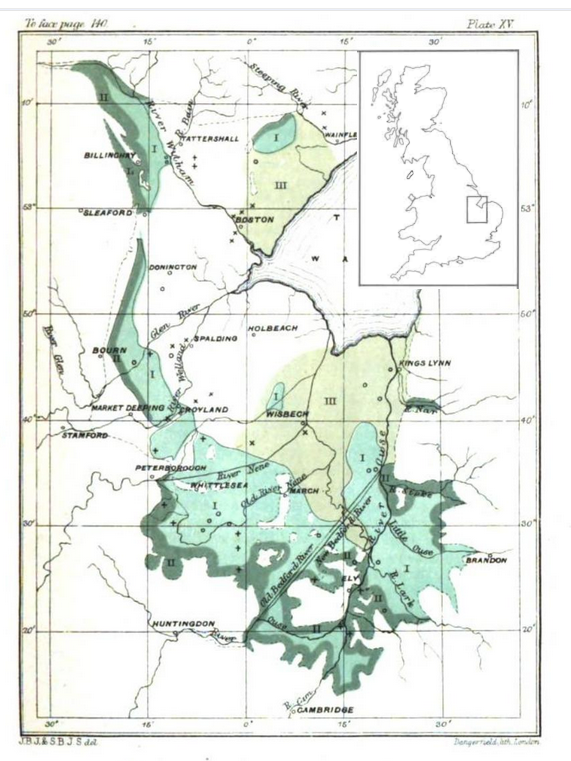
The ground is so wet that dead plants do not fully decompose. Instead, they slowly accumulate in layers and form a soil known as peat. Over thousands of years, this peat layer becomes thicker as more plants grow, die, and are preserved in the waterlogged, low-oxygen conditions. This map (Fig 1) was made in the 19th century, and published in the book Geology of Fenland by Sydney B. J. Skertchly.4 The area of the peat is shown by colour. The lighter portions show the area over which it is covered by marine beds, the darker tint marks the peat surface, and the white portion is the area of marine silts.
In some fens, just beneath the peat are Jurassic and Cretaceous sedimentary layers rich in fossils. Oxford Clay is famous for preserving marine reptiles and rarer dinosaurs. These fossils have greatly enriched British museum collections.5
Other formations include Kimmeridge Clay, Ampthill Clay, and the Gault Formation. Geologists see these layers as the result of marine transgressions over millions of years. Young-age creationists see them as rapid deposits from the biblical Flood.
As early as the beginning of the 17th century, major drainage works were undertaken to convert wetlands into agricultural land. This led to the drying out of these areas and a significant reduction in peat thickness. While ploughing their fields, farmers struck buried “bog oaks,” which they had to excavate.
Some tree trunks reached 90 feet in length and belonged to oaks that once stood over 130 feet tall. Modern English oak forests do not reach such sizes. These discoveries have continued regularly over the centuries and persist to this day.
The term bog oaks is a generic name; the trees are not necessarily oaks. They are described as subfossils, yet they consist of wood that remains completely waterlogged. In 1874, Miller and Skertchly studied Wood Fen peat, north of Ely. They found oak, pine, and yew at different stratigraphic levels. (Fig 2) Trees in the peat are small with horizontal roots. Oaks at the base are massive and deeply rooted in Kimmeridge Clay.6
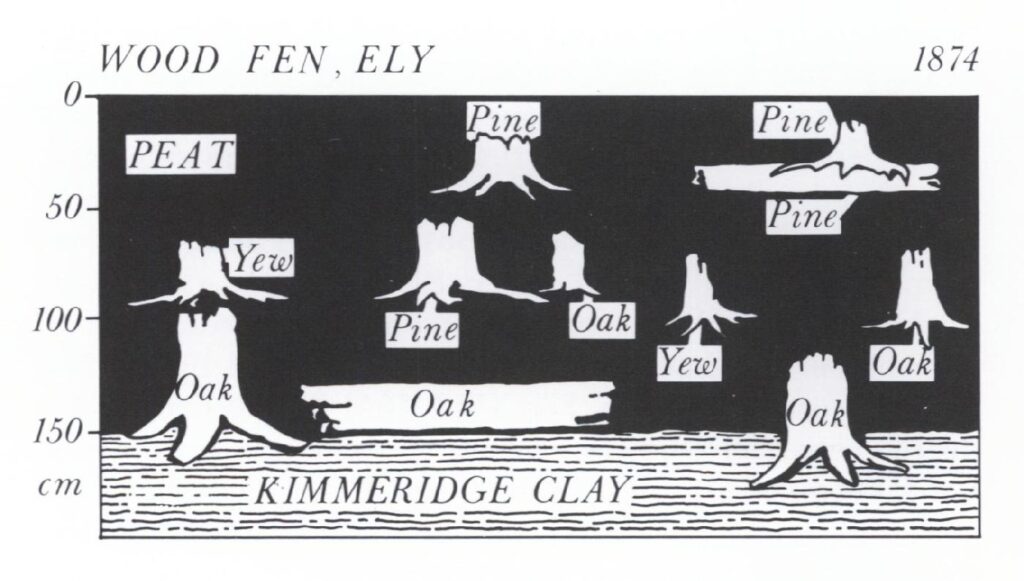
Chronologically, Kimmeridge Clay deposited first. Oaks germinated and rooted deeply. Peat then accumulated. Dead trunks were gradually buried and preserved. Over millennia, several tree generations grew in the peat, developing horizontal roots from water saturation. These were also preserved.
In the 1980s, Queen’s University Belfast analyzed 367 oaks from Fenland fens. They created the “East Anglia” dendrochronology covering 3196–1681 BC. This series was correlated with German and Irish oak chronologies, giving absolute dating.7
Dendrochronologist David Brown shared to me unpublished data from these oaks and GPS coordinates of the fens, which made it possible to produce the map shown in Figure 3.
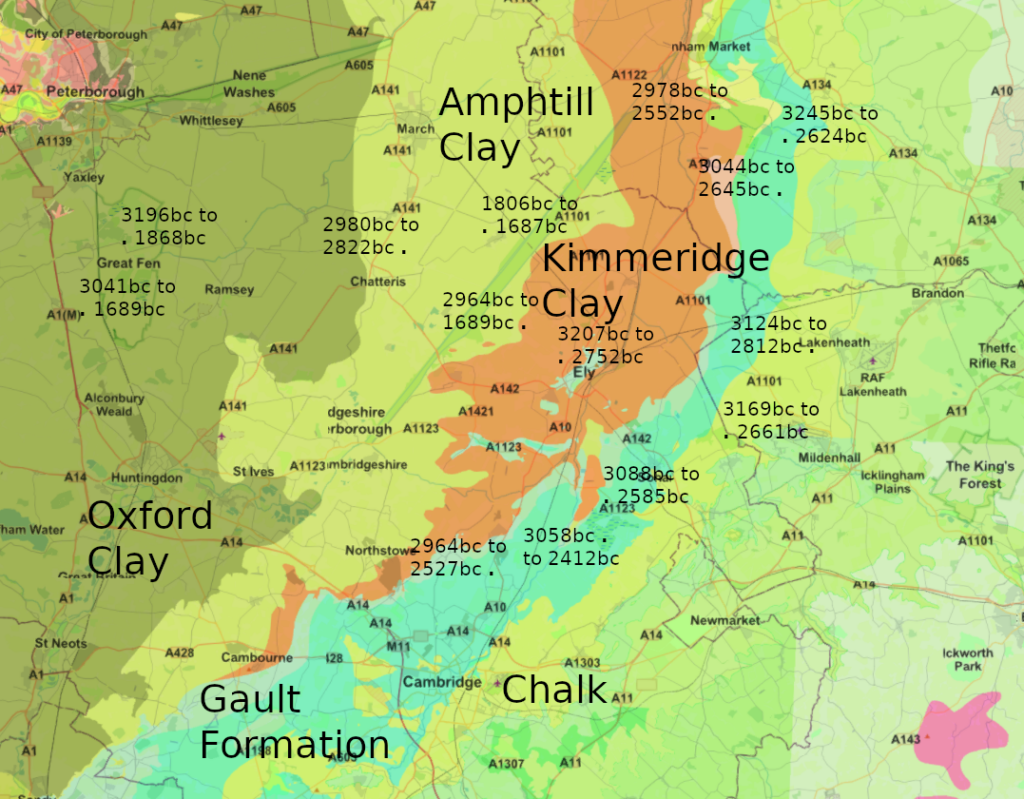
Analysis suggests that the oldest trees likely belong to the same generation. Additional oaks were later added, the oldest beginning growth before 3245 BC.
Two yew chronologies were recently established by Cambridge University using 36 and 32 trees. These were found in peat above Oxford Clay. Using 63 radiocarbon dates, Tatiana Bebchuk dated these trees between 3275–2863 BC (±4 years) and 2662–2245 BC (±6 years).8
Thus, the oldest tree in Fenland germinated before 3275 BC. The British Geological Society assigns Jurassic and Cretaceous layers an age of 170–100 million years.
Two questions challenge this age:
- Why does peat appear only slightly over 5000 years ago? Northern European peat over 8000 years old contains datable oaks.9 If peat could form around 3000 BC, it could have formed earlier as well.
- Why is there no intermediate layer between supposedly million-year-old deposits and the 5000-year-old peat? In Fenland, a large estuary fed by four rivers, such a gap seems unlikely.
The presence of oaks and yews germinating before 3275 BC, rooted in or above these formations, suggests these layers are older than this date, regardless of their generally assigned age.
Conclusion
Dendrochronology from Fenland demonstrates that trees began growing before 3275 BC, rooted in layers that young-age creationists associate with the biblical Flood. This provides a solid chronological marker and makes a Flood date of 3000 or 2350 BC unlikely.
The 3298 BC Flood date, based on the Septuagint, is not in conflict with the dendrochronological data presented here. This highlights the importance of the Septuagint and supports the work of theologians such as Henry B. Smith Jr.
Footnotes
- NathanH83. “Were the Pyramids Built Before the Flood? (Masoretic Text vs. Original Hebrew).” YouTube video, May 28, 2017. ↩︎
- Smith, Henry. “MT, SP, or LXX? Deciphering a Chronological and Textual Conundrum in Genesis 5.” Bible and Spade 31, no. 1 (2018): 18–27. ↩︎
- Creation Ministries International. “Were the Pyramids Built Before the Flood? Deciphering Biblical Chronology.” YouTube video, November 12, 2020. ↩︎
- Skertchly, S. B. J. The Geology of the Fenland. London: Geological Survey of Great Britain, 1877. ↩︎
- Araujo, Ricardo, et al. “The Alfred Leeds Fossil Vertebrate Collection of the National Museum of Ireland – Natural History.” 2008. ↩︎
- Godwin, Harry. Fenland: Its Ancient Past and Uncertain Future. Cambridge: Cambridge University Press, 1978. ↩︎
- Baillie, M. G. L., and D. M. Brown. “An Overview of Oak Chronologies.” 1988. ↩︎
- Bebchuk, Tatiana, et al. “Sudden Disappearance of Yew (Taxus baccata) Woodlands from Eastern England Coincides with a Possible Climate Event around 4.2 ka Ago.” 2023. ↩︎
- Achterberg, I. E. M., et al. “The Goettingen Tree-Ring Chronologies of Peat-Preserved Oaks and Pines from Northwest Germany.” 2017. ↩︎


 Christian Ryan

 Jake Ramgren
 Sara Anne
 Ken Coulson
 Abigail L.

 Hannah Klein
In their 1961 book “The Genesis Flood,” Whitcomb and Morris suggested that there were probably gaps in the Genesis 5 and 11 genealogies, and that creation week could have been 12,000 years before present. Also, ICR published a book on carbon 14 dating by Dr Gerald Aardsma in the 1990s that proposed dating the flood to 12,000 B.C. Older dates for creation week and the flood were predominant in creationism until the end of the 20th century.
If you accept dendrochronology as valid, then you have to account for a 14,000 year old Flood, or older, since they’ve pushed dendro back that far.
I didn’t came to this conclusion. As I say in the article, I think I’ve got reason to believe that the flood was around 3300bc.
But I agree with you, that if you think that the climate was approximately similar before and after the flood and if you think that dendrochronology is reliable, the earth can’t be younger than 12400 years old.
Blessings
I’m starting to take a deep dive into dendro which is a bit daunting since there are, without exaggeration, thousands of potentially relevant articles, books, and other works. However, based on my initial look, serious questions exist regarding dendro such as: lack of transparency (the unavailability of the raw data or even secondary data), the erroneous and irrebuttable presumption of the annuality of rings, circularity (the chronologies were built using the C14 dating they’re supposed to be calibrating and also in reliance on each other), cross-matching correlations at multiple points on the chronology, and no independent audit of their data or conclusions.