
 Brittany Martin
A few years back, I was teaching freshmen about the function of greenhouse gases in Earth’s atmosphere and I overheard one of my students tell his friend, “Did you know that most greenhouse gases actually come from the methane given off by cows passing gas?” I overheard their conversation, and pointed out to him that although many people repeat this fact, there have actually been no scientific studies done to prove it. His response was, “That doesn’t matter. Everyone still knows that it’s true.”
Without realizing it, this student was buying into the notion that rather than the scientific method, it’s scientific consensus that makes science. We are used to hearing the claim of scientific consensus as regards climate change or Covid-19 health restrictions, but the notion that consensus defines science has ancient roots. Ancient Greek philosophy assumed that the consensus of elite philosophers could control knowledge and although this notion was put to death during the medieval period, it was revived in the 20th century as an apologetic for Darwinism.
The views expressed in this article reflect those of the author, and not necessarily those of New Creation.
A History of Platonism
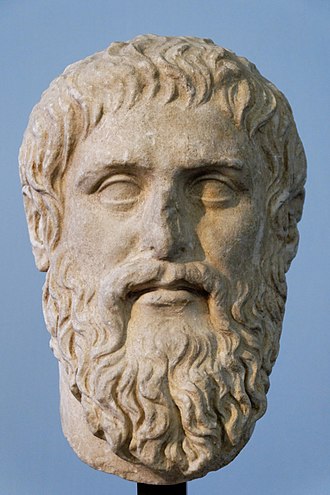
The history of consensus-based science goes back to ancient Greece. Although most courses in natural philosophy begin with Aristotle, less attention is given to Aristotle’s instructor, Plato. Much of Aristotle’s natural philosophy is an application of Plato’s metaphysics, but where did Plato’s metaphysics come from?
One source for Plato’s metaphysics may have been Athens’ battles against Sparta in the Peloponnesian War. Although it occurred a generation before Plato, the battle between Sparta and Athens likely left an imprint on the psyche of most philosophers. Sparta was a militaristic, totalitarian dictatorship. In Sparta, couples were pre-arranged to maximize fit and healthy children. When Spartan children were born, the city’s governors decided whether or not the child was fit enough to live. If deemed unhealthy, then infanticide was routine. Children were not raised by their parents, but were taken by the state and trained for battle. As a result, children did not know their own parents and were all wards of the state. Young boys in military training were deprived of food so they could experience strength under privation, and in order to be kept subordinate, were regularly molested by their male tutors.
Unlike Sparta, Athens was the center of Greek philosophy and democracy. It was where sons of free landowners were given a liberal arts education, which taught grammar, logic, and rhetoric. Plato’s instructor, Socrates, was credited with the Socratic method of teaching, where students learn critical thinking through a question-and-answer format. A liberal arts education prepared the free, male citizens of Athens to understand their rights and prepared them to participate in government.
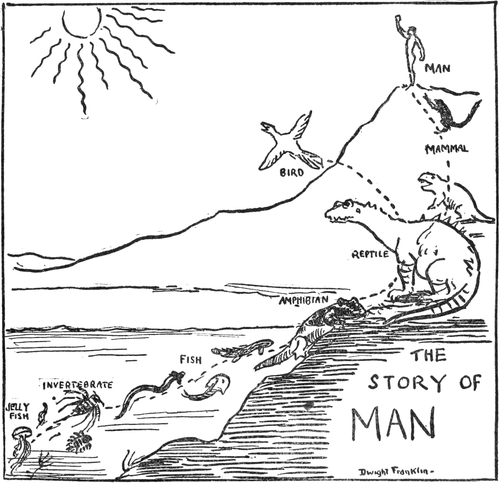
When Sparta attacked Athens, the Greek city-states were thrown into a period of civil unrest. The resulting social and political upheaval would have caused many Athenian citizens to question the fundamental laws of nature. During the war, the philosophers Heraclitus and Parmenides argued over whether there was any stability in the universe. Parmenides argued that despite appearances, stability is still the fundamental basis of the universe. However, Heraclitus embraced social unrest and change. He went so far as to argue that even the material things that appear permanent are really just in different stages of flux. This philosophy he derived from his teacher, Anaximander, who used the principle of constant change to formulate a theory of evolution for all organic life. Anaximander believed that all life was constantly changing and that all organisms had evolved from an original sea creature. He was the first Darwinist, albeit 1,400 years before Darwin. Heraclitus’ famous phrase, “you cannot step into the same river twice,” is the logical conclusion of Anaximander’s philosophy.1
In the generation after Heraclitus and Parmenides, Plato tried to solve their problem by stating that although the world seemed to be in flux, the unchanging spiritual realities exist in a World of Forms. Anything in the material world is a poor copy of the perfect World of Forms, and is therefore subject to change. Because Plato saw the material world as inherently flawed, Plato valued reason over empirical knowledge, which was imparted to his student, Aristotle. Plato believed that a just society would model the World of Forms as closely as possible, in an attempt to put a stop to social change. He designed this perfect society in his work The Republic where social engineering ensures a just and stable society.
Plato ensured justice in his society by making sure that the state remained unchallenged. Since Sparta’s might overpowered Athen’s academia, Athens essentially had to become more Spartan. In The Republic, only the ruling classes have rights and receive an education. Censorship is enforced to keep intellectual activities among the ruling philosopher-kings. Arranged marriages and eugenics ensure the purity of the ruling class, while infanticide and homosexuality are used to maintain population control of who Plato calls the “human sheep”.2 Plato acknowledges that most humans revolt against these ideas, but they were clearly the most rational option to maintain the State3:
The greatest principle of all is that nobody, whether male or female, should ever be without a leader. Nor should the mind of anybody be habituated to letting him do anything at all on his own initiative, neither out of zeal, nor even playfully. But in the midst of war and in the midst of peace—to his leader shall he direct his eye, and follow him faithfully. And even in the smallest matters he should stand under leadership. For example, he should get up, or move, or wash, or take his meals…only if he is told to do so. In a word, he should teach his soul, by long habit, never to dream of acting independently, and to become utterly incapable of it.4
In order to preserve the state, all members of the Republic must forfeit their rights and responsibilities, in a sort of collective selfishness. The natural philosopher Karl Popper stated, “One has first to be disturbed by the similarity between the Platonic theory of justice and the theory and practice of modern totalitarianism”5. Popper’s contemporary, Bertrand Russell, stated:
“Sparta had a double effect on Greek thought: through the reality, and through the myth…The reality enabled the Spartans to defeat Athens in war; the myth influenced Plato’s political theory…and had a great part in framing the doctrines of Rousseau, Nietzsche, and National Socialism.”6
Modern Platonism

As Bertrand Russell notes, the period of the Enlightenment saw a rebirth in Platonic notions of justice and society. A return to Platonic ideas of the superiority of reason can be found throughout the works of Thomas Paine who stated, “My own mind is my own church”.7 In the early 18th century, Jean-Jacques Rousseau argued that sovereignty does not lie with an individual king or citizen, but within the collective people of the state. Rather than justice being the choices and actions of an individual, it is the collective “spirit” of the people in the maintenance of the state.8 Charles Darwin followed in this vein in his book, The Descent of Man. When commenting on the social behavior of various organisms, Darwin argues that morality is based on the ethics of the community rather than the individual. Rather than a Christian view of community wherein a community holds together because individuals behave selflessly, Darwinism declares that the individual’s survival is dependent on the community’s survival. This inverts morality because individuals must behave selfishly in order to preserve a community. Personal responsibility disappears when a behavior can be excused for the greater good.9
In such a society, human rights become privileges granted by the state, and not given by God to serve our neighbors. This stands in stark contrast to a Christian view of rights, which always involves personal responsibility. As Karl Popper said, “Individualism, united with altruism, has become the basis of Western Civilization. It is the central doctrine of Christianity (‘love your neighbor,’ say the Scriptures, not ‘love your tribe’).”10
Scientific Platonism
This change in philosophy went hand-in-hand with a change in scientific study. The love of reason over empiricism even led the authoritarian regime of 19th century Prussia to remove laboratories from the science departments of the universities:
Laboratories had been traditionally excluded from universities (and confined to polytechnics) for reasons that amounted to intellectualized class snobbery. Specifically, lab work required manual skills alien to the hands-free world of liberally educated elites for whom practical applications were an inferior form of knowledge.11
The history of the 20th century is much of the story of Darwinists applying their theory in ways quite reminiscent of Plato’s Republic. Darwin’s cousin, Francis Galton, realized that the salvation of the human race depended on society molding our own evolution. This became known as Social Darwinism. The Social Darwinist Margaret Sanger founded Planned Parenthood because she believed in the sterilization of people who were deemed unfit to reproduce, usually the poor and minorities. Even more recently, the evolutionary apologist Richard Dawkins once posted on Twitter, “It’s one thing to deplore eugenics on ideological, political, moral grounds. It’s quite another to conclude that it wouldn’t work in practice. Of course it would. It works for cows, horses, pigs, dogs, and roses. Why on earth wouldn’t it work for humans? Facts ignore ideology.”
Much like Plato, Thomas Kuhn believed that there is little value in empirical evidence, because the reasoning of scientists determines science. In his 1962 classic, The Structure of Scientific Revolutions, Kuhn explicitly states that the consensus of scientists makes science.12 Change can only happen in a scientific revolution, which occurs when scientific consensus moves toward a new paradigm, which he coined a “paradigm shift.” He argues that Aristotelian physics actually did work, until Isaac Newton invented Calculus. And then Newtonian physics was true until Einstein. “Kuhn was actually trying–as a latter-day Plato might–to insulate [the physical sciences] from responsibility for real world effects.”13
Because Kuhn devalued empirical evidence, a paradigm shift becomes a sort of religious conversion, guided by the most elite scientists. Kuhn states, “I would argue, rather, that in these matters neither proof or error is at issue. The transfer of allegiance from paradigm to paradigm is a conversion experience that cannot be forced”.14 All facts about the natural world become dependent on an interpreting paradigm, so all truth becomes relative, and there are no fixed natural laws. And as has been seen worldwide in the last two hundred years, when a society believes there is no fixed truth outside of oneself, then politics becomes the worship of power.
The recent Covid-19 debacle is a perfect example of a consensus-based Kuhnian paradigm. In early 2020, health officials dispensed with 200 years of germ theory in favor of “experts.” Once the moment passed, health officials could say that “the science” had changed, when a truer statement would be that the paradigm changed. A paradigm shift also keeps those who argued for Covid paranoia from being held responsible for their actions, since they occurred during a different paradigm.
Effect on the Liberal Arts
Once, in my undergraduate days, I asked my chemistry professor a few questions about evolution. Specifically, I wanted to ask him several questions about how a Darwinist would view entropy, since evolution appears to violate the Second Law of Thermodynamics. Within the course of the conversation I mentioned that I was a creationist, at which point the academic discussion stopped and the insults began. No longer was he willing to debate the points of the Second Law of Thermodynamics. Instead he informed me that my parents had brainwashed me, and that if I did not grow up, my career would never amount to anything.
I have many more such stories, as do many other Creation scientists. Since these conversations occur with Ph.D.s who are well educated in their field, they should be adept at coming up with intelligent arguments against Creation, yet it seems to be in the fundamental nature of Darwinism to shut down discussion, and often violently, accompanied by insults. Any questioning of the paradigm is tantamount to rebellion against the scientific authority and must be cut out of discussion. Kuhn’s biographer Steven Fuller states:
In many respects, the postmodern condition associated with Kuhn’s ascendancy marks a return to premodern sensibility. What is often called ‘relativism’–be it in praise or condemnation–is simply the ancient attitude perhaps most clearly defended by Aristotle that all knowledge must be adequate to its objects.15
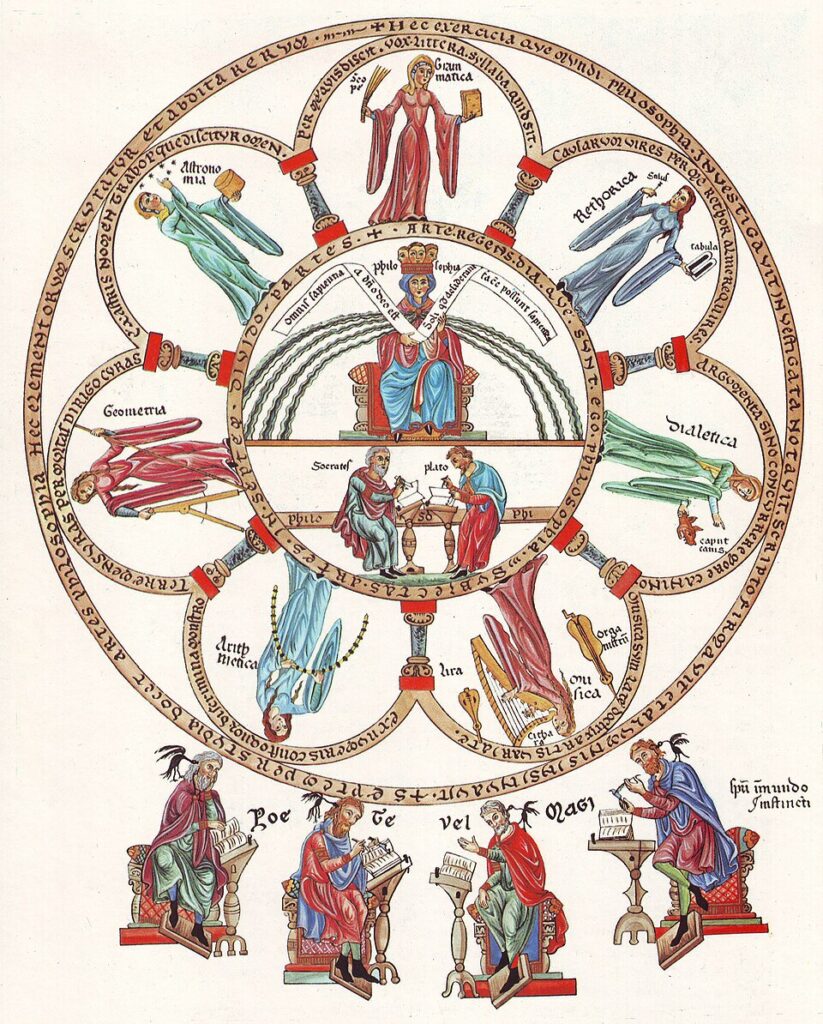
This relativism is not unique to the sciences, but has long since affected the liberal arts. Rather than the education given to the free leaders of society, in most universities around the country, a liberal arts education is often synonymous with a “useless” degree. However, a liberal arts education was supposed to make a free man, fully inculturated to his society in the arts of grammar, logic, and rhetoric. The Greek word for education, “paideia,” was borrowed by the Apostle Paul in Ephesians 6:4 when he states that Fathers should bring up their children in the paideia of the Lord. This word is often translated as “discipline and instruction,” but in Greek, this word refers to the complete education and training of a mature adult. Rather than job training, a liberal arts paideia used the tools of discipline and instruction to raise a mature adult, capable of fulfilling many different callings.
A liberal arts education, combined with the influence of the medieval church created our modern world. However, by valuing reason over revealed truth, Enlightenment and post-Englightenment thinkers embraced the scientific consensus of Darwinism. Only a formal repudiation of Darwinism in all its forms will signal an educational and spiritual revival in the liberal arts.
Learn more about Darwinism & Liberal Arts
Part 2: The Scientific Method Strikes Back
Footnotes
- Popper, Karl, The Open Society and Its Enemies, Princeton University Press, 2020, 20-21. ↩︎
- Ibid., 49. ↩︎
- Plato, Six Great Dialogues, Dover Thrift Edition, 2007, 458-461. ↩︎
- Ibid. 415. ↩︎
- Popper, Karl, The Open Society and Its Enemies, Princeton University Press, 2020, xlv. ↩︎
- Russell, Bertrand, “Chapter XII: The Influence of Sparta,” History of Western Philosophy, George Allen & Unwin, Limited, 1946, 94. ↩︎
- Paine, Thomas, The Age of Reason, C and J Swords, 1794, 14. ↩︎
- Popper, Karl, The Open Society and Its Enemies, Princeton University Press, 2020, 251. ↩︎
- Darwin, Charles, The Descent of Man, and Selection in Relation to Sex, D. Appleton and Company, 1897, 98. ↩︎
- Popper, Karl, The Open Society and Its Enemies, Princeton University Press, 2020, 98. ↩︎
- Fuller, Steven, Kuhn vs. Popper: The Struggle for the Soul of Science, Columbia University Press, 2003, 137. ↩︎
- Kuhn, Thomas, The Structure of Scientific Revolutions, University of Chicago Press, 2012, 94. ↩︎
- Fuller, Steven, Kuhn vs. Popper: The Struggle for the Soul of Science, Columbia University Press, 2003, 69. ↩︎
- Kuhn, Thomas, The Structure of Scientific Revolutions, University of Chicago Press, 2012, 150. ↩︎
- Fuller, Steven, Kuhn vs. Popper: The Struggle for the Soul of Science, Columbia University Press, 2003, 67. ↩︎


 Joshua Cedar

 Abigail Van Huss
 Peter
Peter
 Christian Ryan
Good insights, thanks.